Wild mammals such as deer, foxes, coyotes, raccoons, opossums, squirrels, rabbits, rodents, mustelids, cats, hoofed mammals, and primates
Identify mammals, reptiles, amphibians, pets, and wildlife from one photo
Free AI Animal Identifier by Picture
Upload or paste a clear animal picture. This free animal identifier by picture compares body shape, coat or skin, ears, snout, tail, feet, markings, apparent size, posture, habitat, and geographic context. It can suggest a likely species or broader animal group, explain the visible evidence, and show realistic alternatives when one image cannot support an exact match.
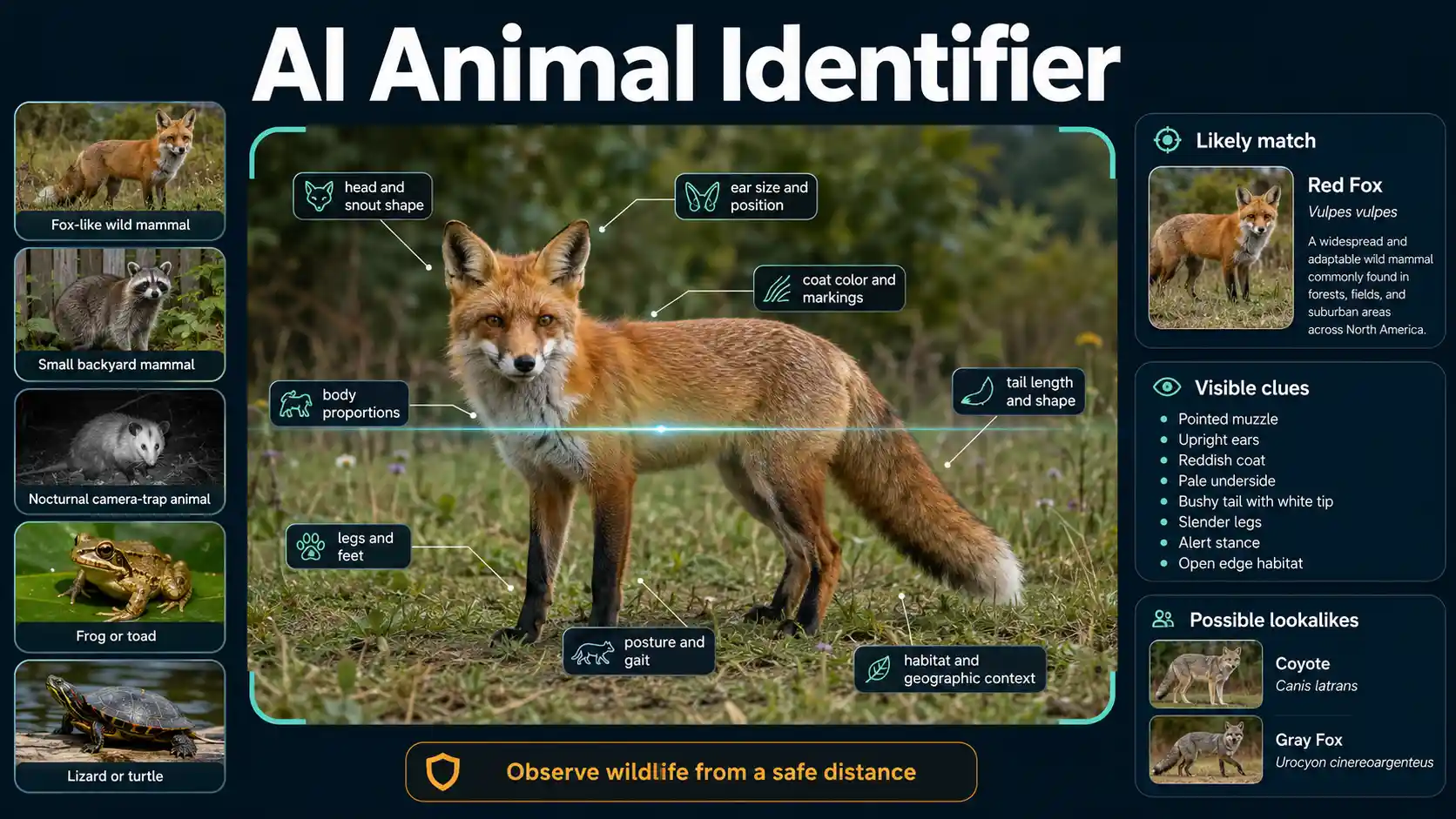
How animal identification works
Anatomy, behavior, location, and scale build the strongest match
The AI wildlife identifier first decides which broad animal group fits the image. It then compares body proportions, head and snout shape, ears, coat or scales, markings, tail, limbs, feet, posture, and apparent movement.
Geography and behavior can change the answer. A small gray mammal climbing a tree, swimming beside a river, crossing a desert road, or appearing on a night camera may represent very different species even when the silhouette looks similar.
- 1Upload, take, or paste one image
Choose a file, use your phone camera, click the paste icon, or press Ctrl+V or Command+V.
- 2Add facts that the photo cannot show
Country, environment, approximate size, location, and observed behavior can narrow the answer.
- 3Review the match and its evidence
Check the likely name, confidence bar, visible clues, alternatives, safety note, and recommended next step.
Animal and wildlife coverage
Identify mammals, reptiles, amphibians, domestic animals, and wildlife signs
The tool covers many visible vertebrates and can return a broad taxonomic group when an exact species is not defensible. Birds receive only a cautious broad result until the dedicated bird workflow is available.
Reptiles such as lizards, snakes, turtles, tortoises, crocodilians, and geckos when body structure and markings are visible
Amphibians such as frogs, toads, salamanders, and newts when skin, limbs, pattern, habitat, and geography provide enough evidence
Domestic and farm animals at species or broad type level, while avoiding unsupported breed, ancestry, ownership, or health claims
Nocturnal and camera-trap animals using silhouette, eye placement, tail, gait, body proportions, habitat, time, and location
Tracks, footprints, nests, burrows, hair, droppings, or remains at a cautious broader level when the animal itself was not photographed
Animal features that matter
Show the structures and context that separate similar wildlife
Color alone rarely identifies an animal. Stronger evidence combines body form, head, ears, tail, feet, markings, scale, habitat, behavior, and geographic range.
Photograph wildlife from a safe distance with a zoom lens. Show the full body when possible, then add a closer view of the head, ears, tail, feet, coat, scales, shell, horns, or other distinctive structures. Include approximate size, country, habitat, time of day, movement, sounds, and whether the animal was wild, captive, domestic, injured, or accompanied by young.
- Use optical zoom, binoculars, a trail camera, or a telephoto lens instead of moving closer to wildlife.
- Show the entire body and keep the head, ears, tail, legs, and feet inside the frame.
- Add a closer image of distinctive markings, coat texture, scales, shell, horns, antlers, paws, claws, or hooves.
- State the country or broad region because many similar animals live on different continents or islands.
- Estimate body length, shoulder height, or track size without placing an object close enough to disturb the animal.
- Note the habitat, time of day, movement, call, feeding behavior, group size, and whether the animal climbed, swam, hopped, or burrowed.
- For tracks, photograph the full trail pattern and one sharp print from directly above with a ruler placed safely beside it.
- Do not handle droppings, bones, carcasses, nests, dens, bats, reptiles, or young wildlife to obtain a better picture.
What the animal result contains
A useful wildlife match explains both identity and uncertainty
The result should identify the animal only as precisely as the evidence allows, explain the visible traits, compare realistic alternatives, and state which observation would most improve confidence.
- The most likely common name and scientific name when visible evidence and geography support them
- A broader class, order, family, genus, or animal group when species-level evidence is missing
- A high, moderate, or low confidence label without an invented numerical probability
- Visible evidence such as body proportions, head shape, ears, coat, scales, markings, tail, limbs, and feet
- Apparent life stage or domestic status only when those details are genuinely visible
- Plausible lookalikes and the feature, range, sound, track, or behavior that may separate them
- Geographic and habitat relevance, including reasons a visually similar species may not fit the location
- A practical next step, safe-viewing guidance, and suggestions for a more useful photograph
Common animal lookalikes
Body proportions and local range can overturn a first impression
These comparisons show why a single face, silhouette, color, or track is not enough. The whole body and the location should agree before a species-level name is used.
Coyote, fox, or domestic dog
Body size, leg length, chest depth, muzzle, ears, tail carriage, coat pattern, gait, behavior, and region help separate wild canids from free-ranging dogs.
Raccoon, raccoon dog, civet, or badger
Facial masks can mislead. Tail rings, body proportions, feet, ears, gait, habitat, and geographic range are more decisive.
Opossum, rat, or other small mammal
Ear shape, snout, body size, tail covering, feet, posture, climbing behavior, and continent help distinguish a marsupial from rodents and similar mammals.
Bobcat, lynx, or domestic cat
Tail length, ear tufts, cheek ruff, leg and paw size, coat pattern, body proportions, track size, and local distribution must be compared together.
Frog or toad
Skin texture, body form, leg proportions, toe pads, parotoid glands, posture, movement, breeding habitat, call, and geography help separate broad amphibian groups.
Lizard, salamander, or newt
Scales versus moist skin, toe structure, body movement, habitat, tail form, and life history separate reptiles from amphibians despite similar outlines.
Why animal identification can fail
Distance, darkness, juveniles, and seasonal variation hide decisive traits
Wildlife photographs often capture a brief encounter rather than a controlled specimen view. A responsible result stays broad when the head, feet, tail, size, location, or behavior is missing.
- The animal is a tiny silhouette in a wide landscape or dark security-camera frame.
- Digital zoom, motion blur, glare, fences, vegetation, or window reflections hide body structure.
- Only the face, tail, paw, track, nest, scat, or damaged remains are shown without the whole animal or context.
- The location, approximate size, habitat, and time of day are omitted for a common brown or gray animal.
- A juvenile, winter coat, wet coat, domestic hybrid, unusual color form, or molting animal is compared only with typical adult photographs.
- An animal is approached, baited, called, cornered, or fed to obtain a closer photograph.
- A lone young animal is assumed to be abandoned before its parent has time to return.
- The request asks a photo to prove danger, rabies, injury, ownership, legal status, breed, or conservation status.
Worked animal-identification scenarios
Real wildlife encounters show how context narrows the possibilities
Each scenario combines the photograph with facts the image may not reveal, such as exact region, scale, time of day, movement, habitat, and whether the evidence shows the animal itself or only its signs.
Unknown mammal crossing a backyard at night
A nocturnal animal identifier from photo evidence works best when a camera-trap frame shows the entire body, gait, ears, snout, tail, leg length, approximate size, time, and region. Those clues can separate a fox, coyote, raccoon, opossum, civet, mongoose, or domestic animal.
Small animal seen beside a garden wall
A backyard animal identifier by picture should compare body shape, tail covering, ear size, foot posture, movement, climbing ability, and local range. A second angle is often more useful than a heavily enlarged crop.
Young animal resting alone in vegetation
A baby animal identifier by photo may suggest a deer fawn, rabbit, fox, seal, or other juvenile, but appearance cannot prove abandonment. Photograph from far away, keep people and pets back, and contact a qualified local wildlife professional before intervening.
Footprints beside mud, snow, or sand
An animal track identifier by picture can compare toe count, pad shape, claw marks, hoof form, print size, stride, and trail pattern. One distorted print rarely proves the species, so photograph several consecutive tracks and the surrounding habitat.
Distant reptile near water or rocks
Body length, limb position, head shape, tail, scales, shell, pattern, swimming posture, basking site, and country can distinguish broad reptile groups. Keep your distance and never handle a snake, crocodilian, turtle, or unknown lizard for identification.
Wildlife safety comes before a closer photograph
Observe from a distance and never treat an AI name as permission to approach
Keep a safe distance from unknown wildlife. Do not touch, feed, corner, capture, or relocate an animal based on an AI result. Contact an appropriate local wildlife, animal-control, veterinary, park, or emergency service when an animal is injured, behaving unusually, or creating an immediate risk.
Wild animals can react unpredictably and may carry teeth, claws, hooves, antlers, venom, parasites, or infectious disease. Do not feed wildlife or interfere with nests, dens, young, carcasses, or apparently injured animals. Use local professional guidance for rescue, conflict, legal, veterinary, and public-safety decisions.
Choose the workflow that matches the subject
Separate vertebrate wildlife from arthropods and unclear scenes
Questions about animal identification by photo
Direct answers before you upload a wildlife picture
Can I identify an animal from a picture for free?
Yes. Upload one clear JPEG, PNG, or WebP image and the tool will suggest the most defensible animal match supported by visible features and context.
What animal is this by picture?
Show the whole animal and add its size, location, habitat, time of day, movement, and distinctive body features. The result may stay at family or genus level when species evidence is missing.
Can I identify an animal from a photo online without an app?
Yes. The identifier works in a modern browser and accepts a saved image, camera photo, drag-and-drop file, or clipboard image.
Is this AI wildlife identifier free to use?
Yes. The current identification request is free and returns a likely match, visible evidence, alternatives, uncertainty, and a practical next step.
Can the tool identify an exact animal species from a photo?
Sometimes. An animal species identifier from photo evidence needs diagnostic anatomy, a compatible geographic range, and enough image detail to separate close relatives.
Can it work as a mammal identifier by picture?
Yes. Full-body proportions, head shape, ears, coat, markings, tail, legs, feet, gait, size, habitat, and region can narrow many mammals.
Can it identify reptiles and amphibians?
Yes, when body shape, scales or skin, limbs, tail, shell, markings, habitat, and geography are visible. Unknown reptiles should never be handled for a closer photo.
Can a night camera identify a nocturnal animal?
It may. Infrared images work best when the whole body, gait, ears, snout, tail, legs, time, habitat, and location remain visible despite limited color.
Can a photo identify animal tracks?
A clear track series can narrow the maker through toe count, pads, claws, hoof shape, print size, stride, and trail pattern, but one damaged print rarely confirms a species.
Can droppings identify an animal?
Droppings may suggest a broad group when size, shape, contents, location, tracks, and other signs agree. Do not touch or closely handle animal waste, and do not treat scat alone as proof of species.
Can the tool tell whether a baby animal is abandoned?
No. Many healthy young animals wait alone while a parent feeds nearby. Observe from a distance and contact a qualified local wildlife rehabilitator or authority before intervening.
Can it identify a dog or cat breed?
It may suggest a visual breed type, but appearance cannot prove ancestry, breed purity, ownership, temperament, or health. Reliable ancestry requires records or appropriate genetic testing.
Can a photo prove that an animal is dangerous or harmless?
No. Behavior is unpredictable, and lookalike species can carry different risks. Keep a safe distance and follow local wildlife guidance regardless of the suggested name.
Can SnapIdentify diagnose an injured, sick, or rabid animal?
No. A photograph cannot diagnose disease, poisoning, injury severity, parasites, or rabies. Avoid contact and report concerning behavior to an appropriate local professional.
Does location improve wildlife identification?
Yes. Country, island, habitat, elevation, season, and proximity to water or buildings can remove lookalikes that do not occur in the area.
Why did the animal identifier return low confidence?
Low confidence usually means the animal is distant, blurred, partly hidden, photographed at night, missing size or location context, or visually similar to several species.
Authoritative wildlife, taxonomy, and AI guidance
Confirm important animal identifications and keep wildlife wild
These wildlife-safety, computer-vision, and taxonomic resources explain responsible observation, common image-identification limits, and scientific-name verification.
- U.S. National Park Service — Watching Wildlife
The National Park Service explains safe wildlife viewing, including keeping distance and avoiding touching, feeding, or harassing animals.
- iNaturalist Help — Computer Vision Limitations
iNaturalist explains why computer-vision suggestions can fail when species coverage, region, life stage, or photographic style differs from familiar training examples.
- Integrated Taxonomic Information System
ITIS provides authoritative scientific names and taxonomic relationships for animals and other organisms through a specialist-reviewed public database.