Common household insects such as ants, cockroaches, silverfish, earwigs, flies, moths, beetles, and pantry pests
Identify household, garden, and flying insects from one photo
Free AI Bug Identifier by Picture
Upload or paste a clear picture of one bug. This free AI bug identifier examines body shape, segmentation, legs, wings, antennae, color, markings, apparent life stage, and any location or habitat details you provide. It returns a likely insect match, explains the visible evidence, and shows alternatives when several bugs look similar.
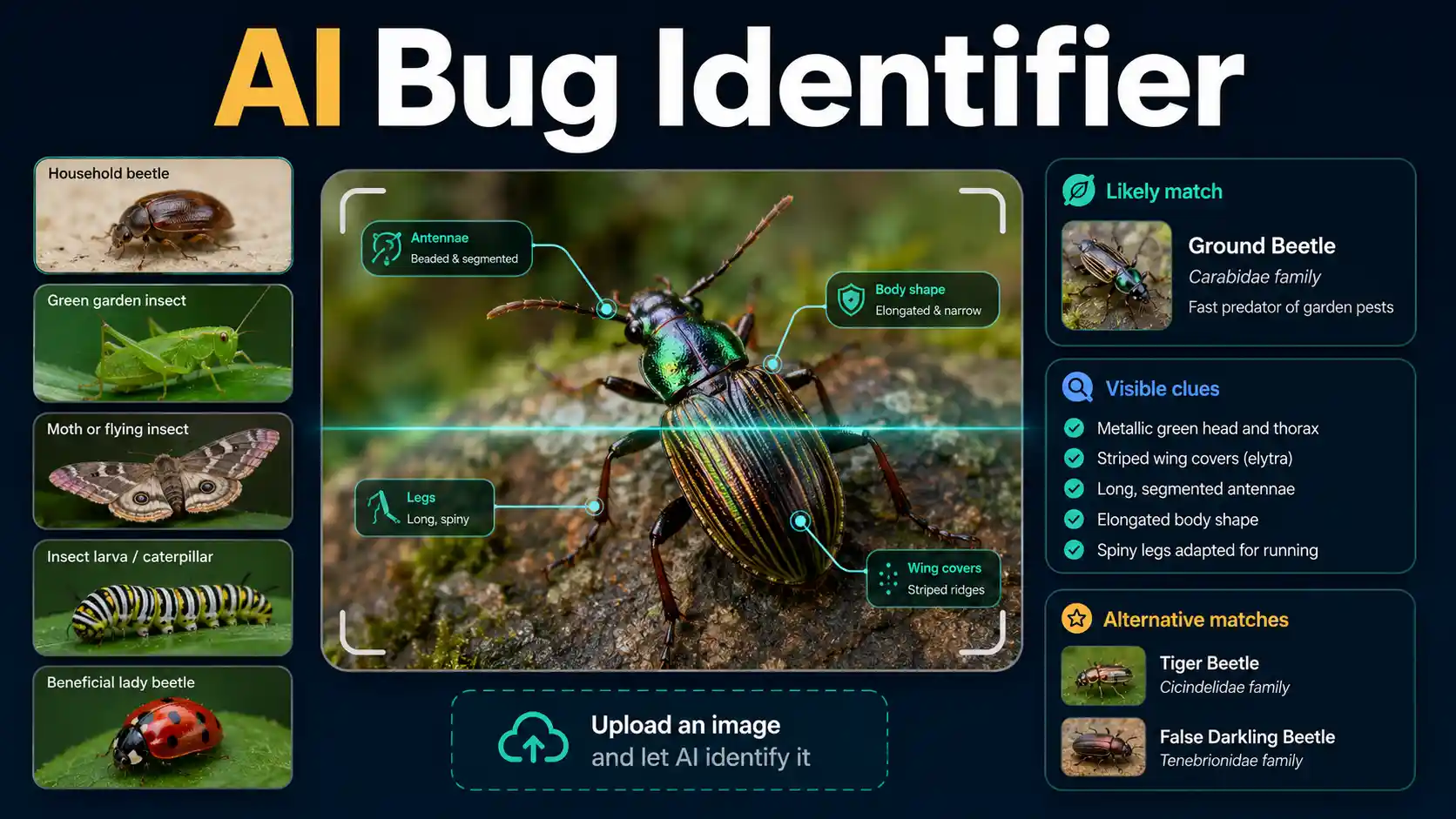
How bug identification works
The image is compared through visible insect anatomy
The tool first decides whether the subject appears to be an insect, another arthropod, an insect life stage, or an object that only resembles a bug. It then compares body outline, segmentation, apparent leg count, antennae, wings, wing covers, color pattern, texture, and markings.
Context can change the leading match. A three-millimeter beetle found in flour suggests different possibilities than a similar beetle found on flowers, carpet, bark, or a windowsill. The answer should remain broad when those details are missing.
- 1Upload, take, or paste one image
Choose a file, use your phone camera, click the paste icon, or press Ctrl+V or Command+V.
- 2Add facts that the photo cannot show
Country, environment, approximate size, location, and observed behavior can narrow the answer.
- 3Review the match and its evidence
Check the likely name, confidence bar, visible clues, alternatives, safety note, and recommended next step.
Bug and insect coverage
Identify common household, garden, and flying insects
The identifier covers common adult insects and many immature forms. It can also flag when the subject appears to be a spider, tick, mite, centipede, millipede, or another non-insect arthropod.
Garden insects such as aphids, caterpillars, leafhoppers, stink bugs, weevils, beetles, true bugs, and scale insects
Flying insects such as moths, flies, mosquitoes, midges, bees, wasps, hoverflies, and winged ants
Beneficial insects and natural enemies such as lady beetles, lacewings, hoverflies, solitary bees, and predatory bugs
Immature forms including larvae, caterpillars, grubs, maggots, nymphs, pupae, and egg cases when enough detail is visible
Broader non-insect arthropod groups such as spiders, ticks, mites, centipedes, and millipedes when the upload is not actually an insect
Insect features that matter
Show the anatomy that separates similar bugs
A bug's color is rarely enough. The strongest clues usually come from body structure, wing type, antennae, life stage, size, and the place where it was found.
Photograph the bug from directly above when it is safe, then add a side view if possible. Keep the insect intact, show its legs and antennae, include a size reference, and note whether it was found indoors, in stored food, on a plant, near water, or around lights.
- Fill most of the frame with one intact bug while keeping a safe distance.
- Take a sharp top view that shows the body outline, legs, antennae, wings, and markings.
- Add a side view when body height, mouthparts, wing position, or leg shape matters.
- Place a ruler or familiar object nearby without touching the specimen.
- Use neutral daylight or even indoor light and avoid strong glare from glossy wings.
- Show the plant, food package, fabric, wood, drain, window, or room where the bug was found.
- Photograph plant damage separately, but include at least one clear image of the insect itself.
- Avoid crushed, wet, dusty, or pesticide-covered specimens because key anatomy may be hidden.
What the bug result contains
A useful match explains both identity and uncertainty
The result should tell you what the insect is likely to be, which features support that answer, what else it could be, and which next observation would improve confidence.
- The most likely common name and scientific name when the image supports them
- A broader order, family, or insect group when species-level evidence is missing
- A high, moderate, or low confidence label shown without false numerical precision
- Visible evidence such as body shape, leg arrangement, antennae, wing structure, color, and markings
- The apparent life stage, including adult, larva, nymph, pupa, egg case, or shed skin when visible
- Plausible lookalikes and the feature that would help separate them
- Useful attributes such as habitat, host plant, indoor setting, likely role, and geographic relevance
- A practical next step, safer handling guidance, and better-photo suggestions
Common insect lookalikes
Small structural clues can change the identification
These comparisons show why one color or one blurry angle is not enough. The tool should mention alternatives when the decisive feature is hidden.
Carpet beetle or bed bug
Carpet beetles are usually more domed and often patterned; bed bugs are flatter, broadly oval, wingless, and visibly segmented.
Winged ant or termite
Ants usually show a narrow waist, elbowed antennae, and unequal wing pairs; termites have a broader waist, straighter antennae, and more equal wings.
Hoverfly or bee and wasp
Hoverflies have one functional wing pair and fly-like eyes; bees and wasps have two wing pairs and different antennae and body structure.
Mosquito or non-biting midge
Legs, antennae, resting posture, wing details, and mouthpart visibility help separate them; a distant silhouette is often insufficient.
Cockroach nymph or beetle
Cockroach nymphs are typically flatter with long antennae and visible abdominal segmentation; beetles often have harder, more defined wing covers.
Flea or springtail
Fleas are laterally compressed with powerful hind legs; springtails are usually tiny, softer-bodied, and may jump using a structure under the abdomen.
Why bug identification can fail
A second angle often matters more than a larger crop
Many insects share the same brown, black, green, or striped appearance. Missing anatomy, inaccurate scale, and unclear habitat can turn a species-level answer into a broad family-level suggestion.
- The insect occupies only a tiny part of the photograph.
- The photo shows a bite, rash, web, nest, droppings, or plant damage but not the insect.
- The specimen is crushed, missing legs, covered in dust, or stuck to an opaque trap.
- Only one blurry angle is available and the wings, antennae, or body segments are hidden.
- Artificial lighting changes the insect's real colors or creates glare on wing covers.
- Several insects appear together and the intended subject is not clear.
- No size reference or location is provided for a very small brown or black bug.
- A spider, tick, mite, centipede, or other arthropod is assumed to be an insect.
Worked bug-identification examples
Context and anatomy narrow the possible match
Each example combines the specimen photo with evidence the camera may not capture by itself, such as exact size, room location, host plant, or behavior.
Tiny beetle near stored food
A close top view, side view, scale reference, pantry location, and image of the package can help separate grain beetles, drugstore beetles, cigarette beetles, and carpet beetles.
Green insect on a garden plant
The host plant, body shape, wing position, antennae, feeding pattern, and nearby plant damage can distinguish aphids, leafhoppers, lacewings, and other green insects.
Flying insect near a window
A photo of the resting wings, waist, antennae, eyes, and body hairs can help separate a fly, midge, moth, winged ant, hoverfly, bee, or wasp.
Larva found in fabric or carpet
Body hairs, case material, segmentation, movement, size, and the surrounding fabric can help distinguish carpet beetle larvae, clothes moth larvae, and unrelated caterpillars.
Use the result responsibly
Identify before deciding whether control is needed
Do not handle an unknown insect that may sting, bite, spray, or trigger an allergic reaction. This tool identifies the specimen, not a bite or rash. Confirm important pest-control or public-health decisions with a qualified local expert.
Many insects are harmless or beneficial. Correct identification helps avoid unnecessary pesticide use and reduces the chance of removing pollinators or natural enemies. Contact a qualified pest professional, extension service, public-health authority, or medical service when the situation carries meaningful risk.
Choose the next identification step
Follow the evidence when the upload shows more than one possible cause
Questions about identifying bugs by photo
Answers before you upload an insect picture
Can I identify a bug from a picture for free?
Yes. Upload one clear JPEG, PNG, or WebP image and the tool will return a likely match when the visible evidence is sufficient.
What photo gives the best bug identification?
Use a close, sharp top view that shows the whole body, legs, antennae, wings, and markings. Add a side view and size reference when possible.
Can the tool identify a tiny brown household bug?
It may narrow the possibilities, but tiny brown bugs often require a macro photo, exact size, room location, and a second angle for a reliable result.
Can it identify insect larvae, caterpillars, or grubs?
Yes, when the body structure, hairs, markings, host material, and size are visible. Immature insects often receive lower confidence than distinctive adults.
Does location improve insect identification?
Yes. Country, climate, indoor room, habitat, host plant, season, and where the insect was resting can separate species with similar appearances.
Can a photo prove that a bug is dangerous or harmless?
No. A photo can suggest a likely identity, but it cannot guarantee sting risk, bite risk, venom significance, disease transmission, or individual behavior.
Can SnapIdentify diagnose an insect bite or rash?
No. Upload the insect specimen rather than a skin mark. Seek appropriate medical advice for severe, worsening, or allergic symptoms.
Is a spider considered a bug or an insect?
A spider is an arachnid, not an insect. The tool may recognize the broader group, but spider species identification needs different anatomical clues.
Can the result tell whether an insect is a garden pest or beneficial?
Sometimes. That role depends on the correct identity, life stage, host plant, behavior, and local context, so the result should not rely on color or appearance alone.
Should I spray pesticide after one AI identification?
No. Confirm the pest, assess whether control is needed, and prefer an integrated pest management approach before choosing any treatment.
Why did the bug identifier return low confidence?
Low confidence usually means the insect is too small, blurry, damaged, partly hidden, photographed from the wrong angle, or visually similar to several alternatives.
Are uploaded bug photos permanently stored by SnapIdentify?
SnapIdentify processes the normalized image for the request and does not intentionally write it to local disk. The configured AI provider processes it under its service terms.
Authoritative insect and pest guidance
Verify important bug identifications before taking action
These resources explain pest identification, integrated pest management, invertebrate classification, and the importance of protecting beneficial insects.
- US EPA Integrated Pest Management Principles
The EPA explains why accurate pest identification and monitoring should come before deciding whether control is necessary.
- UC Statewide IPM Invertebrate Pest Directory
UC IPM provides common names, scientific names, families, orders, and identification resources for household and landscape invertebrates.
- UC Statewide IPM Beneficial Predators
UC IPM describes beneficial predators and why not every insect found in a garden should be treated as a pest.