Common houseplants, foliage plants, succulents, cacti, palms, ferns, aroids, orchids, and indoor vines
Identify houseplants, garden plants, trees, flowers, and weeds from one photo
Free AI Plant Identifier by Picture
Upload or paste a clear picture of one plant. This free AI plant identifier examines growth form, leaf arrangement, shape, margin, veins, surface, stem, flower, fruit, bark, thorns, and any location or habitat details you provide. It returns the most defensible likely match, explains the visible evidence, and lists alternatives when several plants share the same general appearance.
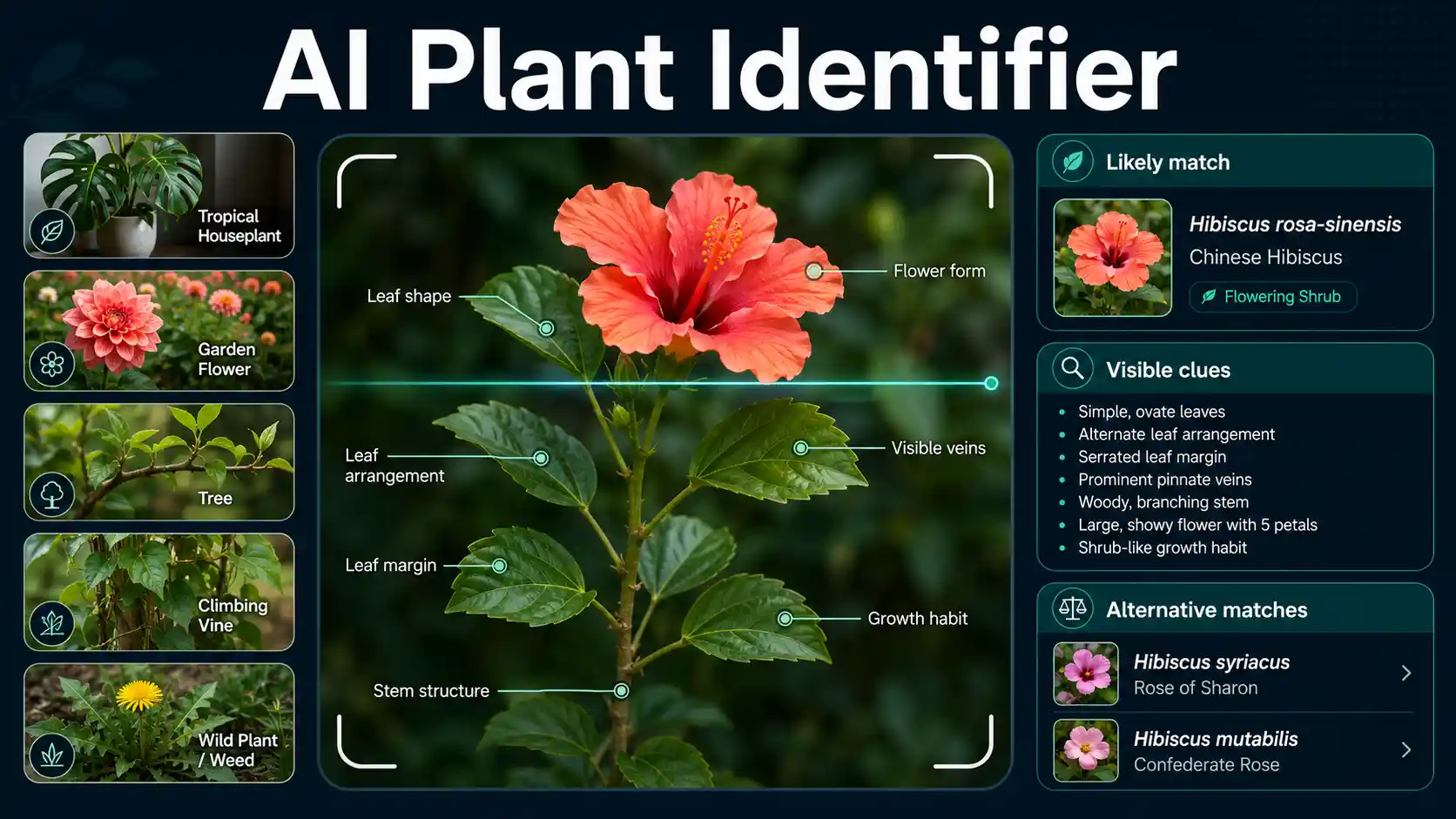
How plant identification works
Whole-plant form and reproductive structures build the strongest match
The tool begins with growth form and leaf structure. It compares whether the plant is woody or herbaceous, upright or trailing, simple or compound-leaved, and how leaves attach along the stem.
Flowers, fruit, cones, seed heads, buds, bark, thorns, and geographic context often separate plants with similar foliage. When those structures are absent, a family or genus can be more responsible than a precise species name.
- 1Upload, take, or paste one image
Choose a file, use your phone camera, click the paste icon, or press Ctrl+V or Command+V.
- 2Add facts that the photo cannot show
Country, environment, approximate size, location, and observed behavior can narrow the answer.
- 3Review the match and its evidence
Check the likely name, confidence bar, visible clues, alternatives, safety note, and recommended next step.
Plant identification coverage
Identify houseplants, garden plants, trees, vines, flowers, and weeds
The identifier covers many cultivated and wild vascular plants. It stays at a broader taxonomic level when a cultivar, juvenile plant, sterile specimen, or detached leaf lacks decisive evidence.
Garden annuals, perennials, bulbs, herbs, vegetables, ornamentals, groundcovers, and volunteer seedlings
Trees and shrubs through leaves, branching, buds, flowers, fruit, bark, thorns, and overall growth form
Wildflowers, weeds, vines, grasses, sedges, rushes, and other plants when enough structural detail is visible
Flowering and fruiting plants through inflorescence, petal, sepal, fruit, cone, pod, berry, and seed-head structure
A broader family, genus, growth form, or plant group when one photograph cannot support a species or cultivar name
Plant features that matter
Show attached leaves, stems, flowers, fruit, and growth form
A single color or leaf outline rarely proves a species. Stronger identification combines several independent features from the same plant.
Photograph the whole plant first, then add close views of a leaf attached to the stem, both leaf surfaces, flowers, fruit, bark, buds, thorns, or seed heads. Include a size reference and state whether the plant is indoors, cultivated, naturalized, or growing wild.
- Take one photograph of the entire plant and its natural growth form.
- Show a leaf still attached to the stem so the arrangement and node are visible.
- Photograph the top and underside of a mature, undamaged leaf.
- Include flowers, buds, fruit, cones, pods, berries, or seed heads when present.
- For trees and shrubs, add clear images of bark, twigs, buds, thorns, and branching.
- Use neutral daylight and avoid filters that change green, red, purple, or flower colors.
- Include a ruler or familiar object for scale without covering plant features.
- State the country, habitat, season, and whether the plant is cultivated, indoor, roadside, woodland, wetland, or garden-grown.
What the plant result contains
A responsible plant match shows morphology and uncertainty
The result should identify the plant only as precisely as the evidence allows, explain the visible structures, list realistic alternatives, and state which additional photograph or observation would improve confidence.
- The most likely common and scientific name when the visible evidence supports them
- A broader family, genus, growth form, or plant group when species-level evidence is missing
- A high, moderate, or low confidence label without false numerical precision
- Visible evidence such as leaf arrangement, shape, margin, veins, stem, flower, fruit, bark, and habit
- Plausible lookalikes and the extra feature needed to separate them
- Useful attributes such as life form, leaf type, flower structure, habitat, season, and geographic fit
- A warning when edibility, toxicity, disease, invasive status, or medicinal use cannot be confirmed
- A practical next step and better-photo suggestions for stronger identification
Common plant lookalikes
Similar leaves can belong to very different plants
These comparisons show why attached leaves, stems, flowers, fruit, growth form, and location must be evaluated together.
Pothos or heartleaf philodendron
Both can have heart-shaped leaves and trailing growth. Petiole structure, leaf base, aerial roots, new-leaf sheaths, texture, and mature growth help separate them.
Poison ivy or harmless three-leaflet vine
Three leaflets alone are not proof. Leaflet stalks, margins, stem position, aerial roots, fruit, growth habit, and local range must be compared.
Wild carrot relative or poison hemlock
White flower clusters can look alike. Stem spots, hairs, odor, leaf division, plant size, bracts, habitat, and fruit are important; never taste an unknown plant.
Maple or plane tree leaf
Both may have broad lobed leaves. Opposite versus alternate arrangement, bark, buds, fruit, vein pattern, and petiole features separate them.
Mint family herb or unrelated aromatic plant
Opposite leaves and square-looking stems suggest some mint relatives, but flower form, aroma, hairs, leaf margin, and stem details are still needed.
Grass, sedge, or rush
Leaf sheath, stem cross-section, nodes, ligules, flower or seed heads, and habitat distinguish these groups more reliably than a distant green clump.
Why plant identification can fail
One detached leaf can match hundreds of plants
Juvenile foliage, cultivars, seasonal changes, shade leaves, damaged specimens, missing flowers, and broad geographic variation can remove the features needed for species-level identification.
- The upload contains several overlapping plants and the intended subject is unclear.
- Only one detached leaf is shown without its stem attachment or growth form.
- The photograph is too distant to see leaf margins, veins, hairs, buds, or flower parts.
- A juvenile, damaged, variegated, or cultivated form is assumed to look like the typical wild plant.
- Only a flower is photographed while leaves, stems, and the whole plant remain hidden.
- Color filters, artificial light, or overexposure change the real leaf and flower colors.
- No location, habitat, season, or cultivation context is provided for a widespread lookalike.
- The request asks whether a plant is edible, poisonous, medicinal, invasive, or diseased when one image cannot prove it.
Worked plant-identification examples
Multiple structures and location narrow the match
Each example combines a whole-plant view with close photographs of attached leaves, flowers, fruit, bark, or seedlings so the tool can compare realistic alternatives.
Unknown houseplant with patterned leaves
A whole-plant image, leaf attachment, stem type, underside, petiole, new growth, and pot context can separate prayer plants, aroids, begonias, peperomias, and similar foliage plants.
Flowering plant in a garden bed
The full habit, leaf arrangement, flower cluster, petal count, bud form, stem texture, bloom season, and country can narrow ornamental and wildflower alternatives.
Tree or shrub with similar leaves
Attached mature leaves, opposite or alternate arrangement, bark, buds, branching, fruit, thorns, and an overall silhouette can separate visually similar woody plants.
Young weed or volunteer seedling
Cotyledons, first true leaves, stem hairs, sap, root form, nearby mature plants, habitat, and a follow-up photo after growth may be needed before species identification.
Use the result responsibly
Never use one photo to decide whether a plant is safe to eat or handle
Do not eat, taste, brew, apply, burn, or give an unknown plant to a person or animal based on an AI result. Plant toxicity and edibility require authoritative confirmation. Seek poison or medical help after a concerning exposure.
Some toxic plants resemble edible species, and different plant parts can carry different risks. Do not taste an unknown specimen. After ingestion, eye exposure, skin exposure, or concerning symptoms, contact an appropriate poison service, veterinarian, or medical professional.
Choose the next identification step
Move from naming the plant to understanding what the photo shows
Questions about identifying plants by photo
Answers before you upload a plant picture
Can I identify a plant from a picture for free?
Yes. Upload one clear JPEG, PNG, or WebP image and the tool will return the most defensible plant match supported by visible structures and context.
What photo gives the best plant identification?
Start with the whole plant, then add an attached mature leaf, its underside, stem, flower, fruit, bark, or seed head. Include size and location.
Can one leaf identify a plant species?
Sometimes, but many plants share similar leaves. Stem attachment, leaf arrangement, flowers, fruit, bark, growth form, and geographic location often determine the final match.
Can the tool identify a houseplant cultivar?
It may identify the species or cultivar group, but many named cultivars differ only subtly and cannot be confirmed without provenance or additional features.
Can it identify trees from bark or leaves?
It can narrow tree possibilities when mature attached leaves, buds, branching, bark, fruit, cones, thorns, size, and location are visible together.
Does location improve plant identification?
Yes. Country, habitat, elevation, season, cultivation status, and whether the plant is indoors or wild can remove lookalikes that do not fit the setting.
Can SnapIdentify tell whether a plant is edible?
No. Do not eat, taste, brew, or use an unknown plant based on an AI result. Edibility requires authoritative identification and safety verification.
Can the result confirm that a plant is poisonous or pet-safe?
No. A likely identity may indicate a possible concern, but toxicity depends on the correct plant, part, dose, route, and exposed person or animal.
Can this tool diagnose a plant disease?
No. Disease, pests, watering stress, nutrient problems, and chemical injury can look alike. Use a symptom-focused plant disease service or local extension expert.
Why did the plant identifier return low confidence?
Low confidence usually means the image lacks the whole plant, attached leaves, flowers, fruit, scale, geographic context, or the specimen is juvenile, damaged, or highly cultivated.
Can a photo prove that a plant is invasive or protected?
No. Invasive, regulated, rare, and protected status varies by jurisdiction and requires a confirmed identity plus current local legal information.
Are uploaded plant photos permanently stored by SnapIdentify?
SnapIdentify processes the normalized image for the request and does not intentionally write it to local disk. The configured AI provider processes it under its service terms.
Authoritative plant and safety references
Verify plant names, distributions, and exposure risks
These botanical, extension, and poison-information resources help confirm accepted names, distributions, plant morphology, and safety decisions that an AI photo result cannot establish alone.
- Plants of the World Online — Royal Botanic Gardens, Kew
Kew provides expert-reviewed plant names, synonyms, descriptions, images, and native or introduced distribution data for global vascular plants.
- NC State Extension Gardener Plant Toolbox
The Plant Toolbox organizes identification features including habit, leaves, flowers, fruit, bark, stems, cultural conditions, and landscape context.
- Poison Control — Poisonous and Non-Poisonous Plants
Poison Control explains why accurate identification matters after exposure and advises against eating wild plants unless their identity is known with certainty.