Common indoor spiders such as cellar spiders, cobweb spiders, house spiders, funnel weavers, sac spiders, and wandering outdoor spiders
Identify house, garden, web-building, and hunting spiders from one photo
Free AI Spider Identifier by Picture
Upload or paste a clear photo of one spider. This free AI spider identifier examines the cephalothorax, abdomen, leg proportions, markings, eye pattern when visible, palps, spinnerets, posture, web structure, apparent life stage, and any location or habitat details you provide. It returns the most defensible match, explains the visible evidence, and lists alternatives when similar spiders cannot be separated from one image.
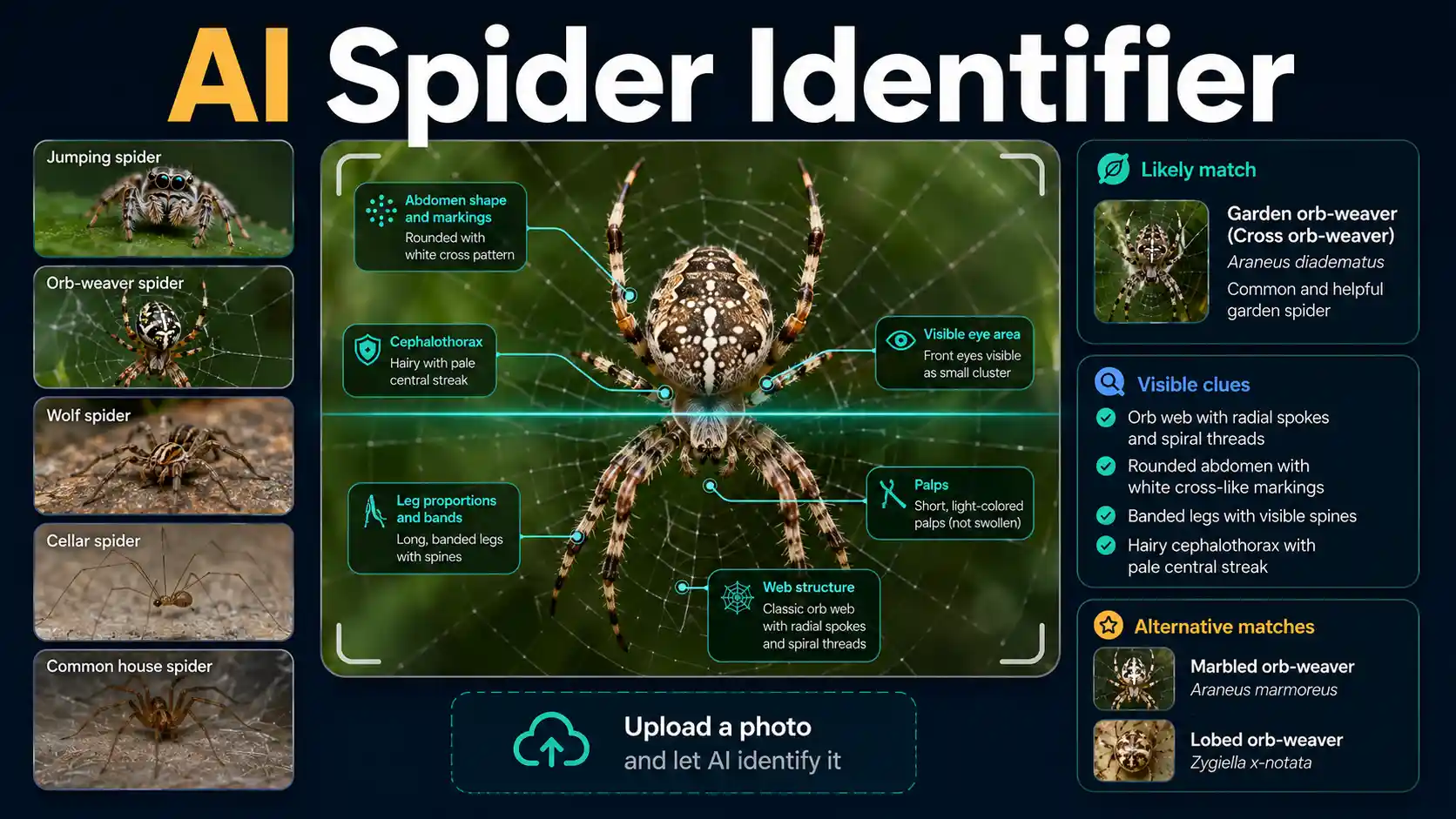
How spider identification works
Body structure, behavior, web, and geography build the match
The tool first checks whether the subject is a true spider or another arthropod. It then compares the cephalothorax, abdomen, leg proportions, markings, hairs, palps, spinnerets, posture, and visible eye arrangement.
Context can be decisive. A spider in an orb web, a fast hunter on the floor, and a long-legged spider hanging in an irregular corner web may share colors but belong to very different families. Geography and body length help remove unlikely matches.
- 1Upload, take, or paste one image
Choose a file, use your phone camera, click the paste icon, or press Ctrl+V or Command+V.
- 2Add facts that the photo cannot show
Country, environment, approximate size, location, and observed behavior can narrow the answer.
- 3Review the match and its evidence
Check the likely name, confidence bar, visible clues, alternatives, safety note, and recommended next step.
Spider and arachnid coverage
Identify common house, garden, web-building, and hunting spiders
The identifier covers many familiar spider families and can recognize broader spider-like arachnid groups. It stays at family level when a single photo cannot support a species name.
Garden and vegetation spiders such as orb weavers, jumping spiders, crab spiders, lynx spiders, and nursery web spiders
Ground-hunting spiders such as wolf spiders and other fast-moving spiders that do not use a prey-catching web
Web-building groups through a combination of spider anatomy, web shape, retreat position, and habitat rather than the web alone
Juvenile and mature spiders when body form, markings, palps, abdomen, and geographic context provide enough evidence
Spider-like arachnids such as harvestmen, ticks, mites, pseudoscorpions, scorpions, and solifuges at a broader group level
Spider features that matter
Show the anatomy and context that separate lookalikes
Color alone rarely identifies a spider. Stronger clues include body proportions, leg form, eye arrangement, markings, web architecture, hunting posture, body length, and location.
Photograph the spider from directly above while keeping a safe distance. Add a side view, the underside only when it can be photographed without handling, and a separate image of the web or retreat. Include a ruler or familiar object nearby and state the country, indoor room, garden habitat, and approximate body length without the legs.
- Fill most of the frame with one spider while remaining outside touching distance.
- Take a sharp top view that shows the cephalothorax, abdomen, markings, and all visible legs.
- Add a side view to show body height, hairs, leg spines, palps, and the relationship between body regions.
- Use a macro setting or optical zoom instead of moving close to an unknown spider.
- Include a ruler or familiar object nearby, but measure body length separately from leg span.
- Photograph the web, retreat, burrow, leaf shelter, or indoor corner as a separate context image.
- State the country or region because many similar-looking spiders have different geographic ranges.
- Avoid flash glare on shiny abdomens and avoid crushing, spraying, or trapping the specimen on opaque glue.
What the spider result contains
A responsible match explains anatomy and uncertainty
The result should state the most defensible identification level, show which visible features support it, list meaningful alternatives, and explain what extra photograph or observation would improve confidence.
- The most likely common name and scientific name when the image supports them
- A broader family or spider group when species-level evidence is missing
- A high, moderate, or low confidence label without a misleading exact percentage
- Visible evidence such as body proportions, leg structure, markings, hairs, palps, posture, and web context
- The apparent life stage or sex only when the photograph provides defensible clues
- Plausible lookalikes and the feature or extra view that would help separate them
- Useful attributes such as hunting style, web type, habitat, indoor relevance, geographic fit, and beneficial role
- A practical next step, safer handling guidance, and better-photo suggestions
Common spider lookalikes
Similar color does not mean the same spider
These comparisons show why body form, web type, eye arrangement, leg details, and geographic range must be considered together.
Brown recluse or common brown house spider
Recluse identification requires several traits and geographic fit. Many cellar, sac, funnel-weaver, wolf, and house spiders are brown and may show vague dark marks.
Black widow or false widow
Widows and false widows can both have rounded abdomens. Clear markings, leg proportions, web, sex, surface shine, and local range help separate them.
Wolf spider or funnel weaver
Wolf spiders are active hunters; funnel weavers often have more visible spinnerets and use a sheet-and-funnel web. Eye arrangement can help when sharply photographed.
Cellar spider or harvestman
Cellar spiders have two main body regions and often hang in loose webs. Harvestmen have a broadly fused-looking body and do not make prey-catching webs.
Jumping spider or small crab spider
Jumping spiders often show large forward-facing eyes and a compact stance; crab spiders usually hold the first legs sideways and use an ambush posture.
Spider or tick
Spiders usually show a distinct abdomen and cephalothorax with longer articulated legs. Ticks have a more compact fused-looking body and a different feeding anatomy.
Why spider identification can fail
One blurry brown spider can match many families
Juveniles, mature males, molts, missing legs, hidden undersides, poor focus, and wide geographic variation can remove the features needed for a reliable species-level answer.
- The spider occupies only a tiny part of the image or is hidden behind a web.
- The upload shows a bite, skin lesion, web, egg sac, or shed skin without a clear spider specimen.
- Only the legs are visible while the abdomen and cephalothorax remain hidden.
- The specimen is crushed, sprayed, missing major parts, or attached to an opaque glue trap.
- A brown color or vague violin-like mark is treated as proof of a brown recluse.
- A dark rounded abdomen is treated as proof of a widow spider without the required markings and context.
- Leg span is reported as body length, making the spider appear much larger than it is.
- Country, region, habitat, web type, and indoor location are omitted for a visually common spider.
Worked spider-identification examples
Multiple views and local context narrow the match
Each example combines a safe specimen photo with body length, location, web type, behavior, or habitat so the tool can compare realistic alternatives.
Small spider in an indoor corner
A top view plus a separate image of the irregular web, exact body length, room type, and region can help distinguish a cellar spider, cobweb spider, juvenile house spider, or accidental outdoor visitor.
Large patterned spider in a garden web
The orb web, abdomen shape, dorsal pattern, leg bands, plant height, season, and country can support an orb-weaver match without implying the spider is dangerous.
Fast brown spider on the floor
Body proportions, eye arrangement when visible, leg hair, spinnerets, markings, and whether a prey-catching web is present can separate wolf spiders, funnel weavers, nursery web spiders, and recluse lookalikes.
Compact spider on a wall or leaf
A close front view of the large forward-facing eyes, a dorsal view, body length, palps, and jumping behavior can support a jumping-spider family identification.
Use the result responsibly
Avoid handling and do not diagnose a bite from an image
Do not touch, trap by hand, or deliberately provoke an unknown spider. This tool identifies a photographed specimen, not a bite or skin mark. Seek urgent medical help for severe symptoms and use a qualified local expert when a potentially significant spider must be confirmed.
Most spiders are beneficial predators, and many household encounters do not require pesticide treatment. A potentially significant identification should be confirmed locally. Seek medical help for severe pain, muscle cramping, breathing difficulty, spreading tissue injury, or other serious symptoms after a suspected bite.
Choose the next identification step
Use anatomy and context to decide which specialist workflow fits
Questions about identifying spiders by photo
Answers before you upload a spider picture
Can I identify a spider from a picture for free?
Yes. Upload one clear JPEG, PNG, or WebP image and the tool will return the most defensible match supported by the visible anatomy and context.
What photo gives the best spider identification?
Use a sharp top view that shows the whole body and legs. Add a side view, approximate body length, location, and a separate photo of the web or retreat.
Can the tool identify a brown recluse from a photo?
It may flag a possible recluse when several anatomical and geographic clues fit, but brown color or a violin-like mark alone is not enough for confirmation.
Can the tool identify a black widow from a photo?
It may suggest a widow when body form, markings, web, sex, and location fit. A dark rounded abdomen by itself is not diagnostic.
Can a spider web identify the spider species?
A web can narrow the likely family or hunting strategy, but it rarely proves a species. Photograph the spider and the retreat as well as the web.
Does location improve spider identification?
Yes. Country, region, habitat, season, and whether the spider was indoors or outdoors can remove lookalikes that do not occur locally.
Can SnapIdentify diagnose a spider bite or skin lesion?
No. A skin lesion cannot reliably identify a spider, and many suspected spider bites have other causes. Seek medical care for severe, spreading, or systemic symptoms.
Can a photo prove that a spider is harmless?
No. A likely identification can inform caution, but one photo cannot guarantee behavior, venom significance, bite risk, or harmlessness.
How can I tell a spider from an insect?
Spiders typically have two main body regions, eight legs, no wings, and no antennae. Insects have three main body regions and six legs.
Why did the spider identifier return low confidence?
Low confidence usually means the spider is too small, blurred, hidden by silk, missing key body views, immature, damaged, or similar to several local species.
Should I spray pesticide after one spider identification?
No. Many spiders are beneficial predators. Confirm the identity and consider exclusion, web removal, or qualified pest guidance before using a pesticide.
Are uploaded spider photos permanently stored by SnapIdentify?
SnapIdentify processes the normalized image for the request and does not intentionally write it to local disk. The configured AI provider processes it under its service terms.
Authoritative spider and safety guidance
Verify important spider identifications before taking action
These university and public-health resources explain spider anatomy, household management, beneficial behavior, venomous-spider precautions, and the limits of visual identification.
- UC Statewide IPM Spiders
UC IPM explains spider anatomy, beneficial predation, common household encounters, bite misconceptions, exclusion, web removal, and why pesticides are often unnecessary.
- University of Minnesota Extension Spiders
UMN Extension compares spiders with insects and explains web-building spiders, hunting spiders, anatomy, silk use, household behavior, and common identification groups.
- CDC Venomous Spiders at Work
CDC provides safety information for possible widow and recluse encounters and recommends avoiding direct contact and seeking appropriate medical attention after a concerning bite.