Common garden and meadow butterflies such as monarchs, admirals, painted ladies, sulphurs, whites, blues, coppers, fritillaries, crescents, and anglewings
Identify butterflies, skippers, caterpillars, chrysalises, and moth lookalikes
Butterfly Identifier with Wing and Habitat Clues
Use this Butterfly Identifier when you are asking what butterfly is this, comparing an orange and black butterfly with a monarch, or trying to name a small blue, yellow, white, brown, or swallowtail-like butterfly from a picture. Upload a sharp photograph and add the location, date, habitat, approximate wingspan, behavior, host plant, and whether the image shows the upper wings, underside, caterpillar, or chrysalis. The tool compares wing shape, vein-guided pattern placement, eyespots, bands, tails, antennae, body form, posture, life stage, season, and geographic range before suggesting the most defensible match.
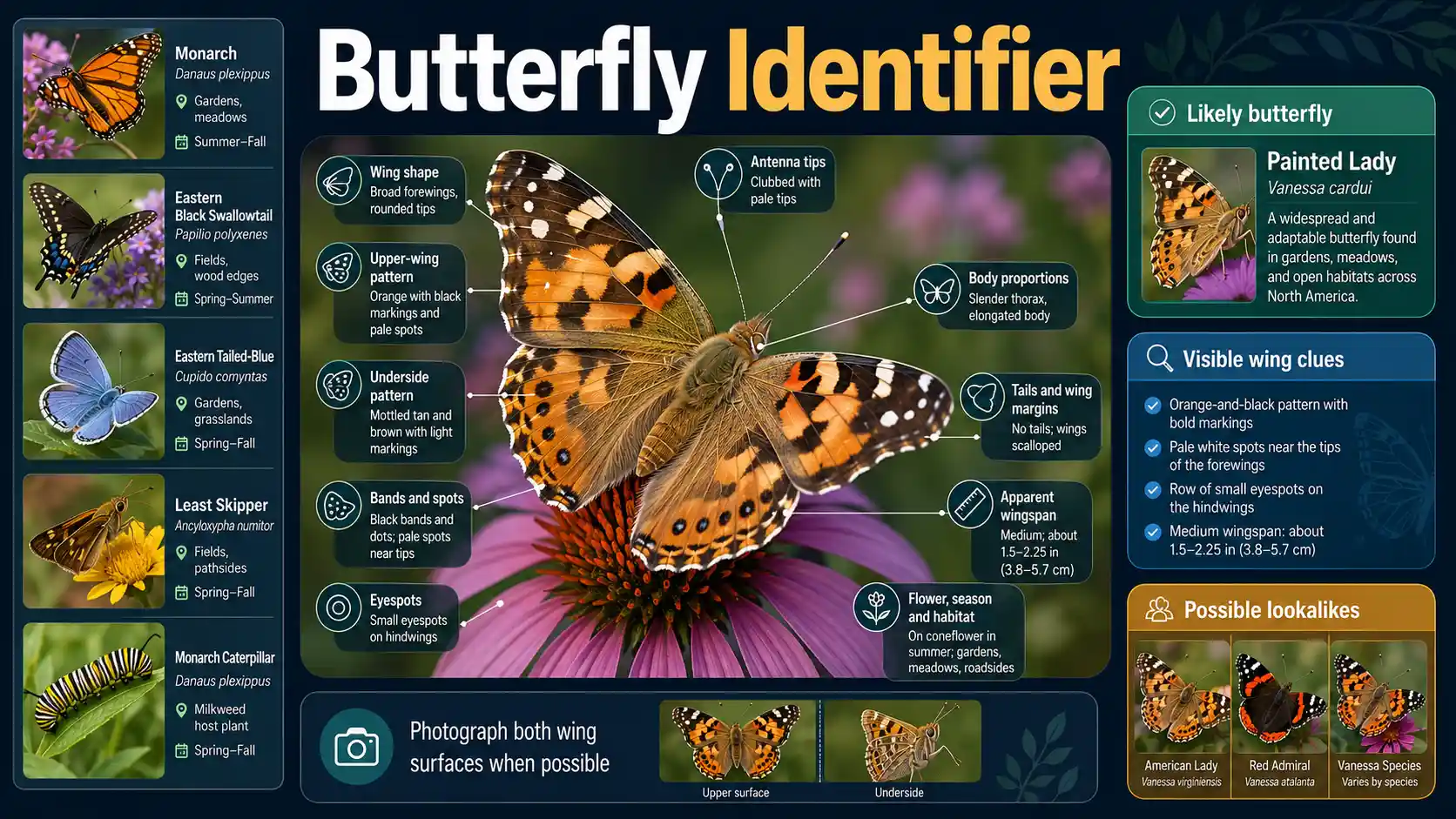
How butterfly identification works
Wing surfaces, antennae, life stage, season, and place build the match
Adult butterfly identification begins with the complete wing outline and the exact position of bands, spots, eyespots, tails, margins, and color fields on both the upper side and underside. The tool also compares clubbed or hooked antenna tips, body proportions, palps, resting posture, apparent size, behavior, wear, and whether the subject better fits a butterfly, skipper, or moth.
Date and location are often decisive. A pattern that fits several species may narrow sharply when the country, state or province, elevation, habitat, flight season, nectar source, or larval host plant is known. Caterpillars and chrysalises require a separate life-stage comparison and frequently deserve a broader result than the adult.
- 1Upload, take, or paste one image
Choose a file, use your phone camera, click the paste icon, or press Ctrl+V or Command+V.
- 2Add facts that the photo cannot show
Country, environment, approximate size, location, and observed behavior can narrow the answer.
- 3Review the match and its evidence
Check the likely name, confidence bar, visible clues, alternatives, safety note, and recommended next step.
Butterfly identification coverage
Identify garden butterflies, skippers, caterpillars, chrysalises, and moth lookalikes
The identifier covers many recognizable adult butterflies and broader larval or pupal groups. It stays at family, genus, species group, or uncertain Lepidoptera level when the underside, tiny markings, genital characters, rearing history, host plant, or specialist regional comparison would be required.
Swallowtails and other tailed butterflies using wing shape, tail number, spots, bands, eyespots, body markings, habitat, and range
Skippers using compact body form, antenna tips, wing posture, markings, size, behavior, and region
Woodland, wetland, mountain, coastal, tropical, urban, and migratory butterflies when location, season, and habitat support the comparison
Butterfly caterpillars and recognizable larval groups using body structures, markings, host plant, feeding sign, and location
Chrysalises, pupae, eggs, and shed skins at a cautious level when attachment, structure, markings, host, season, and region are visible
Butterfly-like moths, day-flying moths, artificial decorations, damaged wings, and other lookalikes when the upload is not actually an adult butterfly
Butterfly features that matter
Show both wing surfaces, antennae, body, size, plant, date, and location
Color alone is weak evidence because wear, lighting, sex, season, temperature, mimicry, iridescence, and regional variation can change appearance. A stronger match combines pattern placement and anatomy with measured size, behavior, habitat, season, host or nectar plant, and geographic range.
Photograph the butterfly without touching its wings. Capture the upper side when it opens its wings and the underside when it rests with them closed. Include a size reference from a safe distance, the flower or host plant, and the surrounding habitat. For caterpillars or chrysalises, show the complete body, attachment point, host plant, markings, spines, hairs, and exact location.
- Fill most of the frame with one butterfly while keeping both forewings, both hindwings, antennae, body, and legs visible.
- Photograph the upper side when the wings open and the underside when the wings close, because the two surfaces may carry different diagnostic patterns.
- Use a fast shutter or steady phone position and avoid digital zoom that turns small spots and scales into blur.
- Include a ruler, flower diameter, leaf, or other nonintrusive size reference without capturing or touching the insect.
- Record the country, state or province, exact date, habitat, elevation, weather, and time of day.
- Show the nectar flower, host plant, mud-puddling site, tree sap, fruit, or other resource the butterfly is using.
- For a caterpillar, show the side, back, head, tail, true legs, prolegs, hairs, spines, horns, shelter, and host plant.
- For a chrysalis, show its shape, attachment, girdle or hanging point, surface markings, support plant, and nearby leaves without moving it.
- Do not hold the wings, pin the insect, remove scales, force the wings open, or provoke flight for a better photograph.
What the butterfly result contains
A useful match explains the pattern, life stage, lookalikes, and uncertainty
The answer should state what butterfly or broader group best fits, which visible marks support it, what alternatives remain, and which second view or contextual fact would improve confidence. It should not turn a color pattern into unsupported claims about rarity, toxicity, migration, pest status, or legal protection.
- The most likely butterfly common name, family, genus, or species when the evidence supports that precision
- A broader butterfly, skipper, moth, caterpillar, or pupa group when species-level characters are hidden or variable
- An adult, caterpillar, chrysalis, egg, shed skin, or uncertain life-stage assessment
- Visible evidence from wing shape, pattern placement, tails, eyespots, antennae, body, posture, size, behavior, and life-stage anatomy
- Relevant host plant, nectar plant, habitat, elevation, date, season, and geographic range clues
- Plausible lookalikes and the specific wing surface, marking, antenna, plant, or regional fact that could separate them
- A cautious explanation of sex, seasonal form, mimicry, wear, or variation only when those ideas are visibly supported
- A practical next step, safer observation guidance, and suggestions for a stronger photograph or expert verification
Common butterfly lookalikes
Wing placement and anatomy separate familiar butterflies from close mimics
These comparisons show why orange, yellow, blue, brown, tailed, or day-flying appearance cannot identify a butterfly by itself.
Monarch or viceroy
Both can show orange-and-black mimicry. Check the hindwing black line, vein pattern, white spots, body, underside, size, behavior, season, and range instead of relying on one color impression.
Butterfly or day-flying moth
Many butterflies have clubbed antennae, while many moths have threadlike or feathery antennae. Wing scales, body, palps, antennae, resting posture, and species-specific pattern together are more useful than daytime activity alone.
Swallowtail or dark mimic
Tails, blue or red hindwing marks, pale bands, abdomen pattern, underside, host plant, and range can separate black swallowtails, pipevine swallowtails, spicebush swallowtails, female tiger swallowtails, and mimics.
Blue or hairstreak
Tiny blues and hairstreaks often require the underside spots, orange crescents, tails, metallic marks, upper-side color, wingspan, habitat, and region. A distant blue upper surface is rarely enough.
White or sulphur
White and yellow pierids may vary by sex and season. Dark wing borders, cell spots, underside pattern, antennae, size, flight period, habitat, and location help separate them.
Butterfly caterpillar or sawfly larva
Caterpillars and sawfly larvae can share colors, stripes, hairs, and group feeding. A clear view of the head, true legs, prolegs, body posture, host plant, and feeding pattern is needed for a broader distinction.
Why butterfly identification can fail
One wing surface, worn scales, blur, and missing season can hide the answer
Butterflies can change appearance through wear, sex, seasonal form, temperature, emergence, lighting, and viewing angle. Many close species also share a wing pattern. A responsible result stays broad when the underside, antennae, body, exact size, date, location, or host evidence is missing.
- The butterfly occupies only a tiny part of the frame and the wing spots cannot be resolved.
- Only the upper wing surface is shown even though the underside carries the strongest diagnostic markings.
- Strong backlight turns translucent wing areas into false colors or removes dark pattern details.
- A faded, worn, wet, newly emerged, or damaged butterfly is compared with a perfect field-guide image.
- The date and geographic location are omitted even though many close species have different ranges or flight periods.
- A flower is assumed to be the caterpillar host plant simply because the adult is drinking nectar from it.
- A day-flying moth is called a butterfly from behavior alone, or a resting butterfly is called a moth from wing posture alone.
- A caterpillar is named from color without showing the head, prolegs, spines, horns, host plant, and body pattern.
- An empty chrysalis, cocoon, leaf shelter, or damaged wing is treated as enough evidence for an exact species.
- A monarch-like orange and black pattern is treated as proof without checking veins, bands, spots, body, underside, location, and season.
Worked butterfly-identification examples
Wing pattern, life stage, plant use, season, and region narrow the match
Each case combines a close specimen photograph with both wing surfaces where possible and the contextual facts that separate familiar butterflies, skippers, caterpillars, chrysalises, and moth lookalikes.
Orange and black butterfly on milkweed
A clear upper and underside view, black vein pattern, white marginal spots, hindwing band, body markings, wingspan, sex-specific details when visible, milkweed use, date, and location can compare monarchs with viceroys, queens, soldiers, painted ladies, and other orange-and-black butterflies.
Large dark swallowtail in a garden
Tail shape, number of tails, pale spots, blue or red hindwing markings, underside bands, abdomen pattern, host plant, nectar flower, region, and season can narrow black swallowtails, spicebush swallowtails, pipevine swallowtails, female tiger swallowtails, and close relatives.
Small blue butterfly beside a path
Photograph the underside spots, tails, orange crescents, metallic scales, upper-side color, wingspan, leg posture, habitat, and region. Many blues and hairstreaks look nearly identical from one distant upper-wing image.
Small brown skipper on a flower
A compact body, hooked antenna tips, forewing spots, hindwing pattern, wing posture, measured size, flight style, grassland or wetland habitat, date, and location can support a skipper group while keeping similar species open.
Striped caterpillar eating a garden leaf
Show the complete caterpillar, head, true legs, prolegs, stripes, spots, spines or horns, droppings, leaf shelter, exact host plant, size, date, and region. The same adult butterfly group can have larvae that look very different from the adults and from one another.
Observe without harming the insect
Do not touch wings or handle unknown hairy and spiny caterpillars
Do not touch butterfly wings or handle an unknown hairy or spiny caterpillar with bare skin. Some larvae can irritate skin, and handling can damage delicate scales or disturb a chrysalis. Confirm important conservation, pest, or collection decisions with a qualified local source.
Wait for natural wing positions, photograph from several angles, and leave eggs, caterpillars, and chrysalises attached unless a qualified local expert directs otherwise. Avoid bare-skin contact with unknown larvae, do not collect protected wildlife, and verify conservation, agricultural, or release decisions with current local authorities.
Choose the next identification step
Use another workflow when the subject or evidence is broader than a butterfly
Questions about identifying butterflies by photo
Direct answers before you upload a butterfly picture
Can I identify a butterfly from a photo online?
Yes. A sharp upper-wing and underside photo, location, date, approximate wingspan, habitat, and behavior can often support a family, genus, or species suggestion.
What butterfly is this?
Start with wing shape, upper and underside patterns, antennae, body form, size, season, habitat, and location. Several independent clues are stronger than color alone.
Can an orange and black butterfly be identified as a monarch from color alone?
No. Monarchs have several orange-and-black lookalikes. Check vein patterns, hindwing bands, white spots, body markings, underside, size, flight season, and geographic range.
How do I identify a yellow or white butterfly?
Photograph both wing surfaces and record size, dark borders, spots, sex-related pattern differences, flower use, habitat, date, and region. Whites and sulphurs often require several subtle clues.
How do I identify a small blue butterfly?
The underside is often essential. Show spots, orange crescents, tails, metallic scaling, wing margins, upper-side color, size, habitat, and location.
Can the tool identify a swallowtail butterfly?
It can compare likely swallowtails using tails, spots, bands, eyespots, abdomen markings, underside pattern, host plants, season, and range. Dark female forms can remain difficult from one angle.
Can it identify a small brown skipper?
Sometimes. A close view of antenna tips, forewing spots, hindwing pattern, posture, body shape, size, habitat, date, and region is needed because many skippers are extremely similar.
How can I tell a butterfly from a moth?
Use several clues together. Butterflies commonly have clubbed antennae, while many moths have threadlike or feathery antennae, but day activity, dull color, body hair, and resting posture are not reliable by themselves.
Can I identify a butterfly from the underside of its wings?
Yes. The underside may show diagnostic spots, bands, eyespots, leaf-like camouflage, tails, and seasonal patterns that are absent or less clear above.
Can the tool identify a butterfly caterpillar?
Sometimes. Show the head, body markings, hairs, spines, horns, true legs, prolegs, exact host plant, size, date, and location. Many larvae remain difficult even for specialists.
Can it identify a chrysalis or pupa?
It may narrow a group using shape, attachment, girdle, hanging point, surface texture, markings, host, season, and region. An exact species may not be defensible from the pupa alone.
Does the flower prove which butterfly species it is?
No. Many adult butterflies visit the same nectar flowers. A nectar plant is context, while the larval host plant is a separate biological relationship that must be verified.
Can a photo determine whether a butterfly is male or female?
Sometimes, when the species is already well supported and visible sex-specific markings or shape differences are known. The result should remain uncertain when those traits are hidden or variable.
Can the result confirm a rare, protected, or endangered butterfly?
No. A likely visual match can justify prompt expert review, but conservation status and legal protections require confirmed identity, exact locality, and current regional information.
Should I touch a butterfly to open its wings for identification?
No. Wait for a natural wing position and take several photographs. Handling can remove scales, damage wings, stress the insect, and reduce the value of the evidence.
Why did the Butterfly Identifier return low confidence?
Low confidence usually means the subject is distant, blurred, backlit, worn, partly hidden, photographed from one wing surface, or belongs to a group separated by tiny characters or regional expertise.
Are uploaded butterfly photos permanently stored by SnapIdentify?
SnapIdentify processes the normalized image for the request and does not intentionally write it to local disk. The configured AI provider processes the image under its service terms.
Authoritative butterfly anatomy and identification references
Verify difficult butterfly, skipper, caterpillar, and chrysalis matches
These museum and observation resources explain butterfly anatomy, scaled wing patterns, antennae, life stages, regional records, host plants, and why many caterpillars require cautious identification.
- Smithsonian Gardens — About Butterflies
Smithsonian Gardens explains butterfly anatomy, club-shaped antennae, wing scales, adult behavior, basking, puddling, courtship, and the biological roles of wing patterns.
- Smithsonian National Museum of Natural History — Butterflies and Beyond
The Smithsonian resource explains Lepidoptera, scaled wings, caterpillar development, and why antennae are more useful than simple day-versus-night rules when comparing butterflies and moths.
- Butterflies and Moths of North America — Identify a Butterfly, Moth, or Caterpillar
BAMONA emphasizes date, location, regional records, photographs, and host-plant information, and notes that many caterpillar stages are difficult to identify even from images.