Likely fungal or oomycete problems such as leaf spots, powdery mildew, downy mildew, rusts, blights, damping-off, rots, and visible fruiting structures
Compare plant symptoms, pathogen signs, pests, and growing stress from one photo
Free AI Plant Disease Identifier by Picture
Upload or paste clear photos of an unhealthy plant. This AI plant disease identifier by picture compares the host plant, affected parts, symptom pattern, visible signs, pests, roots, weather, watering, nutrition, and recent care. It suggests likely causes such as fungal or bacterial disease, pest feeding, nutrient imbalance, root stress, heat, cold, sun, salt, or chemical injury without pretending that one image can replace laboratory diagnosis.
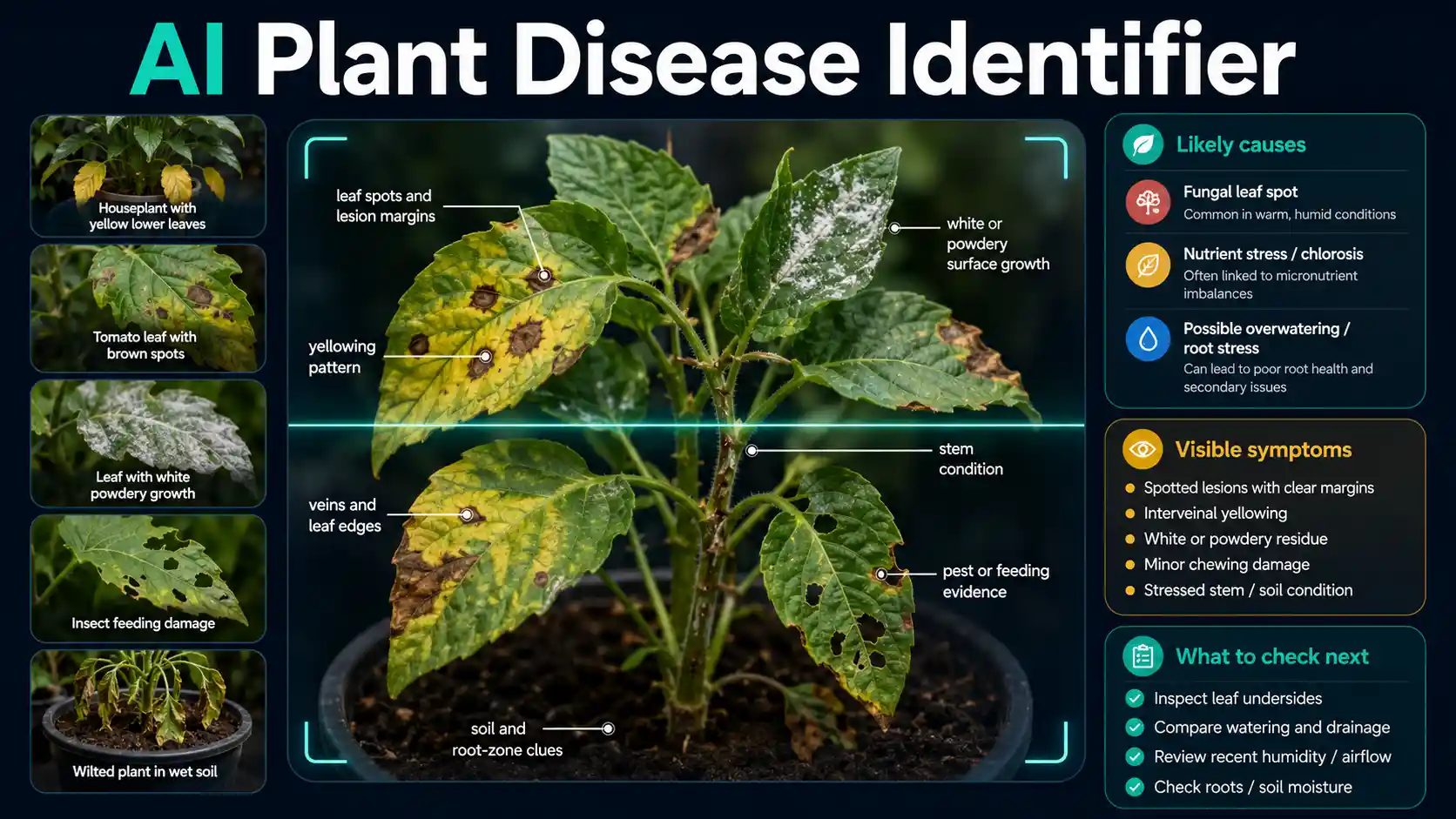
How plant problem diagnosis works
The tool separates symptoms, signs, pests, and growing stress
When someone asks, ‘What is wrong with my plant from a picture?’, the first step is not naming a disease. The tool identifies the host as closely as possible, notes the affected plant part, and compares the symptom pattern across old leaves, new growth, stems, roots, flowers, fruit, and nearby plants.
Plant disease identification by photo is strongest when the upload shows both the whole plant and close evidence such as leaf spots, fungal growth, rust pustules, water-soaked tissue, cankers, rot, pest feeding, or root damage. Watering, weather, fertilizer, drainage, and recent chemical use help separate infectious disease from environmental stress.
- 1Upload, take, or paste one image
Choose a file, use your phone camera, click the paste icon, or press Ctrl+V or Command+V.
- 2Add facts that the photo cannot show
Country, environment, approximate size, location, and observed behavior can narrow the answer.
- 3Review the match and its evidence
Check the likely name, confidence bar, visible clues, alternatives, safety note, and recommended next step.
Plant health coverage
Compare infectious disease, pest damage, and noninfectious stress
The tool can suggest a likely problem category across houseplants, vegetables, flowers, fruit crops, trees, shrubs, lawns, and ornamentals. It stays broad when the exact pathogen, nutrient, or chemical cause cannot be confirmed visually.
Possible bacterial patterns such as angular or water-soaked lesions, soft rot, scorch, cankers, ooze, or vascular symptoms when enough evidence is visible
Virus-like or phytoplasma-like patterns such as mosaic, mottling, rings, distortion, witches'-broom growth, or unusual color breaks while clearly noting that laboratory confirmation may be required
Insect, mite, slug, snail, and other pest damage when feeding marks, insects, eggs, frass, webbing, mines, galls, or colonies appear in the photo
Abiotic stress from watering, drainage, roots, nutrients, salts, pH, light, heat, cold, frost, wind, compaction, transplanting, or chemical exposure
Problems affecting leaves, stems, crowns, roots, flowers, fruit, seedlings, branches, trunks, or the whole plant, including cases with more than one possible cause
Diagnostic evidence that matters
Show the pattern, not only the most damaged leaf
A useful diagnosis combines the host plant, affected plant part, symptom distribution, visible signs, site conditions, timing, and care history. One dramatic close-up without that context can be misleading.
Start with one photo of the whole plant and its surroundings. Then add close views of affected and healthy tissue, both sides of a leaf, stems, the soil line, and roots when they can be exposed without causing extra damage. State the plant name if known, location, recent weather, watering pattern, drainage, fertilizer, pesticide or herbicide use, and when the symptoms began.
- Show the entire plant and enough of the surrounding bed, pot, greenhouse bench, orchard row, or field to reveal the damage pattern.
- Photograph both healthy and affected plants or plant parts so the transition and progression are visible.
- Take close, sharply focused images of spots, margins, veins, stems, cankers, fungal growth, fruiting bodies, insects, eggs, frass, or webbing.
- Show both sides of affected leaves because spores, mites, scale insects, and other signs may occur mainly underneath.
- Include the soil line, crown, lower stem, and roots when root or drainage trouble is suspected and they can be viewed without harming the plant.
- Provide the plant's common or scientific name, cultivar when known, country or region, indoor or outdoor setting, and approximate age.
- Describe when symptoms started, whether they are spreading, which leaves were affected first, and whether nearby plants show the same pattern.
- State recent rain, heat, frost, watering, drainage, fertilizer, repotting, pruning, transplanting, pesticide, and herbicide history.
- Avoid filters, artificial color enhancement, wet leaves, deep shadows, and photos that show only dead detached tissue.
What the plant health result contains
A responsible answer ranks causes and explains what would confirm them
The result should identify the strongest explanation, state what the photo cannot prove, compare realistic alternatives, and recommend the next observation or professional test before treatment.
- The most likely problem category and a cautious named diagnosis only when the visible evidence supports it
- The host plant or broader host group when it can be identified from the uploaded images
- A high, moderate, or low confidence label without a fabricated probability
- Visible symptoms and signs that support the leading explanation
- Alternative infectious, pest-related, nutritional, environmental, root, or chemical causes to compare
- The pattern across leaves, plant parts, nearby plants, and time when that context is available
- A practical next observation, better-photo request, cultural check, or laboratory-verification step
- A safety reminder to confirm the cause before applying pesticides, fungicides, fertilizers, or home remedies
Plant problem lookalikes
Different causes can produce nearly identical symptoms
These comparisons show why a plant problem cannot be diagnosed from color alone. Pattern, signs, roots, weather, care history, and progression often matter more than the most obvious symptom.
Fungal leaf spot, bacterial spot, or scorch
Fungal lesions may show rings or fruiting structures; bacterial lesions may be angular or water-soaked; sun, salt, spray, and drought injury often follow exposure or environmental patterns. None of these traits is absolute by itself.
Powdery mildew or surface residue
Powdery mildew produces characteristic superficial fungal growth on living tissue. Dust, hard-water deposits, foliar sprays, and fine webbing may wipe or distribute differently and may not spread in the same pattern.
Nutrient deficiency or root-zone stress
Leaf position, vein pattern, soil pH, fertilizer history, root condition, drainage, and moisture help separate a true nutrient limitation from overwatering, salt injury, compacted roots, or low light.
Virus-like mosaic or noninfectious distortion
Mosaic, mottling, curl, and stunting can also result from mites, thrips, herbicide drift, temperature stress, nutrient problems, or genetic variegation. Laboratory testing may be needed.
Mite or insect feeding versus disease spots
Stippling, mines, chewing, frass, eggs, webbing, or insects support pest damage. Lesion margins, pathogen signs, and spread through tissue may support disease, but mixed problems are possible.
Drought wilt, waterlogging, root rot, or vascular disease
Soil moisture, root condition, stem discoloration, time of day, recovery after watering, drainage, odor, and progression help distinguish causes that all produce a wilted canopy.
Why plant disease identification can fail
A symptom is evidence, not a complete diagnosis
Many pathogens, pests, nutrient problems, and environmental injuries converge on the same yellowing, spotting, wilting, curling, dieback, or rot. Good diagnosis depends on patterns and history as well as close-up detail.
- Only one detached leaf is photographed, so the host, symptom distribution, and whole-plant pattern are unknown.
- The plant is not identified even though disease possibilities depend strongly on the host species and cultivar.
- The image shows dead tissue only, where secondary fungi or bacteria may have arrived after the original injury.
- No healthy tissue or transition zone is included for comparison.
- Yellowing is assumed to be a nutrient deficiency without checking roots, watering, drainage, light, pests, or natural leaf aging.
- Leaf spots are assumed to be fungal even though bacteria, mites, insects, sun, spray injury, or physical damage can look similar.
- The underside of the leaf, lower stem, crown, roots, and nearby plants are not photographed.
- Recent weather, watering, fertilizer, repotting, pesticide, or herbicide history is omitted.
- A treatment is chosen before the likely cause and product label are verified.
Worked plant-health scenarios
Natural diagnostic situations place search questions in context
Each scenario shows how a person might describe the problem and which photographs and facts make an online plant disease identification more useful.
Leaf spots spreading on tomato plants
A useful tomato plant disease identifier scenario includes the whole row, upper and lower leaves, close views of lesion edges, fruit and stems, recent rain or overhead watering, and whether spots began on older foliage. Those details help compare fungal leaf spots, bacterial problems, early blight, nutrient stress, and spray injury without forcing one diagnosis.
Yellow leaves on an indoor houseplant
A houseplant disease identifier by photo should not treat yellowing as a pathogen automatically. Pot drainage, soil moisture, root color and firmness, light level, leaf age, fertilizer salts, mites, scale, and the pattern on old versus new leaves can point toward overwatering, root stress, pests, nutrition, or normal senescence.
White coating on rose or squash leaves
A close leaf-disease picture can suggest powdery mildew when the white growth has a characteristic surface pattern and appears on living tissue. Dust, mineral residue, spray deposits, webbing, or harmless surface growth remain alternatives until both leaf surfaces and surrounding plants are compared.
A wilting plant in consistently wet soil
Wilting does not always mean the plant needs more water. A whole-plant view, soil condition, crown, roots, stem discoloration, odor, drainage, and symptom progression help separate drought, waterlogging, root rot, vascular disease, transplant shock, and heat stress.
Mosaic or distorted new growth
Mottling and curled leaves may raise concern about a virus, but mites, thrips, herbicide drift, nutrient imbalance, temperature injury, and genetic variegation can create similar patterns. Multiple leaves, new and old growth, nearby plants, and pest evidence are needed before recommending laboratory testing.
Use the result responsibly
Confirm the cause before choosing a treatment
Do not apply a pesticide, fungicide, fertilizer, bleach mixture, oil, or home remedy solely from one AI photo result. Similar symptoms can come from pathogens, insects, watering, roots, nutrients, weather, or chemical injury. Confirm important cases through local extension guidance or a plant diagnostic laboratory.
A wrong treatment can damage the plant, harm beneficial organisms, create residue or exposure risks, and delay the correct response. Follow local extension guidance and product labels, and use a diagnostic laboratory when the result affects crops, valuable plants, regulated pests, or widespread losses.
Choose the next identification step
Use the visible evidence to select the right specialist workflow
Questions about plant disease identification by photo
Answers before you upload an unhealthy plant
Can I identify a plant disease from a picture?
A clear set of photos can narrow the likely cause and show which evidence fits, but many plant diseases need host knowledge, field patterns, microscopy, culturing, or laboratory tests for confirmation.
Is the online plant disease identifier free to use?
Yes. The current browser tool accepts a supported image and returns a likely problem category, visible clues, alternatives, and next steps without requiring an app installation.
What is wrong with my plant if the leaves are turning yellow?
Yellow leaves can result from natural aging, overwatering, dry roots, poor drainage, low light, nutrient imbalance, salt buildup, root injury, pests, or disease. The pattern across old and new leaves helps narrow the cause.
Can a leaf disease identifier diagnose spots from one leaf?
It can suggest possibilities, but one detached leaf often lacks the host, whole-plant pattern, symptom progression, and environmental history needed to distinguish disease from pest or abiotic injury.
Can the tool identify tomato plant diseases?
It can compare common symptom patterns on tomato leaves, stems, fruit, and roots. Accurate context about cultivar, weather, watering, plant age, and symptom spread improves the result.
Can it tell whether plant damage comes from a pest or a disease?
Sometimes. Visible insects, eggs, frass, mines, chewing, stippling, webbing, or scale covers support a pest explanation, while pathogen signs and spreading lesion patterns may support disease. Both can occur together.
Can a photo confirm a fungal, bacterial, or viral infection?
Not always. Some fungal signs are visually distinctive, but bacterial and viral problems frequently overlap with other causes and may require a properly collected sample and laboratory testing.
What photos give the best plant problem diagnosis?
Include the whole plant, its surroundings, healthy and affected tissue, close views of symptoms and signs, both leaf surfaces, and roots or crown when relevant. Add location, timing, weather, watering, and treatment history.
Can the result recommend a fungicide or pesticide?
The result can suggest what to verify next, but it should not prescribe a product or rate from one photo. Confirm the host and cause, then follow local guidance and the legally binding product label.
Can the tool diagnose root rot in a houseplant?
It may identify a root-rot pattern when roots are dark, soft, reduced, or foul-smelling and the soil stays wet, but exact pathogens and treatment decisions may require physical examination or testing.
Why did the plant disease result show low confidence?
Low confidence usually means the host is unknown, the image shows only one symptom, important plant parts are hidden, several causes look alike, or the diagnosis normally requires laboratory evidence.
Are uploaded plant photos permanently stored by SnapIdentify?
SnapIdentify processes the normalized image for the identification request and does not intentionally write it to local disk. The configured AI provider processes it under its own service terms.
Authoritative plant diagnostic guidance
Verify significant plant problems before treatment
These plant pathology and extension resources explain systematic diagnosis, biotic and abiotic causes, image and context requirements, and when a laboratory sample is necessary.
- American Phytopathological Society Plant Disease Diagnosis
APS explains systematic diagnosis through correct host identification, symptoms, visible pathogen signs, affected plant parts, patterns, and the possibility of multiple causal factors.
- UC Statewide IPM Diagnosing Plant Problems
UC IPM distinguishes biotic causes from cultural, environmental, nutrient, moisture, chemical, and mechanical problems and recommends appropriate field and laboratory checks.
- University of Minnesota Digital Crop Doc
UMN Extension explains that photo diagnosis depends on image quality and context and that viral, complex, or uncertain cases may require a plant disease clinic sample.