Common household ants such as pavement ants, odorous house ants, little black ants, ghost ants, Argentine ants, pharaoh ants, thief ants, and related groups when regional evidence supports them
Identify household, garden, winged, mound-building, and wood-nesting ants from one photo
Ant Identifier for Household and Garden Species
Upload a clear photo to compare a likely ant with carpenter ants, pavement ants, odorous house ants, field ants, fire ants, pharaoh ants, thief ants, winged swarmers, termites, tiny wasps, and other lookalikes. The tool evaluates body size, elbowed antennae, one or two waist nodes, thorax profile, spines, hair, color pattern, worker variation, wings, trail behavior, nest site, season, and geographic region. It explains the visible evidence and stays at a broader group when a phone photo cannot show the microscopic features required for a responsible species-level answer.
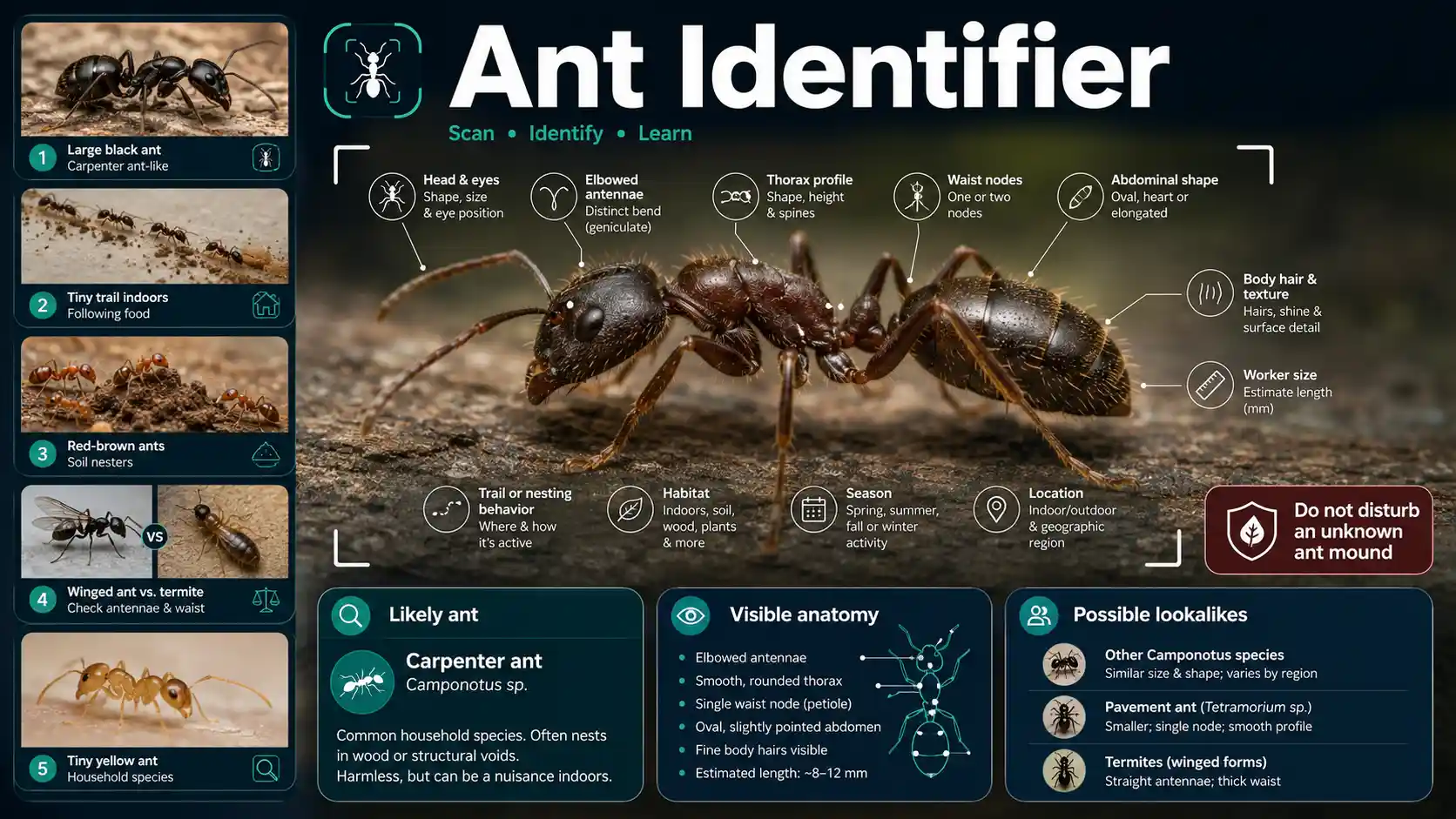
How photo-based ant identification works
Anatomy, measured size, caste, trail behavior, nesting context, season, and geography build the match
A useful ant result starts by confirming that the insect is an ant rather than a termite, small wasp, beetle, true bug, spider mimic, or another arthropod. The analysis compares elbowed antennae, head, thorax, one or two waist nodes, abdomen, legs, hair, spines, color pattern, measured size, wings, behavior, date, nesting context, and geographic region.
Ant identification is often difficult from a phone photo because decisive features can be extremely small. Petiole nodes may be hidden beneath the abdomen, antenna clubs may blur, thoracic hairs and spines may disappear, and workers within one colony may differ greatly in size. The result therefore stays at a broader group when species-level evidence is missing.
Trails, food sources, soil mounds, wood debris, wall openings, moisture, plant associations, and swarm timing can strengthen the match. They remain contextual clues rather than proof of colony size, nest location, structural damage, infestation severity, or treatment need.
The result keeps species identification separate from sting danger, allergy risk, termite infestation, invasive status, food contamination, structural damage, and pest control. Those decisions require current local information and, when property or health is involved, qualified assessment.
- 1Upload, take, or paste one image
Choose a file, use your phone camera, click the paste icon, or press Ctrl+V or Command+V.
- 2Add facts that the photo cannot show
Country, environment, approximate size, location, and observed behavior can narrow the answer.
- 3Review the match and its evidence
Check the likely name, confidence bar, visible clues, alternatives, safety note, and recommended next step.
Household ants, garden ants, wood nesters, mound builders, swarmers, and ant mimics
Identify likely ant groups without calling every black ant a carpenter ant or every red ant a fire ant
The tool can compare workers, probable reproductive ants, trails, mounds, wall entrances, wood-associated evidence, stored-food visitors, plant-foraging ants, and winged swarms. It returns a genus, group, or ant-versus-termite comparison when node count, antennae, thorax, size, wings, date, nest evidence, or regional context is missing.
Large ants such as carpenter ants and field ants using worker size variation, thorax profile, waist, hair, behavior, wood or soil context, and geographic range
Mound-building and soil-nesting ants including fire-ant-like, harvester, field, pavement, mining, and lawn-associated groups at the safest supported level
Winged reproductive ants and ant swarmers compared with termites, tiny wasps, flies, and other winged insects
Workers, probable winged queens, probable males, brood, shed wings, trails, mound entrances, wood debris, and nest-associated evidence when visible
Ant-like arthropods such as termites, wingless wasps, beetles, true bugs, spiders, and other mimics when the upload is not actually an ant
Photo evidence that separates ant groups
Show the antennae, head, thorax, waist nodes, abdomen, wings, measured size, trail, and nest context
A sharp top view reveals overall proportions and markings. A side view often reveals the thorax profile, petiole nodes, spines, hair, and waist attachment. Add measured size, date, exact location, trail behavior, food or moisture source, and a separate distant image of the mound or entrance.
Photograph one intact ant from directly above and from the side when it is safe. Show the head, antennae, thorax, waist, abdomen, legs, and wings if present. Add a ruler or measured size, record the date and location, and photograph the trail, mound, wood debris, food source, or entrance separately without disturbing the colony.
- Use macro mode or a clip-on macro lens and fill the frame with one intact ant without touching it.
- Take a direct top view showing the head, thorax, waist nodes, abdomen, legs, and overall proportions.
- Add a side view to show the thorax profile, waist attachment, spines, body hair, and petiole nodes.
- Photograph the antennae sharply enough to show whether they are elbowed and whether a terminal club is visible.
- For winged insects, show all four wings, the waist, antennae, body length, and any shed wings nearby.
- Include a ruler or provide a measured body length because tiny household ants and larger carpenter or field ants overlap in color.
- Record the date, country, state or province, room or habitat, food source, trail behavior, and time of day.
- Photograph mounds, wall openings, wood debris, moisture damage, food packages, or plant associations separately without probing or blocking the entrance.
- Avoid crushed, pesticide-covered, glue-trap-obscured, backlit, or distant specimens because node count and antenna structure disappear.
What the ant result explains
A responsible answer identifies the likely ant group and shows which evidence supports it
The result should state whether the specimen is likely an ant, the narrowest supported taxonomic level, visible anatomy, likely caste or life stage, realistic ant and non-ant lookalikes, relevant trail or nest context, and the next safe observation needed. It should never convert appearance into a colony estimate, fire-ant guarantee, termite conclusion, structural diagnosis, sting forecast, or pesticide instruction.
- The most likely ant common name and scientific group when the visible evidence supports them
- A broader subfamily, genus, species group, or household-ant category when microscopic traits are missing
- A high, moderate, or low confidence label without false numerical precision
- Visible evidence such as antenna shape, node count, thorax profile, spines, hair, abdomen, wings, size, and worker variation
- The likely caste or life stage only when worker, winged reproductive, brood, or shed-wing evidence is genuinely visible
- Realistic ant and non-ant lookalikes with the feature that would separate them
- Context such as trail behavior, food association, mound, wood, moisture, wall opening, season, and geographic relevance
- A safer next step, better-photo request, and local confirmation advice when pest, termite, sting, or structural decisions matter
Common ant lookalikes and closely related groups
Antennae, waist, wings, nodes, thorax, size, behavior, nest site, season, and region separate similar insects
Small size, dark color, red coloration, winged swarms, wood association, soil mounds, kitchen trails, and narrow waists occur across many ant species and other insects. These comparisons show why one color, trail, mound, or discarded wing cannot establish an exact species.
Winged ant or termite
Ant swarmers usually have elbowed antennae, a constricted waist, and front wings longer than hind wings. Termites usually have straighter beaded antennae, a broad waist, and four wings of similar length. Blur, damage, or shed wings can hide these differences.
Carpenter ant or field ant
Both may be large and dark. Carpenter-ant workers often show a smoothly rounded thorax profile and may forage near moist wood, while field ants commonly nest in soil and show a different thorax profile. Worker variation, hair, nodes, behavior, site, and region matter.
Odorous house ant or pavement ant
Both form indoor trails and can appear small and dark. Node visibility, thorax profile, surface grooves, odor reports, worker size, food association, nest site, season, and geographic range help separate them.
Fire ant or other red mound ant
Red color and a soil mound are not enough. Worker-size variation, two waist nodes, antenna club, mound architecture, defensive behavior observed from a distance, climate, and confirmed regional presence are needed.
Pharaoh ant or thief ant
Both can be tiny and yellowish. Measured size, antenna club, eye size, waist, trail, food preference, building context, season, and geography can narrow them, but expert examination is often needed before management.
Ant or small wasp
Winged ants have elbowed antennae and ant-like waist nodes, while tiny wasps may have a different waist, wing venation, antenna form, and body sculpture. A sharp side view and measured size are especially helpful.
Why ant identification can fail
Color shortcuts, missing scale, hidden waist nodes, blurry swarmers, and infestation assumptions reduce confidence
Ants are small, fast, reflective, and structurally similar. Important node, antenna, hair, and spine features may require macro photography or microscopy. Workers within one colony can vary in size, winged forms look different, and regional common names are inconsistent. A responsible result stays broad when the specimen, scale, caste, date, trail, nest evidence, or location is unclear.
- Using black, red, yellow, or brown color as the main species clue.
- Estimating an ant's size without a ruler or reliable scale reference.
- Photographing only a trail, mound, wood debris, bite, or damaged food without a clear specimen.
- Submitting a crushed ant or an insect hidden beneath glue, dust, pesticide residue, or reflections.
- Assuming every large black ant is a carpenter ant or every red mound ant is a fire ant.
- Calling a winged insect an ant or termite without showing the antennae, waist, and front-to-hind wing proportions.
- Treating a single indoor worker as proof that the colony is nesting inside the building.
- Calling nearby sawdust structural damage without confirming galleries, moisture, wood condition, and the responsible insect.
- Using ambiguous regional names such as sugar ant, grease ant, red ant, or black ant as exact species names.
- Applying spray before identification, which can hide evidence, scatter foragers, or interfere with a species-appropriate management plan.
Worked ant-identification examples
Anatomy, measured size, behavior, nest evidence, season, and geography narrow the match
Each case combines a close specimen photograph with contextual evidence that separates large wood-associated ants, tiny household trail ants, mound builders, winged ant–termite lookalikes, and minute yellow indoor species.
Large black ant beside a window and coarse wood debris
Compare worker-size variation, thorax profile, one waist node, antennae, body hair, moisture, wood condition, gallery-like material, season, and region. A carpenter-ant-like match does not by itself prove an indoor colony or structural damage.
Tiny dark ants following a kitchen trail
Measure a worker and photograph the waist, thorax, antennae, food source, trail route, sink or moisture area, and region to compare odorous house, pavement, Argentine, little black, ghost, and other household ants.
Red-brown ants around a soil mound in a yard
Use a zoomed worker photo, measured size range, node count, mound shape, vegetation, behavior, date, and verified local range to compare fire-ant-like, field, harvester, and other mound-building ants without disturbing the nest.
Winged insects gathering near an indoor window
Compare elbowed or straight antennae, narrow or broad waist, front-to-hind wing length, body form, shed wings, emergence point, date, and region to separate ant alates, termites, and small wasps.
Very small yellow ants in an apartment or bathroom
A macro view, measured size, antenna club, waist nodes, trail pattern, food or moisture source, building type, season, and region can compare pharaoh, thief, ghost, and other tiny ants. Confirm the species before treatment because management can differ.
Observe ant trails, mounds, wall openings, and swarms without disturbing the colony
A photo cannot prove fire-ant danger, termite infestation, structural damage, or treatment need
Do not touch or disturb an unknown ant mound, trail, wall entrance, or winged swarm. A photo cannot confirm fire-ant danger, termite infestation, colony size, or structural damage. Trouble breathing, facial or throat swelling, faintness, widespread hives, or many stings requires immediate emergency medical care.
Do not touch, kick, dig into, flood, burn, spray, vacuum, block, or seal an unknown mound, wall entrance, trail, or winged swarm. Keep children and pets away from active mounds. Do not dismantle wood, walls, flooring, cabinets, or electrical areas for a better photo. After stings, trouble breathing, facial or throat swelling, faintness, widespread hives, severe symptoms, or many stings requires immediate emergency medical care.
Choose the next identification step
Use the wasp, broader insect, or complete-scene workflow when it provides stronger evidence
Questions about identifying ants from pictures
Direct answers before you upload an ant photo
Can an ant be identified from a photo?
Often to a useful group, genus, or common household type. Exact species may require microscopic examination of nodes, hairs, spines, antenna segments, and other tiny structures.
What photo gives the best ant identification?
Provide sharp top and side views of one intact ant, a measured size, the antennae and waist, plus the date, location, habitat, trail, food, mound, or nest context.
Can the tool identify a small black ant?
It can compare likely groups, but small black ants are visually similar. Measured size, node count, thorax shape, antennae, behavior, room, season, and region are essential.
Can it identify tiny ants in my kitchen?
Yes, but photograph a worker closely and include the trail, food source, moisture, room, size, date, and location. One trail does not prove where the colony is nesting.
Is every large black ant a carpenter ant?
No. Field ants and other large dark ants can look similar. Thorax profile, waist node, hair, worker-size variation, nesting site, behavior, season, and geography help separate them.
Do carpenter ants eat wood?
No. Carpenter ants excavate galleries rather than digesting wood. They often use moist, softened, or decayed wood, but a photo cannot establish structural damage.
Can a photo distinguish a winged ant from a termite?
Often. Ants usually show elbowed antennae, a pinched waist, and longer front wings. Termites usually show straighter antennae, a broad waist, and wings of similar length.
Do ants with wings mean there is a nest inside?
Not always. Swarmers can enter from outdoors. Repeated indoor emergence from the same opening is stronger evidence, but local inspection may be needed.
Can it identify a queen ant?
It can suggest a probable reproductive ant when a large thorax, wings or wing scars, abdomen proportions, swarm timing, and associated workers are visible. Size alone is insufficient.
Can it identify fire ants from a mound photo?
A mound can provide context, but workers, measured size, node count, behavior, date, and verified regional range are needed. Do not disturb an unknown mound for a closer image.
Can red color prove an ant is a fire ant?
No. Many field, harvester, wood, and other ants are reddish. Color must be combined with anatomy, worker sizes, mound form, behavior, and geography.
Can the tool tell whether ants are dangerous?
It can explain known traits of a likely match, but a photo cannot predict an individual ant's behavior, sting severity, allergy risk, or colony defensiveness.
Can it diagnose an ant bite or sting?
No. The tool identifies the insect, not a skin reaction. Trouble breathing, facial or throat swelling, faintness, widespread hives, or many stings needs immediate emergency care.
Does one ant indoors prove an infestation?
No. A single worker may be an outdoor forager. Repeated trails, swarmers, brood, nest material, consistent emergence, and species-specific context provide stronger evidence.
Can it tell whether ants damaged my house?
No. A structural conclusion requires inspection of the wood, moisture, galleries, debris, activity, and responsible species. Identification is only one part of that assessment.
Should I spray ants before identifying them?
Avoid automatic spraying. Preserve a specimen and identify the species first because nesting habits, food preferences, risks, and effective management methods differ.
Can I use the Ant Identifier without installing an app?
Yes. Open the page in a browser, choose an image from your device or take a photo, add optional context, and review the likely match and evidence.
Authoritative ant-identification, termite-comparison, pest-management, and sting-safety references
Verify difficult ant groups, winged ant–termite differences, nesting evidence, property concerns, and emergency warning signs
These university-extension, EPA, and poison-control resources explain ant anatomy, waist nodes, household species, carpenter ants, winged ant–termite differences, integrated pest decisions, fire-ant stings, and why serious systemic symptoms require immediate emergency care.
- University of Minnesota Extension — Ants
Detailed guidance on ant anatomy, waist nodes, worker size, nesting biology, common household groups, carpenter ants, and ant-versus-termite differences.
- U.S. Environmental Protection Agency — Termite identification and control
Official comparison of winged ants and termites, including antenna shape and front-to-hind wing proportions, plus structural prevention context.
- Poison Control — Stung by an ant?
Medical-safety guidance on ant stings, multiple stings, imported fire ants, allergic reactions, and emergency warning signs.