Social wasps such as yellowjackets, paper wasps, aerial yellowjackets, and hornets when body and regional evidence are visible
Identify social, solitary, hunting, nesting, and wasp-like insects from one photo
Wasp Identifier Online
Upload a clear photo to compare a likely wasp with yellowjackets, paper wasps, hornets, mud daubers, potter wasps, cicada killers, spider wasps, parasitoid wasps, bees, flies, and other lookalikes. The tool evaluates body proportions, waist, antennae, wing posture, facial and abdominal markings, legs, apparent size, nest material, prey or flower behavior, date, habitat, and geographic region. It explains the visible evidence and stays broad when the image cannot support a responsible species-level answer.
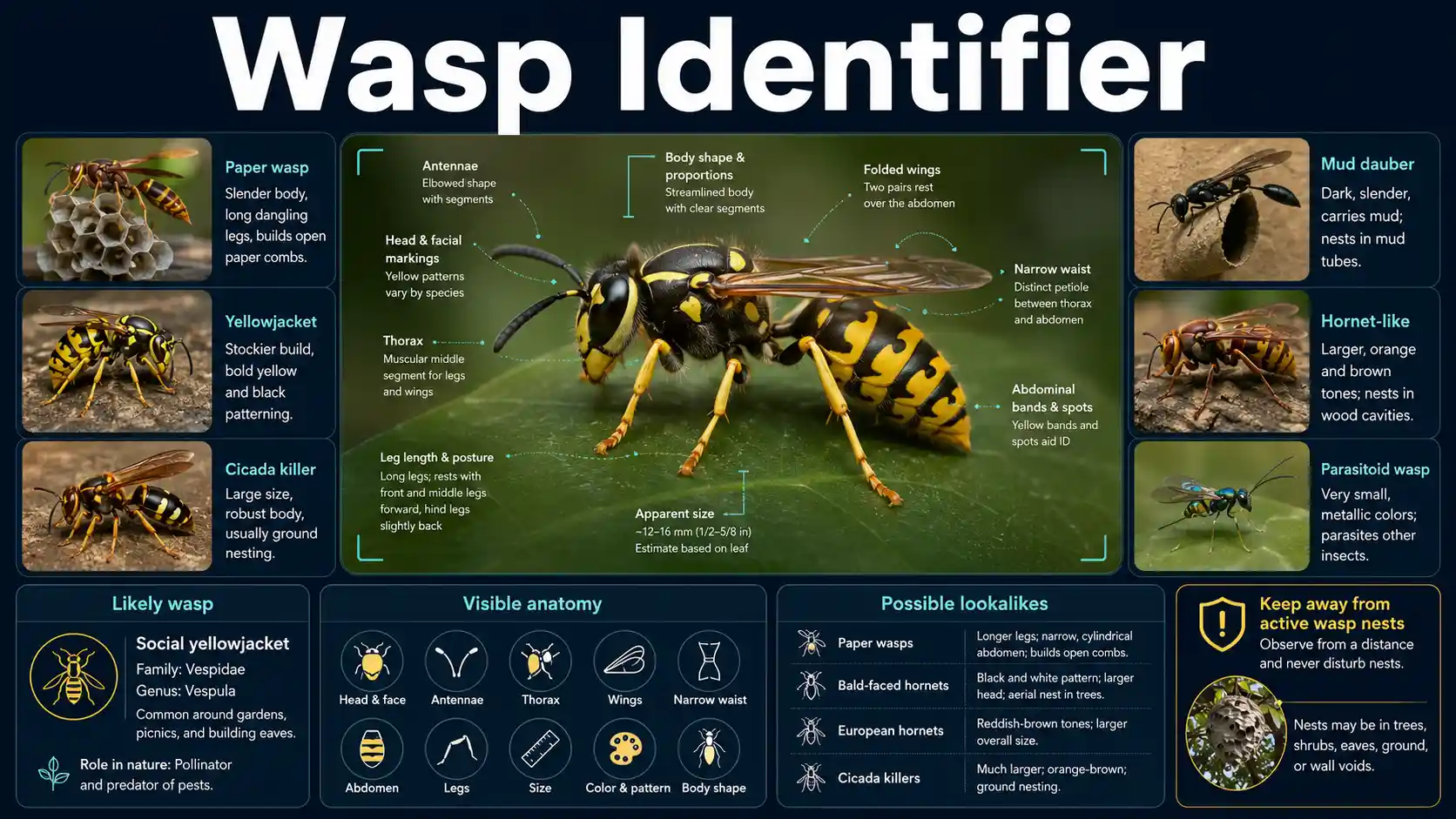
How photo-based wasp identification works
Anatomy, nest context, behavior, season, and geography build the match
A useful wasp result begins by confirming that the insect is a wasp rather than a bee, hoverfly, bee fly, moth, beetle, winged ant, or another mimic. The analysis compares the head, antennae, thorax, waist, abdomen, wings, legs, hair, markings, measured size, behavior, date, habitat, and geographic region.
Social wasps, solitary hunters, mud nesters, potter wasps, parasitoid wasps, and other groups can share black, yellow, red, orange, blue, or metallic colors. Body proportions and ecological evidence therefore matter more than color alone.
Nest architecture can strengthen a match when the builder is also visible. An exposed open comb, enclosed paper envelope, mud tube, pot-like cell, soil entrance, hollow stem, or cavity provides context, but an empty or old nest cannot prove the current insect's identity.
The result keeps identification separate from aggression, sting probability, colony size, nest occupancy, structural damage, invasive status, and removal. Those questions require current local information and, for an active nest near people, a safe site assessment.
- 1Upload, take, or paste one image
Choose a file, use your phone camera, click the paste icon, or press Ctrl+V or Command+V.
- 2Add facts that the photo cannot show
Country, environment, approximate size, location, and observed behavior can narrow the answer.
- 3Review the match and its evidence
Check the likely name, confidence bar, visible clues, alternatives, safety note, and recommended next step.
Social wasps, solitary hunters, nest builders, parasitoids, and mimics
Identify common wasp groups without calling every striped insect a yellowjacket
The tool can compare flower visitors, hunting wasps, scavengers, active entrances, exposed combs, enclosed paper nests, mud cells, soil burrows, and tiny parasitoids. It returns a family or broader group when scale, face, antennae, waist, wings, nest evidence, date, or geographic context is missing.
Solitary hunting wasps such as cicada killers, sand wasps, thread-waisted wasps, spider wasps, and related groups
Mud, clay, or plant-fiber nest builders such as mud daubers, potter wasps, and mason wasps
Tiny parasitoid and gall-associated wasps at a family or broader group when a macro image shows enough anatomy
Wasp nests, entrances, open combs, paper envelopes, mud tubes, pots, burrows, and prey caches as contextual evidence
Bee, hoverfly, bee-fly, moth, beetle, winged-ant, and other wasp-like insects when the upload is not actually a wasp
Photo evidence that separates wasp groups
Show the face, antennae, waist, wings, legs, abdomen, size, behavior, and nest context
A sharp side view often reveals the waist, leg length, body depth, wing posture, and facial proportions. A top view can clarify thorax and abdominal patterns. Add a safe size estimate, date, region, behavior, and distant nest image when relevant.
Photograph the wasp from a safe distance without blocking its route. A sharp side or top view should show the head, antennae, thorax, waist, abdomen, wings, and legs. Add a second photo of the nest or entrance only from a safe position, include a size reference without approaching, and note the date, country or region, exact setting, and behavior.
- Stay outside the wasp's flight path and use phone zoom rather than moving close to an active insect or entrance.
- Take a sharp side view showing the face, antennae, thorax, waist, abdomen, wings, and legs.
- Add a top view when abdominal markings, thorax pattern, wing folding, or body width matters.
- Include a safe scale reference in the same plane, or provide a measured estimate without touching the insect.
- Record the date, country, state or province, habitat, and whether the wasp was on a flower, prey, food, wood, mud, soil, or a wall.
- Photograph a nest or entrance from a safe distance without blocking it, climbing, opening a cavity, or using a ladder.
- Show nest material and architecture, such as open paper cells, an enclosed paper envelope, mud tubes, mud pots, a soil hole, or a hollow stem.
- Use neutral daylight when possible and avoid glare that hides facial markings, wing posture, or abdominal bands.
- Do not capture, pin, crush, spray, chill, or handle the wasp merely to obtain a closer photograph.
What the wasp result explains
A responsible answer identifies the likely wasp group and shows why the evidence fits
The result should state whether the insect is likely a wasp, the narrowest supported taxonomic level, the visible anatomy and behavior, realistic wasp and non-wasp lookalikes, relevant nest context, and the next safe observation needed. It should never convert appearance into an aggression forecast, sting guarantee, colony estimate, or removal instruction.
- Whether the subject is likely a wasp or a bee, fly, ant, moth, beetle, or other mimic
- The most likely common name and scientific group at the narrowest level supported by the image
- A high, moderate, or low confidence label without false numerical precision
- Visible evidence from the head, antennae, waist, wings, legs, abdomen, markings, size, behavior, and nest context
- A cautious distinction between social, solitary, hunting, mud-nesting, potter, parasitoid, or other wasp groups
- Plausible lookalikes and the safest next feature or photograph needed to separate them
- A clear separation between identity, nest occupancy, aggression, sting risk, conservation status, and removal decisions
- A practical next step that avoids disturbing an active insect or nest
Common wasp lookalikes
Body hair, antennae, eyes, waist, wings, legs, behavior, and nest evidence separate similar insects
Striped colors, narrow bodies, flower visiting, hovering, digging, and paper or mud structures occur across many insects. These comparisons show why one color pattern, nest shape, or behavior cannot establish a wasp species by itself.
Paper wasp or yellowjacket
Paper wasps are often more slender with long dangling legs and may use an exposed open comb. Yellowjackets are often more compact with different facial and abdominal patterns and may use enclosed aerial, cavity, or underground nests. European paper wasps can closely mimic yellowjackets.
Wasp or bee
Many wasps have a smoother body and sharper waist, while many bees are hairier and may carry pollen. Some wasps are hairy and some bees are sparsely haired, so combine antennae, wings, legs, pollen structures, behavior, and body shape.
Wasp or hoverfly
Hoverflies usually have very large fly eyes, short antennae, one functional wing pair, and no wasp waist. Wasps have longer segmented antennae and two wing pairs, though motion blur can hide the hindwings.
Cicada killer or hornet
Cicada killers are large solitary ground-nesting wasps with distinctive abdominal markings and often a soil mound. Hornet-like social wasps differ in head, thorax, abdomen, nest, behavior, season, and range. Size alone cannot identify either.
Mud dauber or thread-waisted hunting wasp
Mud daubers often have a very long threadlike waist and use mud cells, while other thread-waisted wasps may dig soil nests or use cavities. Body color, waist form, prey, cell architecture, substrate, and region help narrow the group.
Wasp nest or unrelated structure
Old bird nests, paper debris, fungal growth, mud tubes, spider egg sacs, bee cells, insect galls, foam, and manufactured material may resemble wasp nests. Direct adult traffic and construction behavior provide stronger evidence than shape alone.
Why wasp identification can fail
Color shortcuts, unsafe approach, old nests, missing scale, and aggression assumptions reduce confidence
Wasps move quickly, fold their wings, enter dark cavities, and change appearance with sex, wear, lighting, and seasonal generation. Mimics share the same colors. A responsible result stays broad when the face, antennae, waist, wing posture, abdomen, size, date, behavior, nest evidence, or location is missing.
- Using yellow-and-black color as proof that the insect is a yellowjacket.
- Photographing only a nest while the builder or occupant is never visible.
- Approaching an active entrance closely enough to block the insects' flight path.
- Assuming a large wasp is a hornet or regulated invasive species without scale and regional evidence.
- Confusing a hoverfly, bee fly, bee, winged ant, moth, or beetle with a wasp.
- Treating one wasp near a house as proof of a nest inside the structure.
- Using an abandoned paper or mud nest to identify the current insect seen nearby.
- Relying on a blurry image that hides the antennae, waist, wing posture, face, and abdominal markings.
- Assuming every solitary wasp is aggressive or harmful because it is large or brightly marked.
- Applying pesticide, sealing a cavity, or disturbing soil before confirming the occupant and current activity.
Worked wasp-identification examples
Anatomy, nest material, behavior, season, size, and geography narrow the match
Each case combines a safely taken insect photo with evidence that separates paper wasps, yellowjackets, hornets, large solitary diggers, mud daubers, and tiny parasitoid wasps.
Slender wasp beneath an eave beside an open comb
Long dangling legs, a narrow waist, body pattern, orange or dark antennae, wing posture, open uncovered paper cells, date, and region can support a paper-wasp group without predicting aggression or colony size.
Compact yellow-and-black wasp near food or a ground entrance
A smooth compact body, short-looking legs, facial markings, narrow folded wings, scavenging behavior, entrance location, season, and geography may support a yellowjacket group. Food-table behavior alone does not identify the species.
Large black-and-yellow wasp digging in sunny soil
Measured size, abdominal bands or spots, wing color, facial pattern, soil mound, prey, season, and region can separate cicada killers and other solitary diggers from social yellowjackets or hornets.
Dark slender wasp beside a mud tube on a wall
Threadlike waist, leg length, wing tint, body color, mud-cell architecture, prey remains, date, and region can narrow mud daubers and related solitary wasps. An empty mud cell does not prove current occupancy.
Tiny metallic wasp on a leaf or insect egg mass
Macro detail of the antennae, waist, wing venation, body sculpture, measured size, host egg mass, plant, and region may support a parasitoid group, but many species require microscopy or expert keys.
Observe wasps and nests without provoking defensive behavior
A photo cannot predict aggression, sting severity, or whether a nest should be removed
Keep away from active wasp traffic and do not touch, block, open, spray, burn, flood, strike, or seal an unknown nest. A photo cannot predict aggression or allergy risk. Trouble breathing, throat tightness, faintness, widespread hives, facial swelling, or many stings requires immediate emergency medical care.
Stay out of active flight paths and do not touch, block, open, spray, burn, flood, strike, dig, vacuum, trap, or seal an unknown nest. Do not climb, use a ladder, enter an attic, or remove siding for a better photograph. After a sting, trouble breathing, throat tightness, faintness, widespread hives, facial swelling, or many stings requires immediate emergency medical care.
Choose the next identification step
Use the bee, broader insect, or complete-scene workflow when it provides stronger evidence
Questions about identifying wasps from pictures
Direct answers before you upload a wasp photo
Can I identify a wasp from a photo?
Yes. A sharp photo can often support a wasp family or common group, and sometimes a species, when the face, antennae, waist, wings, abdomen, size, behavior, date, and location are visible.
What kind of wasp is this?
Upload a clear side or top view and include the region, date, measured size, setting, behavior, and any nest material. The result will compare the strongest visible candidates and explain the uncertainty.
How can I tell a wasp from a bee?
Many wasps look smoother and more sharply waisted, while many bees are hairier and may carry pollen. Those are tendencies, not universal rules, so antennae, wings, legs, body hair, waist, behavior, and context should be combined.
How can I distinguish a paper wasp from a yellowjacket?
Paper wasps are often more slender with long legs that dangle in flight and may use an exposed open comb. Yellowjackets are often more compact and may use enclosed aerial or underground nests. Region and multiple body traits still matter.
Can the tool identify a hornet?
It can compare hornet-like candidates using size, head, thorax, abdomen, markings, wing color, nest type, region, and season. It should not label a high-consequence hornet species from a weak or distant image.
Can a photo identify a wasp nest?
A photo can classify an open paper comb, enclosed paper envelope, mud tube, pot-like mud cell, soil entrance, hollow stem, or cavity. The nest alone may not reveal the exact builder or whether it is occupied.
Does one wasp near my house prove there is a nest inside?
No. One wasp may be hunting, feeding, resting, drinking, or exploring. Repeated direct traffic into the same opening is stronger evidence, but the entrance should not be blocked or approached closely.
Can the tool tell whether a wasp is aggressive?
No. A still photo cannot predict individual behavior or nest defensiveness. Distance from the nest, disturbance, season, species, and immediate circumstances can change risk.
Can a picture show whether a wasp can sting?
Not reliably. Many female wasps can sting, males cannot, and sex may be impossible to establish from an ordinary image. Do not handle an unknown wasp based on a visual result.
Can it identify a northern giant hornet or another regulated hornet?
It can flag a plausible high-consequence lookalike only when size, anatomy, markings, and location strongly fit. Do not capture it. Photograph from a distance and report the image to the appropriate local authority for confirmation.
Are large ground-nesting wasps always dangerous?
No. Cicada killers, sand wasps, and other solitary diggers can be large and conspicuous. Their identity and nest context matter, and size alone does not establish aggression or sting risk.
Are all wasps pests?
No. Many wasps pollinate flowers, hunt plant-feeding insects, or parasitize crop pests. A wasp near a garden may be beneficial even when its appearance is unfamiliar.
Can the tool decide whether a nest should be removed?
No. That decision depends on confirmed identity, active use, entrance location, human traffic, vulnerable occupants, allergy history, local law, season, and professional site assessment.
Should I seal a wall opening used by wasps?
Do not seal an opening while insects are actively entering and leaving. Sealing can trap them inside or redirect them into occupied rooms. Seek qualified local advice for an active structural nest.
Can it diagnose a reaction after a wasp sting?
No. Trouble breathing, throat tightness, faintness, widespread hives, facial swelling, or many stings requires immediate emergency medical care rather than photo identification.
What is the best photo for identifying a wasp?
Use a sharp side view showing the head, antennae, waist, abdomen, wings, and legs, plus a top view, safe size estimate, date, location, behavior, and distant nest-context image when relevant.
Can I use the Wasp Identifier without installing an app?
Yes. The tool runs in a modern browser and accepts a device image, a newly taken photo, drag-and-drop, or a pasted image.
Authoritative wasp-identification, biology, nest, and sting-safety references
Verify difficult wasp groups, nest architecture, beneficial species, regional lookalikes, and emergency warning signs
These university-extension, USDA, and poison-control resources explain social and solitary wasps, body and wing clues, nest forms, beneficial parasitoids, and why severe systemic symptoms after a sting require immediate emergency care.
- University of Minnesota Extension — Wasps and bees
Explains identification, wing posture, body hair, markings, nest architecture, seasonal life cycles, and behavioral differences among yellowjackets, paper wasps, hornets, honey bees, and bumble bees.
- USDA Agricultural Research Service — Wasp identification information
Describes image-based identification keys that use wing shape, body segmentation, biological information, and geographic evidence to distinguish diverse wasp groups, including tiny beneficial parasitoids.
- Poison Control — Bee, wasp, hornet, and yellowjacket stings
Explains expected local sting reactions and emergency warning signs such as breathing difficulty, throat tightness, faintness, or hives away from the sting site.