Honey bees, bumble bees, carpenter bees, mason bees, leafcutter bees, mining bees, sweat bees, plasterer bees, longhorn bees, squash bees, cuckoo bees, and other visible bee groups
Identify honey bees, bumble bees, solitary bees, and bee lookalikes
Bee Identifier with Body, Pollen, and Nesting Clues
Upload a clear bee picture to compare body shape, hair distribution, facial markings, antennae, wings, leg structure, pollen-carrying hairs, apparent size, flower use, nesting behavior, season, and location. This Bee Identifier can suggest a likely bee family, genus, or species group, explain the visible evidence, and keep the result broader when close native bees, males, worn individuals, or wasp and fly mimics cannot be separated responsibly from one photo.
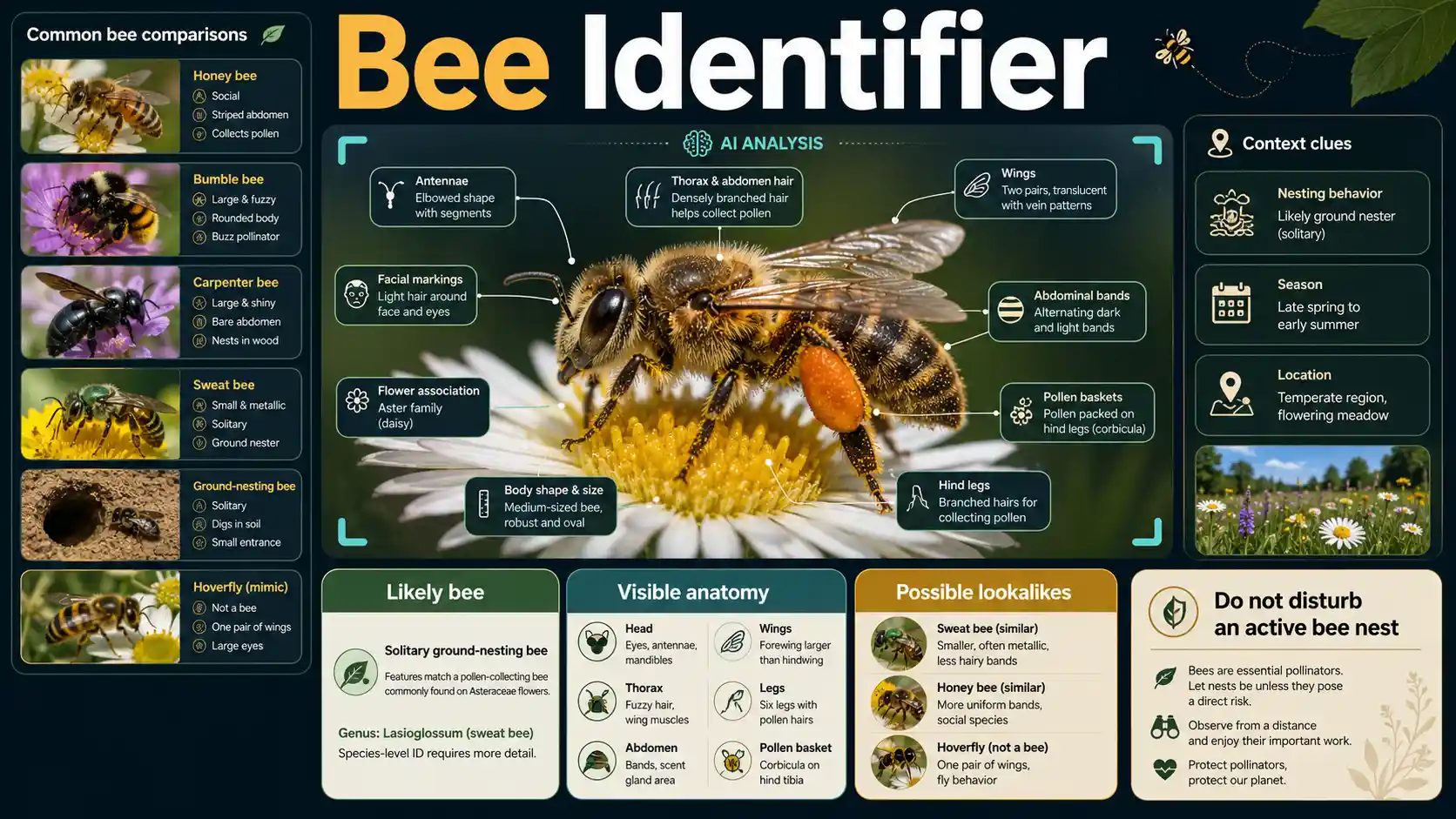
How photo-based bee comparison works
Compare anatomy, pollen structures, behavior, nesting context, season, and range
A bee photo becomes more useful when the full insect is visible from more than one angle. The analysis first checks whether the subject is actually a bee, then compares body build, hair, face, antennae, wings, abdominal markings, legs, pollen-carrying structures, size, behavior, flowers, nesting substrate, date, and geographic range.
Bee identification often depends on combinations of characters rather than one bright color. Hair placement, hind-leg form, facial markings, abdominal bands, metallic sheen, antenna length, body proportions, pollen location, and nest material can separate honey bees, bumble bees, carpenter bees, mason bees, leafcutter bees, mining bees, sweat bees, cuckoo bees, and mimicking flies or wasps.
The result should stay at family, genus, or species-group level when the image hides microscopic or sex-specific characters. It must also keep identity separate from aggression, sting risk, colony behavior, structural damage, conservation status, and whether a nest should be removed.
- 1Upload, take, or paste one image
Choose a file, use your phone camera, click the paste icon, or press Ctrl+V or Command+V.
- 2Add facts that the photo cannot show
Country, environment, approximate size, location, and observed behavior can narrow the answer.
- 3Review the match and its evidence
Check the likely name, confidence bar, visible clues, alternatives, safety note, and recommended next step.
Native bees, managed bees, solitary nesters, and mimics
Identify common bee groups without calling every yellow-and-black insect a honey bee
The tool can compare social and solitary bees, flower visitors, nest entrances, pollen loads, and bee-like insects. It returns a broader group when males, worn individuals, pollen coverage, hidden anatomy, or regional lookalikes prevent a responsible exact answer.
Large fuzzy, small dark, metallic green, banded, long-antennal, masked-face, pollen-carrying, and sparsely haired bee forms
Garden, orchard, meadow, woodland, wetland, desert, urban, greenhouse, farm, and coastal bees photographed with flower and regional context
Ground holes, hollow stems, wood cavities, mud partitions, leaf-lined cells, resin, fiber, and wall or structure entrances when the actual bee and nesting behavior are visible
Male, female, worker, queen, or uncertain bee forms only when visible traits support a cautious life-stage or caste description
Bee lookalikes such as yellowjackets, paper wasps, hornets, hoverflies, bee flies, robber flies, clearwing moths, beetles, and other flower-visiting insects
Photo evidence that separates bee groups
Show the face, antennae, body hair, wings, legs, pollen, size, flower, and nesting behavior
A sharp top view reveals the body outline and abdominal pattern, while a side view can show facial proportions, hair, hind legs, pollen structures, wing posture, and the shape of the abdomen. Date, location, flower use, and nesting substrate often remove regional lookalikes.
Photograph the bee from a safe distance while it rests or visits a flower. Show the full top and side profile, face, antennae, wings, hind legs or underside, measured size, flower or nesting surface, observation date, and country or region. Do not handle the bee, block a nest entrance, or move flowers merely to expose hidden anatomy.
- Keep a safe distance and photograph the bee without touching, trapping, pinning, chilling, or handling it.
- Take one sharp top view that shows the head, thorax, abdomen, wings, color bands, and overall body outline.
- Add a side or three-quarter view showing the face, antennae, body hair, hind legs, underside, and any pollen load.
- Include a safe size reference or estimate the body length without placing an object against the bee.
- Photograph the flower, leaf, ground hole, hollow stem, wood surface, wall opening, or other substrate where the bee was naturally observed.
- Record the country or region, date, habitat, weather, time of day, and whether the bee was feeding, hovering, carrying pollen, digging, entering a cavity, or resting.
- Use even daylight and avoid flash glare that can hide wing tint, metallic color, fine hair, or facial markings.
- Photograph several individuals separately when a nest or flower patch contains visibly different bees, because males, females, parasites, and mimics may occur together.
- Do not block, open, probe, excavate, seal, spray, or move a nest entrance merely to obtain a better photograph.
What the bee result explains
A responsible answer shows the likely bee group and why the visible evidence fits
The result should state whether the specimen is a bee, the narrowest supported taxonomic level, the visible anatomy and behavior, realistic bee and non-bee lookalikes, and the next safe photo or observation needed. It should never use appearance to invent aggression, ancestry, sting danger, nest population, or removal advice.
- The most likely bee common name and scientific name when visible evidence and range support them
- A family, genus, species group, or broader bee classification when species-level characters are missing
- A high, moderate, or low confidence label without a false numerical accuracy score
- Visible evidence from body build, hair, face, antennae, wings, abdomen, legs, pollen structures, size, flower, nest, season, and geography
- A cautious male, female, worker, queen, or unknown description only when the image supports it
- Realistic wasp, fly, moth, beetle, and closely related bee lookalikes with the next safe feature needed to separate them
- A clear distinction between likely identity, pollination behavior, nesting activity, sting uncertainty, and whether professional help is actually needed
- Safer observation guidance, uncertainty limits, and practical next steps for local extension, beekeeper, entomologist, pest professional, poison-control, or emergency confirmation
Common bee lookalikes
Antennae, eyes, wings, body hair, waist, legs, pollen, and behavior separate similar insects
Yellow-and-black bands, flower visiting, hovering, fuzziness, and large size occur in many insects. These comparisons show why color or one behavior cannot identify a bee by itself.
Honey bee or hoverfly
Honey bees have long segmented antennae, two wing pairs, a hairy bee body, and female workers may carry pollen on widened hind legs. Hoverflies usually show very large fly eyes, short antennae, one functional wing pair, and no bee pollen structures.
Bumble bee or carpenter bee
Bumble bees commonly have a densely hairy abdomen. Many large carpenter bees have a shinier, more sparsely haired abdomen and may visit wood cavities. Sex, wear, species, light, and region can blur that difference, so show the abdomen and face.
Bee or yellowjacket
Many bees are hairier and may carry pollen, while yellowjackets often have a smoother body, sharper waist, bold markings, and different scavenging or nest behavior. Some bees are sparsely haired and some wasps are fuzzy, so combine several traits.
Leafcutter bee or mason bee
Both are solitary megachilid bees and females often carry pollen under the abdomen. Leafcutters may use cut leaf pieces, while mason bees commonly use mud partitions. Nesting material helps, but many species require expert characters.
Metallic sweat bee or metallic wasp
Small sweat bees may be bright green or blue with bee-like hair and pollen structures. Metallic wasps can be similarly colored but differ in body shape, waist, surface sculpture, legs, behavior, and nesting association.
Ground-nesting bee or ground-nesting wasp
Both may use soil holes. Show the adult's hair, antennae, waist, legs, pollen load, prey or nesting material, entrance form, date and behavior. The hole alone cannot identify the occupant.
Why bee identification can fail
Motion blur, hidden legs, pollen coverage, missing scale, and safety assumptions reduce confidence
Bees move quickly, disappear inside flowers, change appearance with sex and wear, and may become coated with pollen. Similar insects copy bee colors and behavior. A responsible result stays broad when the face, antennae, wings, abdomen, hind legs, size, date, flower, nest behavior, or location is missing.
- The bee is photographed only as a small moving blur, so body hair, antennae, wings, legs, and abdominal markings cannot be compared.
- Only yellow-and-black color is used, even though bees, wasps, flies, moths, and beetles can share similar warning patterns.
- A large dark bee is called a bumble bee without showing the abdomen texture, face, hind legs, and nesting context needed to compare carpenter bees.
- A hoverfly is assumed to be a bee because it visits flowers and has yellow abdominal bands.
- The photo hides the hind legs or underside, preventing assessment of pollen baskets, scopal hairs, or pollen placement.
- No measured size, date, country, habitat, flower, or nest substrate is supplied for a bee group with many regional lookalikes.
- Several insects at a nest entrance are treated as one species even though parasites, males, flies, wasps, and different bees may occur together.
- An insect entering a wall, deck, or wood surface is assumed to be causing structural damage without direct evidence.
- A still image is used to declare a nest abandoned, harmless, aggressive, Africanized, or safe to approach.
- A sting or skin reaction is uploaded instead of a clear photograph of the insect, and the image is expected to provide a medical diagnosis.
Worked bee-identification examples
Body form, pollen placement, flower use, nest behavior, season, and geography narrow the match
Each case combines a complete bee photo with the evidence that separates honey bees, bumble bees, carpenter bees, metallic sweat bees, ground nesters, and hoverfly mimics.
Orange-brown bee with pollen baskets on a flower
Compare the compact build, hairy thorax, banded abdomen, wing position, hind-leg pollen load, body length, flower, date, and region. Those features may support a honey bee, but the tool should still compare similar native bees and flies when the face or wing details are unclear.
Large black-and-yellow fuzzy bee on a garden bloom
Show the abdomen hair, thorax pattern, face, hind legs, wings, body length, flower and region. A densely hairy abdomen can support a bumble bee, while a shiny or sparsely haired abdomen may suggest a carpenter bee, but worn individuals and regional species require caution.
Small metallic green bee collecting pollen
Use the metallic color distribution, body proportions, facial markings, abdominal bands, pollen placement, measured size, flower type, season and location to compare sweat bees and other small metallic bees.
Bee entering a round hole in soil or a garden bank
Photograph the bee, entrance diameter, soil texture, surrounding holes, carried pollen, date and repeated behavior from a distance. A ground entrance can support a mining, sweat, plasterer or other solitary bee group, but the hole alone cannot identify the maker.
Yellow-and-black flower visitor hovering in place
Compare antenna length, eye size, visible wing count, body hair, waist, hovering behavior, face and leg structure. Large fly eyes, short antennae and one visible wing pair may support a hoverfly rather than a bee.
Observe bees and nests without disturbing them
A photo cannot predict sting behavior or diagnose an allergic emergency
Do not handle an unknown bee or approach, block, open, spray, burn, seal, or disturb an active nest. A photo cannot predict sting behavior or diagnose an allergic reaction. Trouble breathing, throat tightness, faintness, widespread hives, or swelling away from the sting site requires immediate emergency medical care.
Photograph a bee where it naturally rests and keep clear of active entrances. Do not touch the insect, block or probe a hole, open a wall or hive, spray chemicals, burn material, flood soil, or seal an active nest based on an image result. After a sting, trouble breathing, throat tightness, faintness, widespread hives, or swelling away from the sting site requires immediate emergency medical care.
Choose the next identification step
Use the broader insect, flower, or complete-scene workflow when it provides stronger evidence
Questions about identifying bees from pictures
Direct answers before you upload a bee photo
Can a bee be identified from a photo?
Often to a useful family, genus, species group, or common species. Exact identification may require the face, wings, legs, pollen structures, measured size, sex, date, flower or nest association, and geographic range.
What kind of bee is this?
Upload sharp top and side views, include the face and hind legs, estimate body length, and add the flower or nesting surface, date, habitat, and location. The tool will compare the most likely bee with realistic lookalikes.
Can it distinguish a honey bee from a hoverfly?
Often. Honey bees have long segmented antennae, two wing pairs, a hairy bee body, and female workers may show pollen baskets. Hoverflies usually have very large eyes, short antennae, one wing pair, and no bee pollen structures.
How do I tell a bumble bee from a carpenter bee?
Show the abdomen and face. Bumble bees usually have a densely hairy abdomen, while many large carpenter bees have a shinier, more sparsely haired abdomen. Species, sex, wear, and region can blur that difference.
Can the tool identify a small black bee?
It may narrow small dark bees to mining, sweat, mason, plasterer, masked, small carpenter, or other groups. A macro image, measured size, face, pollen placement, nesting behavior, date and region are important.
Can it identify a metallic green bee?
Often to a likely sweat-bee or related group. Show where the metallic color occurs, the face, abdominal bands, body hair, pollen placement, size, flower, season and geographic location.
Can a ground-nesting bee be identified from the hole?
Not reliably from the hole alone. Photograph the adult entering or leaving, the entrance diameter, soil, surrounding nest pattern, carried pollen, date and region without blocking or excavating the nest.
Does a bee carrying pollen prove it is a honey bee?
No. Many female native bees carry pollen on hind-leg or abdominal hairs. The location and form of the pollen load can help identify the bee group, but pollen alone does not prove honey bee.
Can the tool identify a male or queen bee?
Sometimes cautiously. Males, workers and queens can differ in size, antennae, face color, leg structures and hair, but a single photograph often cannot establish sex or caste with confidence.
Can a photo show whether a bee will sting?
No. Species, sex, nest context, disturbance and individual behavior matter, and appearance cannot predict whether a bee will sting. Avoid handling unknown bees or disturbing nests.
Can it identify an Africanized honey bee?
No. Africanized and other honey bees cannot be reliably separated by ordinary photographs. Do not infer ancestry, defensiveness or danger from color, size or one image.
Can it tell whether a bee nest is abandoned?
Not from one still image. Activity can vary with weather, season and time of day. Observe only from a safe distance and use a qualified local professional when a nest affects safety or a structure.
Does a bee entering wood mean structural damage?
Not automatically. The insect, wood condition, hole type, repeated activity and extent must be examined. A photo cannot measure structural damage or prove that the bee made every hole.
Should I spray or seal a bee nest entrance?
Do not spray, seal, burn, flood, block or open an active entrance based on an image result. Confirm the insect and seek local professional guidance, especially around buildings, public areas, children or known allergies.
Can the tool diagnose a bee-sting allergy?
No. Trouble breathing, throat tightness, faintness, widespread hives or swelling away from the sting site can signal a medical emergency and require immediate emergency care.
Can the tool confirm that a bee is rare or protected?
No. Conservation and legal status depend on a confirmed identification, location and current local rules. Verify important records with a regional expert or official authority.
Can I use the Bee Identifier without installing an app?
Yes. Use it in a modern browser to choose an image from your device, take a new photo, drag and drop a file, or paste a copied image.
Authoritative bee-anatomy, identification, and sting-safety references
Verify difficult bee groups, pollen structures, regional lookalikes, and emergency warning signs
These USDA, Smithsonian, and poison-control resources explain bee identification characters, pollen-carrying hairs, native lookalikes, and why severe allergic symptoms after a sting require immediate emergency care.
- USDA Agricultural Research Service — Exotic Bee ID
Explains bee identification using color, hair placement, leg shape, anatomy, distribution, and interactive comparison with native lookalikes.
- Smithsonian National Museum of Natural History — Precious Pollinators
Describes pollen-trapping hairs and specialized pollen-carrying structures on bees and their role in pollination.
- Poison Control — Bee Stings and Allergic Reactions
Explains common local sting symptoms and emergency warning signs such as breathing trouble, faintness, widespread hives, or swelling away from the sting site.