Common garden annuals, perennials, bulbs, bedding plants, climbers, and ornamental flowering shrubs
Identify garden flowers, wildflowers, bouquet blooms, and tree blossoms from visible botanical clues
Flower Identifier with Bloom and Plant Clues
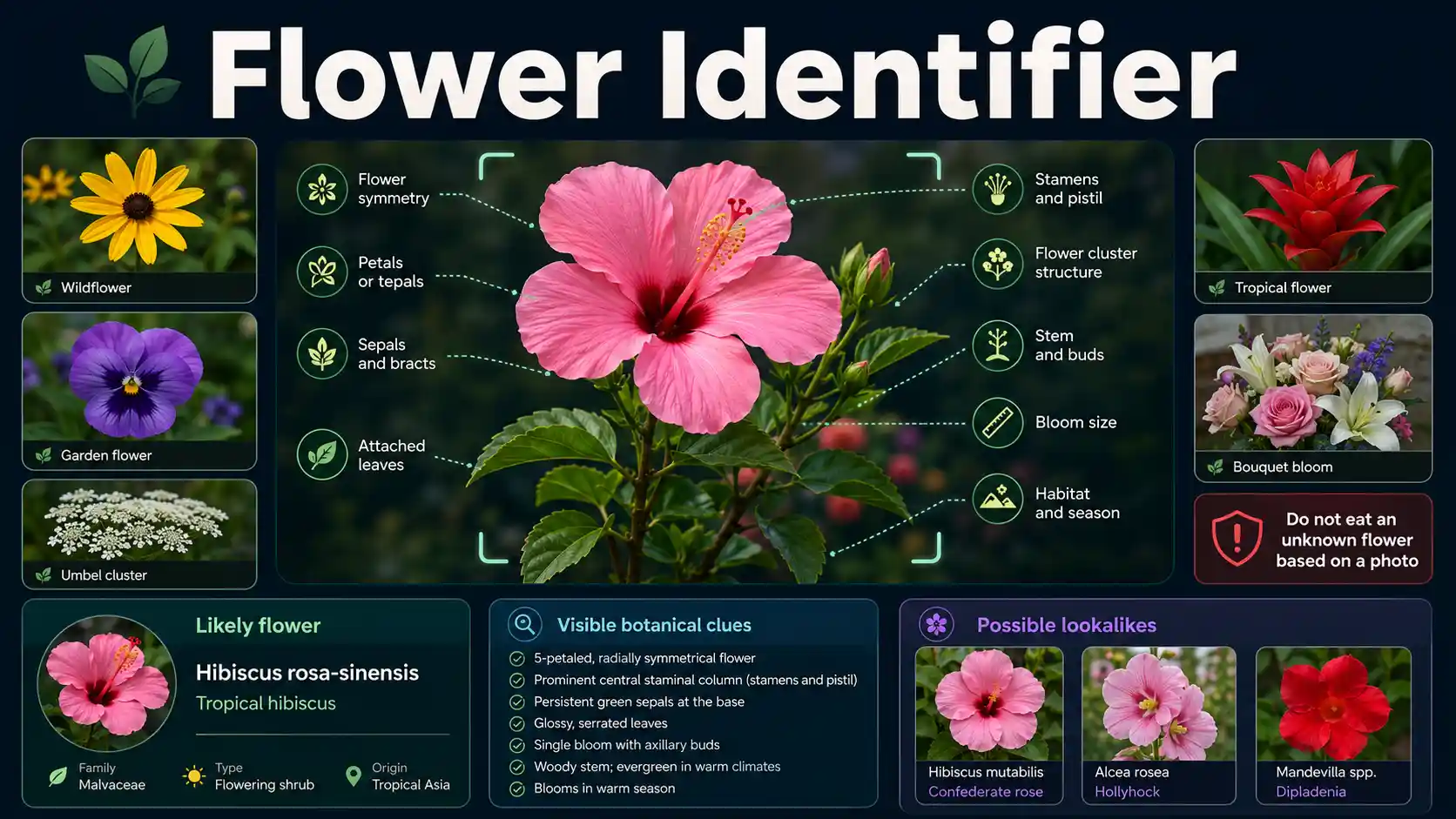
Upload or paste a clear flower picture to investigate the likely plant behind the bloom. This Flower Identifier compares flower symmetry, petal or tepal number, sepals, bracts, stamens, pistils, flower clusters, leaves, stems, buds, fruit, bloom season, habitat, and geographic location. It can help answer what flower is this, but it stays at a broader family or genus when a detached bloom or decorative cultivar hides the features needed for a responsible species match.
How flower identification works
A bloom becomes more identifiable when the rest of the plant remains visible
The analysis begins by deciding whether the image shows one flower, a cluster of many flowers, colorful bracts surrounding smaller flowers, or a flower-like cone, seed structure, or manufactured decoration. It then compares symmetry, petal or tepal arrangement, sepals, bracts, stamens, pistils, flower size, and cluster architecture.
Leaves, stems, buds, fruit, growth form, bloom season, habitat, cultivation, and geography often separate flowers that look almost identical from the front. A detached bouquet bloom may support a florist group, while a rooted wildflower with leaves and fruit may support a more precise botanical match.
- 1Upload, take, or paste one image
Choose a file, use your phone camera, click the paste icon, or press Ctrl+V or Command+V.
- 2Add facts that the photo cannot show
Country, environment, approximate size, location, and observed behavior can narrow the answer.
- 3Review the match and its evidence
Check the likely name, confidence bar, visible clues, alternatives, safety note, and recommended next step.
Flower and blossom coverage
Identify garden flowers, wildflowers, bouquet blooms, houseplants, and tree blossoms
The identifier covers many flowering plants and can also explain when the colorful structure is a composite head, inflorescence, bract, spathe, tepal, or other specialized plant part rather than a simple single flower.
Wildflowers and naturalized flowering plants when leaves, stems, habitat, season, and geographic context are visible
Tree and shrub blossoms through a combination of flower clusters, leaves, buds, bark, branching, fruit, and whole-plant form
Houseplant and tropical flowers such as aroids, orchids, bromeliads, hibiscus-like blooms, gingers, and other cultivated flowering plants
Cut flowers and bouquet blooms at a broader genus, hybrid, or florist-group level when the stem, leaves, and whole plant are unavailable
Composite flower heads, umbels, spikes, racemes, panicles, cymes, solitary blooms, and other inflorescence arrangements
Flower-like structures such as colorful bracts, spathes, cones, seed heads, and artificial flowers when they are not conventional single blooms
A broader family or genus when double flowers, hybrids, cultivars, damage, or missing structures prevent a responsible species-level answer
Botanical flower features that matter
Show the flower structure and the plant that produced it
Flower color is memorable but weak by itself. The strongest visual evidence combines floral structure with leaves, stem, growth form, fruit, bloom season, habitat, scale, and geography.
Start with one sharp close view of a fresh flower, then add the complete flowering stem or whole plant when possible. Show the flower from the front and side, include the back of the bloom, leaves, stem attachment, buds, flower cluster, fruit or seed head, and a ruler or familiar object for scale. State whether it was growing wild, in a garden, indoors, on a tree or shrub, or inside a bouquet, and include the country, region, season, habitat, and approximate plant height.
- Photograph one fresh, fully open flower from directly in front without removing it from the plant.
- Add a side view and a view of the back so the flower tube, sepals, bracts, ovary area, and attachment are visible.
- Show the entire flower cluster and then one individual flower when many small blooms form one head, spike, umbel, or panicle.
- Include mature attached leaves, their arrangement along the stem, leaf underside, margin, veins, and petiole or sheath.
- Photograph the stem, buds, fruit or seed head, thorns, hairs, tendrils, bark, or sap only from a safe distance without damaging the plant.
- Include the whole plant or flowering branch to show growth form, branching, height, and whether the bloom is on a tree, shrub, vine, herb, or rosette.
- Place a ruler or familiar object nearby for scale without bending, picking, or handling an unknown wildflower.
- Use natural, even light and avoid filters because camera processing can change flower color and hide surface texture.
- Add the country, region, date, habitat, cultivation status, and whether the flower came from a garden, florist, bouquet, roadside, meadow, forest, wetland, or houseplant.
What the flower result contains
A responsible flower match explains structure, context, and uncertainty
The result should identify the flower only as precisely as the visible evidence allows, explain which botanical structures support the match, compare realistic alternatives, and say which additional view would improve confidence.
- The most likely common name and scientific name when flower and supporting plant structures justify them
- A family, genus, hybrid group, cultivar group, or florist category when species-level evidence is incomplete
- A high, moderate, or low confidence label without a fabricated numerical accuracy score
- Visible evidence from symmetry, petal or tepal arrangement, reproductive structures, inflorescence, leaves, stem, fruit, season, and habitat
- An explanation of whether the photograph shows one flower, a composite head, a cluster of flowers, colorful bracts, or another flower-like structure
- Plausible lookalikes and the next leaf, flower-back, whole-plant, fruit, or location detail that could separate them
- Relevant attributes such as growth form, bloom season, cultivated or wild context, geographic fit, and likely ornamental group
- A practical next step, safer handling guidance, and better-photo suggestions without making edibility, toxicity, or legal claims
Common flower lookalikes
Similar colors and petal shapes can hide different plant structures
These comparisons show why leaves, stems, flower backs, fruit, cluster architecture, habitat, and geography must be evaluated with the bloom itself.
Daisy, aster, sunflower, or another composite head
What looks like one flower may contain many disk and ray florets. Head size, involucre bracts, leaf arrangement, stem, fruit, plant height, season, and region help separate composite-flowered genera.
True lily or daylily
Both may have six showy tepals, but leaf arrangement, stem structure, flower attachment, anthers, bulb or crown context, fruit, and the number of flowers per stalk differ. A flower photo cannot establish edibility or pet safety.
Rose or camellia
Double cultivars can hide reproductive parts. Leaf arrangement, compound versus simple leaves, stipules, stem prickles, glossy texture, sepals, fruit, woody habit, and bloom season separate them.
Hibiscus, hollyhock, or another mallow
A staminal column suggests the mallow family, but leaf form, epicalyx bracts, woody or herbaceous growth, flower position, fruit, plant height, and geography help narrow the genus.
Daffodil, jonquil, or another Narcissus cultivar
Trumpet and cup proportions, flower number per stem, tepal shape, leaf width, fragrance, flowering time, and cultivar history may narrow the group, but many garden hybrids cannot be confirmed from appearance alone.
Queen Anne's lace, poison hemlock, or another white umbel
White umbrella-shaped clusters require extreme caution. Stem spots or hairs, bracts, leaf division, plant height, fruit, habitat, and region matter; never taste, brew, or handle an unknown plant to test the identity.
Why flower identification can fail
One colorful face rarely contains the whole botanical answer
Detached flowers, double cultivars, florist breeding, fading, camera filters, missing leaves, hidden reproductive parts, and absent location can make many unrelated plants appear nearly identical.
- Only the colorful front of one bloom is shown, while the back, sepals, bracts, tube, and attachment remain hidden.
- The flower is detached from the leaves and stem, removing the strongest clues for separating similar species.
- A composite flower head is treated as one large flower instead of many small florets.
- The photo is taken too far away, so petal arrangement, stamens, stigma, hairs, and surface details disappear.
- Strong filters, artificial light, or faded petals are used as proof of the flower's natural color.
- A double cultivar is compared directly with a simple wild flower even though extra petals hide reproductive structures.
- A bouquet flower is assumed to be a wild species even though florist hybrids, dye, refrigeration, and trimming altered its appearance.
- No bloom size, plant height, country, season, habitat, or cultivation context is supplied.
- Several different flowers appear in one arrangement and the intended subject is not identified.
- The request asks whether the flower is edible, poisonous, medicinal, pet-safe, invasive, protected, or legal to pick from appearance alone.
Worked flower-identification examples
Flower structure plus whole-plant context narrows the match
Each example combines a bloom close-up with leaves, stems, cluster type, plant habit, season, habitat, scale, and geography so the tool can compare realistic botanical alternatives.
Yellow daisy-like wildflower beside a road
A front view can show the central disk and surrounding rays, but a side view of the flower head, involucral bracts, leaves, stem hairs, plant height, season, and region are needed to compare asters, sunflowers, coreopsis, ragworts, and other composite-flowered plants.
Purple five-lobed flower in a garden bed
Flower symmetry, whether the lobes form a fused tube, stamen placement, calyx shape, leaf arrangement, stem texture, plant habit, and nursery context can separate phlox-like, petunia-like, verbena-like, campanula-like, and other cultivated flowers.
White umbrella-shaped wildflower
The umbel structure, bracts beneath the cluster, stem spots or hairs, leaf division, plant height, smell only when already safely known, fruit shape, habitat, and region matter because harmless and hazardous carrot-family plants can resemble one another.
Large red tropical flower near a patio
The central staminal column, petal overlap, calyx and bracts, leaf shape, woody or herbaceous stem, flower orientation, plant height, and tropical cultivation context can distinguish hibiscus-like flowers from hollyhocks, mallows, canna-like blooms, and other ornamentals.
Unlabeled bloom from a florist bouquet
Photograph the flower front, side, stem, remaining leaves, buds, sepals, flower size, and the complete bouquet. The result may identify a rose, ranunculus, peony, lisianthus, carnation, chrysanthemum, lily, orchid, or florist hybrid group without claiming an exact cultivar.
Use the flower result responsibly
A beautiful flower is not automatically edible, harmless, or legal to collect
Do not eat, taste, brew, feed, or use an unknown flower as medicine based on a photo result. Some attractive flowers and other plant parts can irritate skin or harm people and animals. Confirm any safety, exposure, foraging, protected-species, or invasive-species decision with an appropriate qualified source.
Some ornamentals and wild plants contain irritants or toxins, and some protected flowers should not be picked. Keep unknown plants away from children and animals, avoid tasting or brewing them, wash after accidental contact when appropriate, and seek poison, veterinary, medical, conservation, or extension guidance when the decision carries risk.
Choose the right plant or object workflow
Use the surrounding plant, damage pattern, or material to choose the next analysis
Questions about identifying flowers by photo
Direct answers before you upload a flower
Can I identify a flower from a picture online?
Yes. Upload a clear flower photo with the attached leaves, stem, whole plant, scale, season, habitat, and location for the strongest visual comparison.
Can I use the Flower Identifier without installing an app?
Yes. The identifier runs in a modern browser and accepts a selected file, phone-camera image, drag-and-drop upload, or pasted image.
What flower is this if I only have one bloom?
One bloom may support a family or genus, but an exact species often needs leaves, stem, flower back, cluster arrangement, fruit, whole-plant form, season, and location.
What photos produce the best flower identification?
Take the bloom from the front, side, and back, then show the complete cluster, attached mature leaves, stem, buds, fruit or seed head, and whole plant.
Can the tool identify a wildflower from a photo?
It can suggest a wildflower match when the plant remains rooted and the image includes habitat, leaves, stem, growth form, bloom season, scale, and geographic region.
Can it identify a garden flower or named cultivar?
It can often identify the species, hybrid group, or ornamental type, but many named cultivars require a plant label, provenance, or specialist comparison beyond appearance.
Can it identify flowers from a bouquet?
Often at a genus or florist-group level. Cut stems, missing leaves, double flowers, dye, refrigeration, and breeding can remove the features required for an exact match.
Can it identify a flower by color alone?
No. Yellow, purple, white, pink, red, and blue occur across many unrelated plants. Structure, leaves, stem, fruit, season, habitat, and location are more reliable.
Can the tool identify a tree from its blossom?
It can narrow possibilities, but a flowering branch, leaves, buds, bark, branching, fruit, tree size, season, and location are much stronger than one fallen blossom.
Can it identify a tropical or houseplant flower?
Yes, when the whole plant, leaves, flower structure, growth habit, pot context, and cultivation conditions are visible. Cultivars may remain broader than species level.
Are colorful bracts the same as flower petals?
Not always. Bougainvillea, poinsettia, many aroids, and other plants use colorful bracts or spathes around smaller true flowers, so the result should explain the visible structure.
Can a flower photo confirm that the plant is edible?
No. Do not eat, taste, brew, garnish with, or feed an unknown flower based on an AI result. Edibility requires authoritative identification and safety verification.
Can it tell whether a flower is poisonous or safe for pets?
No. A likely identity can indicate a concern, but toxicity depends on the correct plant, plant part, dose, route, and exposed person or animal.
Can the result prove that a wildflower is invasive, rare, or protected?
No. Those classifications vary by jurisdiction and require a confirmed identity plus current local conservation and legal information.
Can the Flower Identifier diagnose damaged or spotted blooms?
No. Disease, insects, weather, watering, nutrients, age, and handling can produce similar flower damage. Use a symptom-focused plant analysis or local diagnostic service.
Why did the flower result have low confidence?
Low confidence usually means the photo shows only one angle, lacks leaves or stem, contains a double cultivar, has faded or damaged petals, or omits size, season, habitat, and location.
Are uploaded flower photos permanently stored by SnapIdentify?
SnapIdentify processes the normalized image for the request and does not intentionally write it to local disk. The configured AI provider processes it under its service terms.
Authoritative botanical and exposure references
Verify accepted names, morphology, distributions, and safety separately
These botanical, extension, and poison-information resources help verify plant names, distributions, flower structures, growth traits, and exposure concerns that a single AI photograph cannot establish alone.
- Plants of the World Online — Royal Botanic Gardens, Kew
Kew provides expert-reviewed accepted plant names, synonyms, descriptions, images, classifications, and native or introduced distributions for global vascular plants.
- NC State Extension Gardener Plant Toolbox
The Plant Toolbox organizes flower color, shape, petal number, inflorescence, bloom time, leaves, stems, fruit, growth habit, cultural conditions, and safety information.
- Poison Control — Poisonous and Non-Poisonous Plants
Poison Control explains why accurate plant identification matters after exposure and warns against eating wild or unknown plants without certain expert identification.