Household beetles such as carpet beetles, larder beetles, spider beetles, click beetles, ground beetles, lady beetles, and occasional outdoor visitors
Identify household, pantry, garden, wood-boring, aquatic, and beneficial beetles
Beetle Identifier for Household and Garden Species
Use this Beetle Identifier when you are asking what kind of beetle is this, whether a small brown beetle came from stored food, or why a metallic beetle appeared on a garden plant. Upload one sharp photograph and add the specimen's size, location, host plant, room, food product, wood source, water habitat, or observed behavior. The tool compares hardened wing covers, body outline, pronotum, antennae, legs, markings, texture, apparent life stage, and geographic context before suggesting the most defensible beetle group or species.
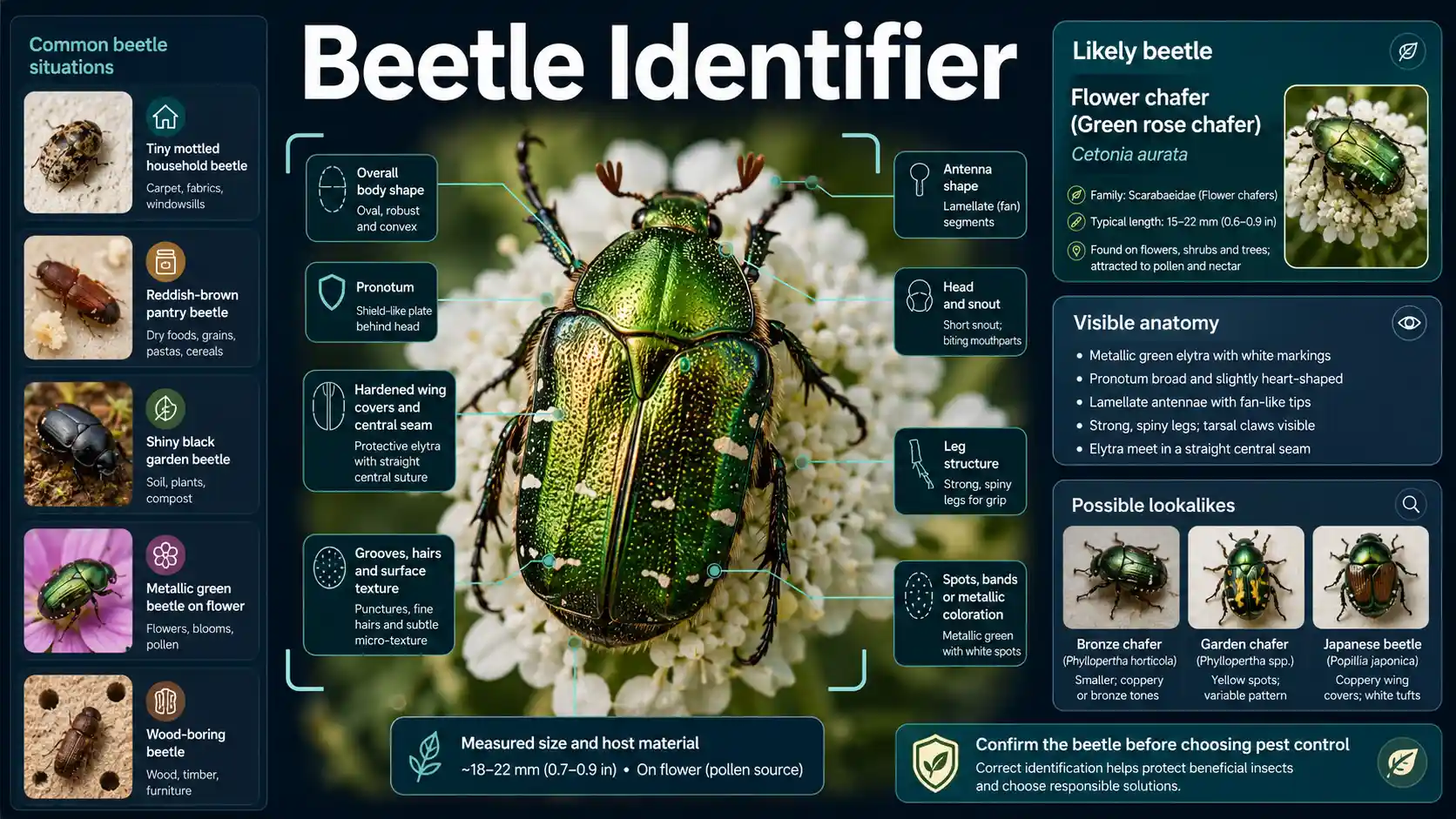
How beetle identification works
Wing covers, anatomy, life stage, and habitat build the match
Adult beetles are separated from other insects through their overall body plan and hardened forewings, called elytra, which usually meet along a central seam and protect the flight wings beneath. The tool also compares the pronotum behind the head, antennae, legs, snout, exposed abdomen, surface texture, grooves, hairs, markings, and measured size.
Context often decides between visually similar species. A three-millimeter brown beetle found inside flour suggests different possibilities than one collected from wool, bark, flowers, compost, pond water, or a windowsill. Larvae require a different comparison based on the head, true legs, hairs, body shape, tail end, and material in which they were living.
- 1Upload, take, or paste one image
Choose a file, use your phone camera, click the paste icon, or press Ctrl+V or Command+V.
- 2Add facts that the photo cannot show
Country, environment, approximate size, location, and observed behavior can narrow the answer.
- 3Review the match and its evidence
Check the likely name, confidence bar, visible clues, alternatives, safety note, and recommended next step.
Beetle identification coverage
Identify household, pantry, garden, wood, water, and beneficial beetles
The identifier covers many adult beetles and recognizable larval groups. It stays at family or broader group level when tiny structures, genital characters, internal anatomy, microscopic surface details, or rearing to adulthood would be required for a defensible species name.
Stored-product beetles such as drugstore beetles, cigarette beetles, grain beetles, flour beetles, weevils, and related pantry pests
Garden and crop beetles such as leaf beetles, flea beetles, scarabs, weevils, Japanese beetles, cucumber beetles, and Colorado potato beetles
Beneficial or neutral beetles such as lady beetles, ground beetles, soldier beetles, rove beetles, carrion beetles, and dung beetles
Wood-associated beetles such as powderpost beetles, bark beetles, longhorn beetles, metallic wood borers, and furniture beetles at a cautious group level
Aquatic and moisture-associated beetles such as diving beetles, water scavenger beetles, whirligig beetles, and shoreline species
Beetle larvae, grubs, pupae, shed skins, and beetle-like insects when enough anatomy and habitat context are visible
Beetle features that matter
Show the wing covers, pronotum, antennae, legs, size, and host
Color by itself is weak evidence. A reliable comparison combines several independent anatomical features with exact size, life stage, geographic location, and the plant, food, fabric, wood, soil, water, or room associated with the specimen.
Photograph the complete beetle from directly above, then add a side view and a close view of the head and antennae when safe. Include a ruler without touching the specimen. Show the plant, pantry product, fabric, wood, soil, water, trap, or room where it was found, because a nearly identical beetle can have a very different role in a different setting.
- Fill most of the frame with one intact specimen and keep the head, thorax, wing covers, legs, and antennae visible.
- Take a sharp top view that shows the elytra seam, body outline, pronotum, color pattern, grooves, hairs, and markings.
- Add a side view to show body height, snout, leg form, underside color, and whether the abdomen extends beyond the wing covers.
- Include a millimeter ruler or familiar object for scale without touching or pinning the beetle.
- Use even daylight and adjust the angle to reduce glare from glossy or metallic wing covers.
- Show the exact host or setting, such as flour, grain, wool, carpet, flowers, leaves, bark, firewood, soil, compost, pond, or windowsill.
- Photograph holes, frass, galleries, chewed leaves, fabric damage, or package contamination separately from the specimen.
- For a larva or grub, show the head, true legs, body hairs, tail end, curvature, segmentation, and the material where it was found.
- Do not crush, glue, wash, spray, or dismantle the specimen before photographing the structures needed for identification.
What the beetle result contains
A useful match separates identity, role, damage evidence, and uncertainty
The answer should explain what beetle group best fits, which visible structures support that match, what alternatives remain, and what evidence would improve confidence. It should not turn one specimen into an unsupported infestation, pest, invasive-species, or treatment conclusion.
- The most likely beetle common name, family, genus, or species when the photograph supports that precision
- A broader beetle group when species-level features are too small, hidden, variable, or dependent on microscopy
- An adult, larva, grub, pupa, shed skin, or uncertain life-stage assessment
- Visible evidence from wing covers, pronotum, head, snout, antennae, legs, body form, texture, hairs, and markings
- Relevant habitat, host plant, food product, fabric, wood, soil, water, season, and geographic context
- Plausible lookalikes and the exact feature or second photograph that could separate them
- A cautious explanation of whether the specimen may be beneficial, incidental, or potentially associated with damage
- A practical next step, safer handling guidance, and advice to confirm before control or disposal
Common beetle lookalikes
Small structural differences separate beetles from similar insects
These comparisons show why folded wings, dark color, a rounded body, or household location cannot identify a beetle by themselves.
Beetle or true bug
Beetles usually have hardened forewings meeting along a straight central seam and chewing mouthparts. True bugs often show overlapping half-hardened wings, a visible triangular scutellum, and a piercing-sucking beak.
Carpet beetle or bed bug
Adult carpet beetles are small, domed beetles with wing covers and often mottled scales. Bed bugs are flatter, broadly oval, wingless, visibly segmented, and shaped for hiding in cracks.
Ground beetle or cockroach nymph
Ground beetles usually have distinct hardened wing covers and a more defined pronotum. Cockroach nymphs are typically flatter with very long antennae, spiny legs, visible abdominal segmentation, and rear cerci.
Drugstore beetle or cigarette beetle
Both are tiny reddish-brown pantry beetles. Head visibility from above, antenna shape, elytra grooves, body hair, exact size, and the affected product help separate them.
Lady beetle or leaf beetle
Many lady beetles are rounded and predatory, while leaf beetles vary widely and usually feed on plants. Pronotum pattern, antennae, body profile, host, feeding damage, and larval form matter more than red or spotted color.
Wood-boring beetle or old damage
Fresh powder, new holes, live larvae or adults, moisture, galleries, and repeated activity support an active source. Historic exit holes or dust from movement cannot establish a current infestation by themselves.
Why beetle identification can fail
Tiny anatomy, glare, damage, and missing habitat can hide the answer
Beetles are an exceptionally diverse insect group, and many small brown or black species look nearly identical in ordinary photographs. A responsible result remains broad when antennae, tarsi, underside structures, microscopic texture, life stage, host, or geographic context are missing.
- The beetle appears as a tiny dark dot without enough resolution to see the head, antennae, wing covers, or body shape.
- The photograph shows plant damage, wood holes, fabric loss, or pantry debris but no insect specimen.
- A crushed or glue-covered beetle hides the antennae, legs, elytra seam, and surface texture.
- Metallic glare changes a green, blue, bronze, purple, or black beetle's apparent color.
- No size reference is supplied for a small black or brown beetle that has many close household lookalikes.
- An adult found on a windowsill is assumed to be feeding on the nearby fabric, food, or wood without larval or damage evidence.
- A hairy carpet beetle larva is confused with a caterpillar, clothes moth larva, or unrelated household debris.
- A true bug, cockroach nymph, earwig, fly, wasp, or moth is assumed to be a beetle because its wings are folded.
- One beetle is treated as proof of an infestation, active wood damage, or contaminated food source.
- Color alone is used to name a lady beetle, scarab, leaf beetle, jewel beetle, or ground beetle.
Worked beetle-identification examples
Specimen anatomy and the place it was found narrow the match
Each example combines a close specimen photograph with measured size and host evidence so the result can distinguish a harmless visitor, beneficial predator, stored-product beetle, fabric-associated species, plant feeder, or wood-boring group.
Tiny mottled beetle on a windowsill
A close top view, exact length, rounded body, mottled wing-cover scales, clubbed antennae, nearby shed larval skins, and the presence of wool, fur, feathers, or stored natural fibers can support carpet beetle identification. One outdoor-feeding adult near a window does not by itself prove fabric damage.
Small reddish-brown beetle inside a pantry
The head's visibility from above, antenna shape, body outline, elytra grooves, package holes, affected product, moisture, and specimen size can help separate drugstore beetles, cigarette beetles, flour beetles, grain beetles, spider beetles, and small weevils.
Shiny black beetle running through a garden at night
A fast ground-running habit, long legs, visible mandibles, pronotum shape, elytra grooves, body sheen, shelter under stones, and exact size can distinguish many predatory ground beetles from darkling beetles, rove beetles, and crop-feeding species.
Metallic green beetle on leaves or flowers
Body proportions, antennae, leg form, wing-cover texture, spots or stripes, host plant, feeding damage, flower use, season, and country can narrow jewel beetles, scarabs, leaf beetles, flower chafers, Japanese beetles, and metallic lady beetles.
Small holes and fine powder in a wooden item
Photograph the adult or larva if present, then show hole diameter, shape, powder texture, wood type, finished or unfinished surface, moisture, galleries, and whether fresh powder reappears. Damage alone may support a wood-boring group but rarely proves an exact species or active infestation.
Use the result responsibly
Confirm the beetle and active damage before choosing control
Avoid crushing or handling an unknown beetle with bare hands. Some beetles can pinch, release irritating chemicals, contaminate stored products, or be associated with damaged plants, fabrics, or wood. Identification should come before treatment, disposal, or pest-control decisions.
Many beetles are harmless or beneficial, and one adult indoors may have flown in from outside. Isolate potentially contaminated food, avoid spreading suspect firewood or plant material, keep unknown beetles away from bare skin, and use current integrated pest management or qualified local advice before applying pesticides or treating structural wood.
Choose the next identification step
Use another workflow when the subject or evidence is broader than a beetle
Questions about identifying beetles by photo
Direct answers before you upload a beetle picture
Can I identify a beetle from a photo online?
Yes. A sharp top view, side view, size reference, location, and host material can often support a family, genus, or species suggestion. Tiny or highly similar beetles may remain at a broader group level.
What kind of beetle is this?
Start with body shape, hardened wing covers, pronotum, antennae, legs, markings, exact size, and where it was found. Those combined clues are more useful than color alone.
How can I identify a small black beetle in my house?
Use a macro photograph and measure it in millimeters. State whether it was near a window, carpet, pantry, pet food, houseplant, damp area, stored fabric, or wooden object.
Does one carpet beetle mean I have an infestation?
No. Adults may enter from outdoors and feed on pollen. Repeated adults, hairy larvae, shed skins, or damage to wool, fur, feathers, or similar materials provide stronger evidence of an indoor source.
Can the tool identify a pantry beetle?
It can compare likely stored-product beetles when the specimen and affected package are visible. Keep the product isolated and check labels, seams, holes, larvae, webbing, dust, and neighboring dry goods.
Can it identify a wood-boring beetle from holes alone?
Usually not to species. Hole shape, diameter, frass, galleries, wood type, moisture, and an adult or larva are needed to distinguish powderpost, bark, longhorn, metallic wood-boring, and other beetle groups.
Can I identify a beetle larva or white grub?
Sometimes. Show the head capsule, true legs, body curve, hairs, segmentation, tail structures, exact size, and where it was living. Many larvae need adult rearing or specialist examination for an exact name.
Are all beetles household or garden pests?
No. Many beetles are predators, pollinators, decomposers, scavengers, or harmless visitors. Lady beetles and many ground, soldier, and rove beetles can be beneficial in gardens.
Is a ladybug actually a beetle?
Yes. Ladybugs, more accurately called lady beetles, belong to the beetle order Coleoptera and have hardened forewings covering the flight wings.
Can color identify a green, red, black, or brown beetle?
No. Many unrelated beetles share those colors, and lighting can alter metallic surfaces. Body structure, antennae, pronotum, markings, size, host, and geography are more reliable together.
Can a beetle photo prove what caused plant damage?
Not always. The beetle may be feeding, hunting other insects, visiting flowers, sheltering, or passing through. Match the specimen with fresh damage, host plant, feeding pattern, life stage, and repeated observations.
Should I spray pesticide after one beetle identification?
No. Confirm the species, determine whether damage is active and meaningful, and use current integrated pest management guidance before choosing any control method.
Can the tool tell whether a beetle bites, pinches, or releases chemicals?
It can flag a possible concern when identity is reasonably supported, but it cannot guarantee individual behavior. Avoid bare-hand handling of unknown beetles and do not provoke them for a photograph.
Can it identify an aquatic beetle?
It may distinguish diving, water scavenger, whirligig, riffle, and shoreline beetle groups when body shape, swimming legs, underside, water habitat, size, and location are visible.
Why did the Beetle Identifier return low confidence?
Low confidence usually means the specimen is too small, blurry, damaged, reflective, partly hidden, photographed from one angle, or belongs to a group that requires microscopic characters.
Can the result confirm an invasive or regulated beetle?
No. A likely match can justify prompt local verification, but invasive or quarantine status requires a confirmed identity and current information from the relevant agriculture or forestry authority.
Are uploaded beetle photos permanently stored by SnapIdentify?
SnapIdentify processes the normalized image for the request and does not intentionally write it to local disk. The configured AI provider processes the image under its service terms.
Authoritative beetle anatomy and pest-management references
Verify important beetle identifications before treating plants, food, fabric, or wood
These museum and extension resources explain insect anatomy, common beetle groups, chewing damage, beneficial predators, and why identification should come before control.
- Smithsonian National Museum of Natural History — What Is an Insect?
Smithsonian explains the shared insect body plan and describes beetle elytra as hardened structures that protect the flight wings underneath.
- UC Statewide IPM — Beetles
UC IPM summarizes household, pantry, garden, root-feeding, leaf-feeding, and wood-boring beetle groups and the chewing damage associated with many species.
- UC Statewide IPM — Beneficial Predators
UC IPM describes lady beetles, ground beetles, soldier beetles, and other natural enemies that can help control insect and mite pests.