Backyard and urban birds such as sparrows, finches, thrushes, doves, pigeons, starlings, blackbirds, crows, jays, woodpeckers, and hummingbirds
Compare bird shape, plumage, behavior, habitat, season, and range
Bird Identifier with Visual Species Clues
Bird Identifier helps you identify a bird from a photo online by comparing overall shape, relative size, bill, head pattern, plumage, wings, tail, legs, posture, behavior, habitat, season, and location. Upload one clear image to receive the most defensible species or bird-group match, the visible clues behind it, realistic lookalikes, and the next field mark to check when the photograph is not decisive.
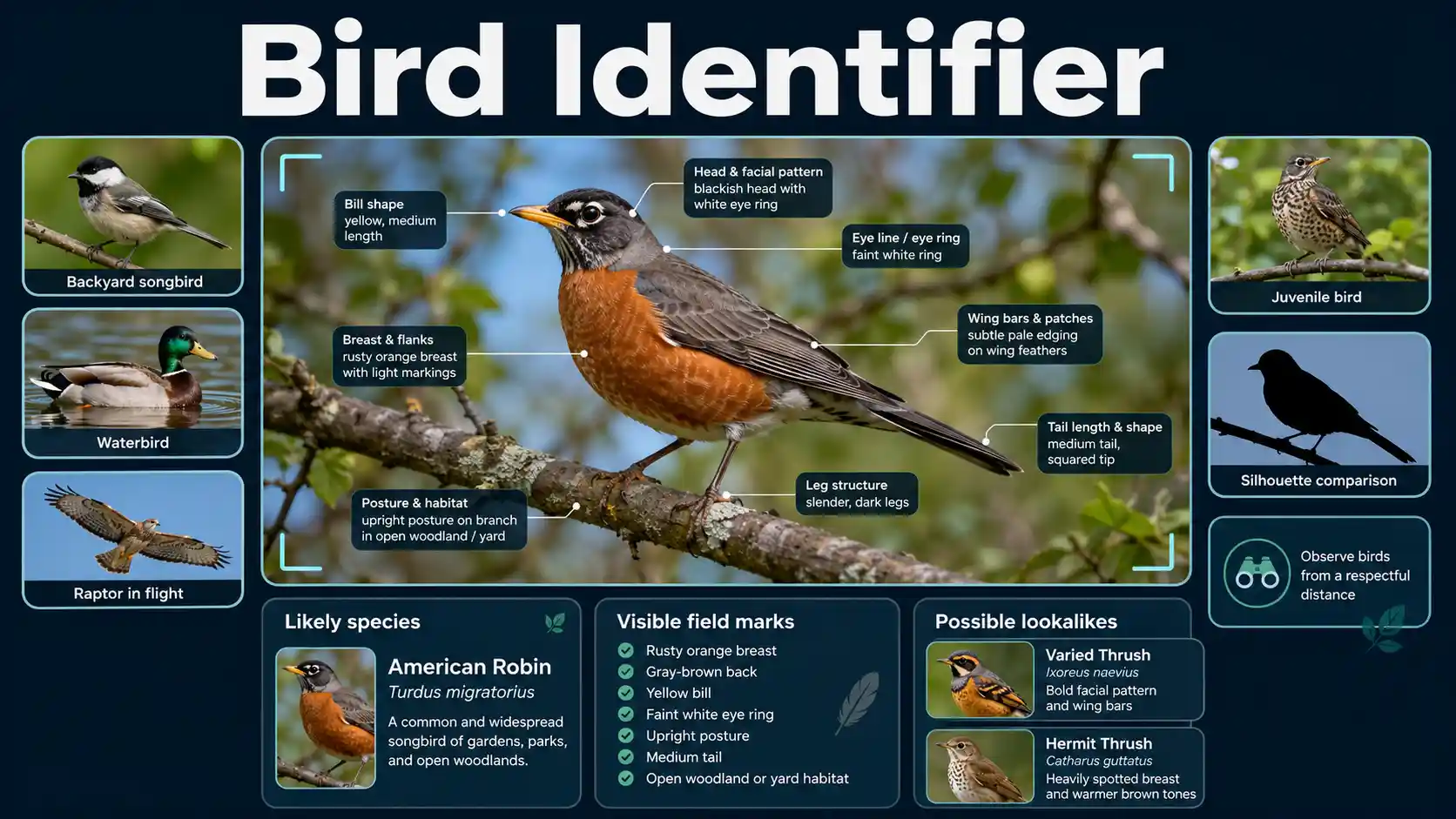
How bird identification works
Shape, structure, behavior, habitat, season, and range build the match
A useful Bird Identifier begins with the bird's overall family-like shape. It compares relative size, bill, head, neck, body, wings, tail, legs, posture, and flight silhouette before relying on fine color details.
Color pattern, behavior, habitat, date, and geographic range then refine the possibilities. When you identify a bird from a photo online, those contextual clues can separate species whose plumage looks nearly identical in one still image.
An AI bird identifier works best as a field-evidence assistant, not a final authority. Juveniles, females, seasonal plumage, molt, distant birds, and unusual lighting can make the correct answer broader than a single species.
- 1Upload, take, or paste one image
Choose a file, use your phone camera, click the paste icon, or press Ctrl+V or Command+V.
- 2Add facts that the photo cannot show
Country, environment, approximate size, location, and observed behavior can narrow the answer.
- 3Review the match and its evidence
Check the likely name, confidence bar, visible clues, alternatives, safety note, and recommended next step.
Bird identification coverage
Compare backyard birds, waterbirds, raptors, owls, shorebirds, and more
The tool covers many wild and domestic birds and can return a family, genus, or species group when a photo does not contain enough field marks for a precise species.
Waterbirds such as ducks, geese, swans, grebes, coots, rails, herons, egrets, gulls, terns, shorebirds, and kingfishers
Raptors and nocturnal birds such as hawks, falcons, eagles, kites, vultures, owls, and nightjars when silhouette and field marks are visible
Woodland, grassland, wetland, coastal, desert, mountain, tropical, and migratory birds using habitat, season, behavior, and geographic range
Adult males, adult females, juveniles, fledglings, eclipse plumage, winter plumage, and molting birds at the level supported by the visible evidence
Domestic, ornamental, aviary, and escaped birds at species or broad type level without unsupported ownership, breed, origin, or legal claims
Feathers, nests, eggs, tracks, and other bird signs at a cautious broader level when the bird itself is not clearly photographed
Bird field marks that matter
Show the bill, body shape, wings, tail, plumage pattern, and setting
A bird's brightest color is often less useful than where the color occurs and how the bird is built. The strongest result combines several independent field marks with behavior, habitat, date, and location.
Photograph the bird from a respectful distance and keep the whole body in frame when possible. Add a closer crop that preserves the bill, head, wing, tail, legs, and major markings. State the country or region, date or season, habitat, approximate size compared with a familiar bird, behavior, flock size, and whether the bird was perched, swimming, wading, soaring, or feeding.
- Use optical zoom or a telephoto lens instead of walking closer to the bird.
- Keep the full bird visible so body proportions, legs, wing length, and tail shape remain comparable.
- Add a sharper crop that shows the bill, eye area, crown, throat, breast, wing bars, rump, and tail pattern.
- Photograph the bird from the side when possible, then capture a front, rear, or flight view without disturbing it.
- Use natural light and avoid filters because warm light, shade, wet feathers, and camera processing can change plumage color.
- Record the country or region, date, habitat, approximate size, feeding style, flight pattern, flock size, and any call you heard.
- For a water bird identifier by picture, include the whole body, bill profile, head shape, flank pattern, tail, leg position, and surrounding water habitat.
- For a baby bird identifier by picture, photograph from a distance and note whether it is feathered, hopping, perching, calling, or being attended by adults.
- For a bird feather identifier by photo, show both surfaces beside a ruler, but leave the feather where found when collection or possession rules are uncertain.
What the bird result contains
A responsible species suggestion shows field marks and uncertainty
The result should identify the bird only as precisely as the evidence allows, explain which field marks fit, compare credible alternatives, and state which photograph, sound, location fact, or seasonal clue would improve confidence.
- The most likely common and scientific name only when the visible evidence supports that precision
- A broader bird family, order, species group, or domestic type when the photo cannot separate close alternatives
- A high, moderate, or low qualitative confidence label without false numerical precision
- Visible evidence from size, shape, bill, head, plumage, wings, tail, legs, posture, behavior, habitat, season, and range
- Likely age, sex, or plumage class only when several reliable field marks support it
- Plausible lookalikes and the specific field mark, call, flight style, location, or seasonal clue that would separate them
- A note when lighting, molt, juvenile plumage, distance, or image compression may be changing the appearance
- A practical next observation, better-photo suggestion, and wildlife-safe guidance
Common bird lookalikes
Small structural and behavioral clues separate similar birds
These comparisons show why overall color or one distant photograph is not enough. Size, bill, wings, tail, behavior, habitat, season, and local range should point to the same answer.
Crow or raven
Relative size, bill and throat shape, tail outline, wing proportions, flight style, vocalization, social behavior, habitat, and regional range help separate large black corvids.
Cooper's Hawk or Sharp-shinned Hawk
Head projection, leg thickness, tail shape, relative body size, flight style, age, and direct size comparison are more reliable than one plumage mark.
Downy or Hairy Woodpecker
Bill length relative to the head, overall size, outer-tail markings, calls, habitat, and direct comparison can separate these similar black-and-white woodpeckers.
House Finch, Purple Finch, or Cassin's Finch
Bill shape, head pattern, streaking, color distribution, back pattern, wing structure, voice, elevation, habitat, and range are all important.
Female duck or juvenile waterbird
Bill shape and pattern, head profile, eye stripe, speculum, flank texture, body posture, tail, diving behavior, season, and location often matter more than brown color.
Gull age classes and similar species
Bill, leg color, wingtip pattern, mantle tone, tail, head streaking, size, molt, age cycle, season, and region must be compared together.
Why bird identification can fail
Lighting, molt, age, migration, and distance can change the apparent bird
Birds rarely pose in a standard field-guide view. A responsible answer stays broad when the bill, wing, tail, size, behavior, date, habitat, or geographic range is missing.
- The bird occupies only a tiny part of the frame and the bill, eye, wing, and tail marks are lost.
- Color is treated as decisive even though lighting, white balance, shade, wet feathers, or molt may be changing it.
- The location and date are missing even though migration and seasonal plumage strongly affect the likely species.
- Only the head or breast is visible, preventing comparison of body shape, wings, tail, legs, and posture.
- Several birds appear in the photo and the intended subject is not identified.
- A juvenile, female, winter-plumaged, molting, or unusually colored bird is compared only with a typical adult male image.
- A distant black silhouette is assigned to a crow, raven, hawk, eagle, or vulture without checking size, tail, wings, flight, and range.
- A feather, nest, egg, dropping, or blurry flight image is treated as proof of one species.
- The photographer moves closer to a nest, chick, roost, shoreline flock, or injured bird and changes its behavior.
Worked bird-identification scenarios
Real observations show how field marks and context narrow the match
Each scenario starts with a natural bird-identification question and then identifies the extra visual, seasonal, behavioral, and geographic evidence needed for a useful answer.
Small brown bird at a backyard feeder
A backyard bird identifier by photo needs more than brown plumage. Bill thickness, crown and eye pattern, wing bars, breast streaking, tail shape, feeding style, flock behavior, season, and location can separate sparrows, finches, wrens, female blackbirds, and juvenile birds.
Dark bird photographed against the sky
Someone asking what bird is this by picture should compare relative size, neck, bill, wing shape, fingered wingtips, tail outline, flapping versus soaring, and geographic range. A backlit silhouette alone rarely separates crow, raven, vulture, hawk, eagle, or large gull.
Duck-like bird swimming on a lake
A water bird identifier by picture works best with a side profile showing the bill, forehead, head shape, neck, flank, wing patch, tail, waterline posture, diving or dabbling behavior, season, and wetland location.
Young bird hopping on the ground
A baby bird identifier by picture should first note feather development, tail length, ability to hop or perch, visible injury, nearby adults, and immediate hazards. A fully feathered fledgling is often still being cared for, so identification does not automatically justify intervention.
Single patterned feather found outdoors
A bird feather identifier by photo can compare feather type, overall length, vane symmetry, tip shape, barring, spots, edge pattern, shaft color, and region. One feather often supports only a family or broad group, and local rules should be checked before it is collected or transported.
Bird welfare comes before a closer image
Do not disturb a bird, nest, chick, roost, or flock to improve confidence
Observe birds from a respectful distance. Do not disturb nests, eggs, chicks, roosts, feeding flocks, or injured wildlife to obtain a closer image. An AI match cannot determine whether a bird needs rescue or whether a feather, nest, egg, or specimen may legally be possessed.
Keep pets and people away from young birds and nests. Do not feed, capture, relocate, or attempt to rehabilitate a bird based on an AI result. Contact a licensed local wildlife rehabilitator, veterinarian, park authority, or emergency service when a bird has a clear injury or faces immediate danger.
Choose the workflow that matches the subject
Separate birds from other animals, insects, and indirect evidence
Questions about bird identification by photo
Direct answers before you upload a bird picture
Can I use a free bird identifier by picture?
Yes. Upload one clear bird picture in the browser to receive a likely match, visible field marks, credible lookalikes, confidence, and a practical next observation.
Can I identify a bird from a photo online?
Yes. Upload a clear image and add the location, date, habitat, size, and behavior. The result will stay at family or group level when species evidence is incomplete.
Is this AI bird identifier free?
Yes. The current browser tool accepts a supported image and returns a likely match, visible clues, lookalikes, confidence, and a safer next step.
Can I use the Bird Identifier online with no app?
Yes. Choose a file, use a phone camera, drag an image into the uploader, or paste one from the clipboard in a modern browser.
What photograph produces the best bird identification?
Show the whole bird in neutral light, then add a crop of the bill, head, wing, tail, legs, and markings. Include location, date, habitat, size, and behavior.
Can a bird species identifier from an image name every bird?
No. Distant, juvenile, female, molting, backlit, partly hidden, hybrid, or regionally variable birds may support only a family, genus, or species group.
Why do location and season matter for bird identification?
Migration, breeding range, winter range, elevation, habitat, molt, and seasonal plumage can remove species that look similar but should not occur there then.
Can the tool identify a bird from a silhouette?
Sometimes at a broad level. Wing shape, tail outline, neck, bill, size, flight style, flock pattern, and range may help, but a dark silhouette often remains uncertain.
Can it distinguish male, female, and juvenile birds?
Sometimes. The result should mention age or sex only when several reliable plumage, structure, season, and behavior clues agree.
Can a backyard bird identifier by photo separate similar sparrows?
It can narrow them when the bill, face, crown, throat, breast, wings, tail, size, behavior, season, and geographic location are visible together.
Can a baby bird identifier tell whether the bird was abandoned?
No. A photo can suggest nestling or fledgling stage, but it cannot prove abandonment. Keep people and pets back and contact a licensed local rehabilitator when the bird is clearly injured or in immediate danger.
Can the Bird Identifier diagnose a sick or injured bird?
No. It cannot diagnose disease, poisoning, fractures, starvation, parasites, or injury severity. Use a qualified wildlife rehabilitator or veterinarian for health concerns.
Can a bird feather identifier by photo prove the species?
Usually not by itself. Feather type, size, shape, pattern, shaft, and location may narrow the group, but expert comparison may be needed and possession rules vary by place.
Can it identify a bird from a nest or egg?
Only cautiously. Nest placement, materials, structure, egg pattern, habitat, and attending adults can add clues, but nests and eggs alone often overlap across species.
Should I move closer to a nest for a better picture?
No. Keep your distance and avoid changing the adults' behavior. A lower-confidence result is better than disturbing nesting birds or exposing eggs and chicks.
Are uploaded bird photos permanently stored by SnapIdentify?
SnapIdentify processes the normalized image for the request and does not intentionally write it to local disk. The configured AI provider processes it under its service terms.
Authoritative birding, AI, and wildlife guidance
Confirm difficult birds and observe them responsibly
These bird-identification, computer-vision, and wildlife-care resources explain field marks, the limits of AI suggestions, and why young or injured birds may require qualified local guidance rather than immediate handling.
- Cornell Lab Bird Academy — Four Keys to Bird Identification
Cornell explains how size and shape work together with color pattern, behavior, and habitat to identify birds more reliably than color alone.
- eBird Help — Merlin Photo ID
eBird explains that AI bird suggestions can make mistakes, may focus on the wrong bird, and should be treated as evidence to evaluate rather than definitive answers.
- U.S. Fish and Wildlife Service — Baby and Injured Wildlife
The Service explains the difference between nestlings and fledglings, why many young birds should be left with nearby parents, and when licensed rehabilitation guidance is appropriate.