Adult flea-like insects using a wingless narrow side profile, six legs, enlarged hind legs, head form, bristles, comb-like rows, measured size, and host or room context
Identify adult fleas, immature stages, flea dirt, and flea lookalikes from one photo
Flea Identifier for Adults, Larvae and Lookalikes
Upload a sharp macro photo of one suspected flea or related sign. This Flea Identifier compares adult fleas, larvae, eggs, cocooned pupae, cat-flea-like and dog-flea-like groups, human-flea-like groups, bird and rodent fleas, flea dirt, and common lookalikes. It evaluates a narrow side-compressed body, six legs, enlarged hind legs, antennae, bristles or combs, measured size, life stage, host, room, date, and geographic region. A visual match cannot diagnose a bite or allergy, reveal pathogen status, prove the exact host of origin, count an infestation, choose a pet treatment or pesticide, or decide whether a home needs professional treatment.
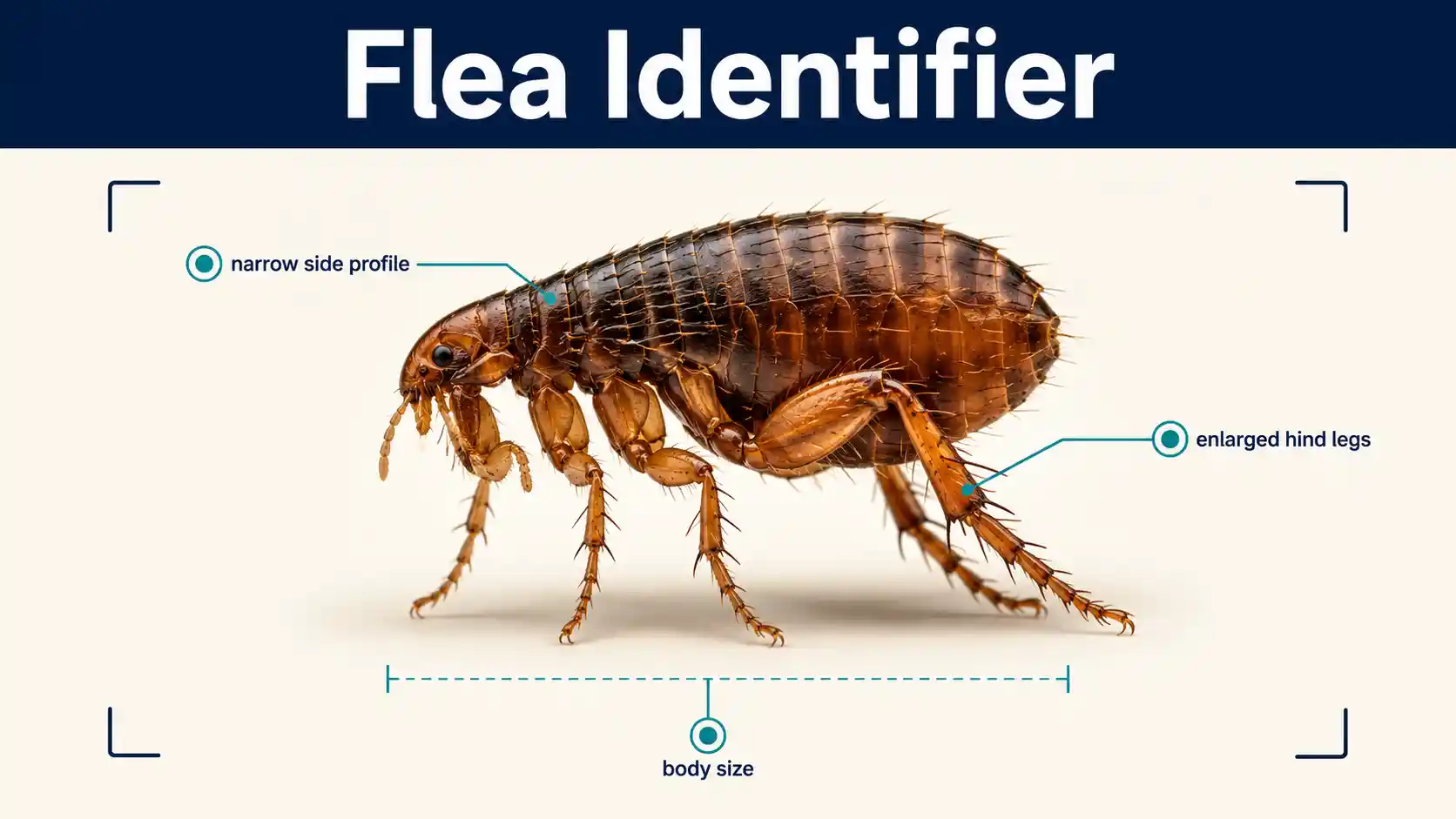
How photo-based flea identification works
Combine a true side view, millimeter scale, legs, head, life stage, host setting, and environmental evidence
The analysis first decides whether the image shows an adult flea, pale immature stage, possible flea dirt, tick, bed bug, louse, springtail, beetle, mite, larva, seed, lint, or other debris. An intact specimen supports a stronger result than a bite or environmental mark.
Adult fleas are compared through their wingless narrow side-compressed body, six legs, enlarged hind legs, head profile, bristles, and any visible genal or pronotal combs. A top view alone can hide the feature that most clearly separates a flea from a broad flat bed bug.
Eggs, larvae, and cocooned pupae look very different from adults. Pale grains and dusty cocoons often lack decisive visible anatomy, while larvae need a close view of their legless segmented body, bristles, scale, and surrounding material.
Host, room, nest, date, climate, and geography refine the candidates. They do not prove species, exact origin, infestation size, pathogen status, bite cause, or the correct control plan.
- 1Upload, take, or paste one image
Choose a file, use your phone camera, click the paste icon, or press Ctrl+V or Command+V.
- 2Add facts that the photo cannot show
Country, environment, approximate size, location, and observed behavior can narrow the answer.
- 3Review the match and its evidence
Check the likely name, confidence bar, visible clues, alternatives, safety note, and recommended next step.
Adults, larvae, eggs, pupae, flea dirt, host-associated groups, and flea lookalikes
Identify likely flea evidence without calling every jumping speck, dark crumb, white grain, bite, or scratching pet a flea
The page covers adult fleas, immature life stages, cat-flea-like and dog-flea-like groups, human-, bird-, and rodent-associated possibilities, pet and household settings, flea dirt, and common arthropod or debris lookalikes.
Cat-flea-like and dog-flea-like adults to the level supported by a clear lateral head view, comb structures, dimensions, geography, and expert-visible anatomy
Human-flea-like, bird-flea-like, rodent-flea-like, and other wildlife-associated flea groups when the specimen and contextual evidence justify a broader match
Possible flea eggs, pale legless larvae, debris-covered cocoons, and immature-stage material while explaining why exact photo identification is often limited
Possible flea dirt on pet fur, bedding, combs, or environmental material as supporting evidence rather than proof of species, source, or population size
Common lookalikes including ticks, bed bugs, lice, springtails, small beetles, mites, fly or moth larvae, seeds, lint, and other dark or pale debris
Flea evidence that matters
Read the side profile, hind legs, head, bristles, combs, dimensions, life stage, host setting, and location together
No dark color, jump, bite pattern, pet host, carpet location, pepper-like speck, or pale grain proves a flea by itself. A stronger match combines intact anatomy, millimeter scale, a side view, and documented context.
Photograph one intact specimen in sharp macro focus from the side and above when possible. Place a millimeter ruler beside it and show the head, antennae, narrow body profile, six legs, enlarged hind legs, bristles, and any comb-like rows. Record whether it was found on a pet, person, bedding, carpet, upholstered furniture, trap, nest material, or wildlife. Photograph flea dirt, eggs, larvae, cocoons, and the surrounding site separately.
- Use macro mode and fill the frame with one intact specimen without crushing it.
- Take a sharp side view because the narrow laterally compressed body is a key adult-flea clue.
- Add a top view showing the head, thorax, abdomen, six legs, and relative width of the body.
- Show the enlarged hind legs, antenna area, bristles, and comb-like rows when the camera can resolve them.
- Place a millimeter ruler in the same plane as the specimen instead of estimating size from memory.
- Use neutral light and avoid flash glare on dark bodies, transparent tape, or collection containers.
- Record the host or exact site, such as cat, dog, person, pet bed, carpet edge, sofa, nest box, trap, or wildlife bedding.
- Photograph pale eggs, larvae, dusty cocoons, dark debris, and any adult specimen as separate close views.
- If using a flea comb, photograph the intact specimen and debris before they are smeared or covered by hair.
- Do not upload only a bite, rash, scratching pet, or distant room scene when a specimen can be documented safely.
What a responsible flea result includes
A likely flea group or life stage, visible evidence, realistic lookalikes, uncertainty, and a safer next step
The answer states whether the upload best fits an adult flea, broader flea group, immature stage, flea-dirt-like evidence, another arthropod, or uncertain debris. It explains the supporting features and missing evidence without inventing bites, allergy, pathogens, source, population size, or treatment.
- The most likely adult flea group, immature stage, flea-dirt-like evidence, lookalike arthropod, or uncertain object supported by the image
- A named species only when visible morphology, measured size, geography, and supporting context justify that level
- A high, moderate, or low confidence label without a fabricated percentage
- Visible evidence such as side compression, leg count, enlarged hind legs, head shape, bristles, combs, color, dimensions, and life-stage form
- Host, room, nest, season, and geographic clues described as context rather than proof of species or origin
- Realistic lookalikes and the feature or second photograph that would help separate them
- A clear separation between identity and bites, allergy, pathogen status, infestation size, host source, pet treatment, pesticide choice, or professional-treatment need
- A practical next step for preserving a sample, improving the image, checking context, and obtaining qualified confirmation
Flea lookalikes and difficult comparisons
Separate fleas from ticks, bed bugs, lice, small beetles, springtails, and unrelated immature insects or debris
Jumping behavior, dark color, a pet host, bedding, carpet, or an itchy mark can mislead. These comparisons show why side profile, leg count, hind-leg form, antennae, wing covers, scale, life stage, and context matter.
Flea or tick
Adult fleas are six-legged insects with antennae, a narrow side-compressed body, and enlarged hind legs. Tick nymphs and adults are eight-legged arachnids without antennae or jumping legs.
Flea or bed bug
Fleas look narrow from the side and have enlarged hind legs. Bed bugs are broad, flat, oval insects when viewed from above and show different abdominal segmentation and leg proportions.
Flea or louse
Lice are generally flattened from top to bottom and have legs and claws adapted to hold hair or feathers. Fleas are compressed from side to side and have a greatly enlarged hind pair for jumping.
Flea or small beetle
Small beetles have hardened wing covers that often meet in a central seam and a more rigid rounded body. Fleas are wingless, laterally compressed, and lack elytra.
Flea or springtail
Springtails often have longer visible antennae, favor damp habitats, and may show a forked jumping organ under the abdomen. Fleas have enlarged hind legs and the characteristic narrow adult profile.
Flea larva, fly larva, moth larva, or debris
A flea larva is pale, legless, segmented, and bristled when detail permits. Fly larvae, clothes moth larvae, carpet beetle larvae, plant fibers, and hair require head, leg, hair, case, scale, and habitat comparisons.
Why flea identification can fail
Bite-only photos, motion blur, missing side views, crushed specimens, absent scale, debris shortcuts, and treatment assumptions reduce confidence
Fleas are tiny, fast, dark, and easily hidden by fur, fibers, glue, glare, or crushing. Eggs, larvae, and cocoons resemble unrelated pale material, while flea dirt resembles ordinary debris. The result stays broad when decisive anatomy or scale is missing.
- The upload shows only itchy skin, red bumps, or a scratching pet without a specimen.
- A dark jumping speck is called a flea even though the body, legs, and antenna area are blurred.
- The insect is photographed only from above, hiding its narrow side profile and enlarged hind legs.
- No millimeter scale is provided for a tiny adult, egg, larva, beetle, springtail, or piece of debris.
- The specimen is crushed, smeared, covered by pet hair, or embedded in opaque trap glue.
- Any black pepper-like material on fur or bedding is treated as confirmed flea dirt.
- One smooth white grain is identified as a flea egg without scale, surrounding evidence, or visible structure.
- The current pet, person, bird nest, or rodent site is assumed to prove the flea species or exact host of origin.
- One captured flea is used to estimate infestation size, duration, room of origin, or treatment need.
- A visual match is used to infer disease status or choose a medication, pesticide, dose, or pet product.
Worked flea identification examples
Body compression, hind legs, head profile, combs, scale, life stage, host setting, room, and geography narrow the match
Each case combines visible anatomy with context to compare adult flea groups, immature stages, possible flea dirt, and common household lookalikes without diagnosing bites or overclaiming infestation status.
Small dark jumping insect combed from a cat
A sharp side view, millimeter scale, narrow body, enlarged hind legs, head profile, comb structures, and geographic region can support a cat-flea-like or related group. The cat host alone does not prove the species, pathogen status, allergy cause, or treatment choice.
Brown flea-like specimen found on dog bedding
The tool compares cat-flea-like and dog-flea-like adults with lice, bed bugs, ticks, and beetles using body compression, six legs, jumping legs, head form, combs, measured size, and a second top view. Bedding context cannot reveal the exact host of origin or infestation size.
Pale worm-like larva in a carpet edge
A macro view of the head end, segmentation, bristles, leglessness, measured length, nearby debris, room humidity, and any adult fleas can compare a flea larva with fly larvae, clothes moth larvae, carpet beetle larvae, and fibers. A distant pale thread remains uncertain.
Pepper-like specks collected with a flea comb
Dark reddish-brown debris on a pet or bed may be compatible with flea dirt, but a photo cannot prove its identity. Separate close views of the debris, an intact adult specimen, the combing location, and repeated physical evidence make the conclusion stronger.
Tiny jumping insect near a damp window
Long antennae, a moisture-associated setting, a compact body, and a visible jumping fork can support a springtail rather than a flea. A true flea should show a laterally compressed body and enlarged hind legs; a sharper side view is decisive.
Keep visual identity separate from health, veterinary, pesticide, and infestation decisions
A photograph cannot diagnose bites or allergy, reveal pathogens, identify the exact source host, count fleas, or choose treatment
A flea photo can support visual identification, but it cannot diagnose bites, allergies, infection, or an infestation. Avoid choosing pet medication or pesticides from an image result. Confirm important findings with a veterinarian, extension service, or qualified pest professional.
Preserve a specimen or clear photographs when practical, document where and when it was found, and avoid handling wildlife bedding, nests, droppings, or unknown pest-control residue with bare hands. Seek medical advice for severe or concerning human symptoms and veterinary advice for an unwell pet, heavy parasite burden, or product selection. Follow current product labels exactly; never use a dog-only flea product on a cat. Confirm the pest before major pesticide, disposal, or professional-service decisions.
Choose the next identification step
Use the tick, bed bug, or broader insect workflow when another body plan or household context fits better
Questions about identifying fleas from pictures
Answers before you upload a flea photo
Can a flea be identified from a photo?
Often to a likely flea or broader flea group when a sharp macro photo shows the side profile, six legs, enlarged hind legs, measured size, head, bristles, and collection context.
What does an adult flea look like?
An adult flea is a small wingless insect with a narrow side-compressed body, six legs, and enlarged hind legs adapted for jumping.
Can a photo distinguish a cat flea from a dog flea?
Sometimes only cautiously. These fleas are similar, and exact separation may require a clear lateral head view or microscopic examination of combs and other structures.
Does finding a flea on a cat prove it is a cat flea?
No. Host association can support a comparison, but some flea species use several hosts. The specimen's anatomy and geography matter.
What do flea eggs look like?
Flea eggs are very small, pale, smooth, and nonsticky. Lint, dandruff, sand, seeds, and other insect eggs can look similar in a photograph.
What does a flea larva look like?
A flea larva is pale, legless, worm-like, and may show bristles and a darker gut in a detailed macro view. It normally develops in sheltered environmental material rather than on the host.
Can a flea pupa be identified from a picture?
Usually only with low confidence. The pupa sits inside a cocoon that can collect dust and debris, hiding the features needed for visual identification.
Can flea dirt be identified from a photo?
A photo may show dark pepper-like debris compatible with flea dirt, but debris or a reddish smear is not proof. An intact flea and repeated supporting evidence are stronger.
How can I tell a flea from a tick?
Adult fleas are six-legged insects with antennae, a narrow side profile, and enlarged hind legs. Tick nymphs and adults are eight-legged arachnids without antennae.
How can I tell a flea from a bed bug?
Fleas are narrow from the side and have enlarged jumping legs. Bed bugs are broad, flat, oval insects with a visibly segmented abdomen when viewed from above.
How can I tell a flea from a louse?
Lice are generally flattened from top to bottom and have legs adapted to grip hair or feathers. Fleas are compressed from side to side and have much larger hind legs.
How can I tell a flea from a springtail?
Springtails often have obvious antennae, occur in damp places, and may show a forked jumping organ. Fleas have a narrow side-compressed body and enlarged hind legs.
Can a bite pattern prove that fleas are present?
No. Flea bites overlap with other insect bites, skin irritation, and allergic reactions. Identify a specimen or obtain professional medical or pest confirmation.
Can the tool tell whether a flea carries disease?
No. Appearance cannot reveal bacteria, viruses, parasites, infection, or whether transmission occurred.
Does one flea mean my home is infested?
No. One specimen deserves investigation, but it cannot reveal population size, duration, source, or whether professional treatment is needed.
Can the tool select a flea treatment for my pet?
No. Treatment depends on the animal species, age, weight, health, product label, and veterinary judgment. Never apply a dog-only product to a cat.
Which photos produce the best flea result?
Provide sharp side and top views of one intact specimen beside a millimeter ruler, plus the host or exact collection site, date, region, and separate images of immature stages or debris.
Authoritative flea life-stage, morphology, host, household-evidence, product-safety, and identification-limit references
Verify flea anatomy, eggs, larvae, pupae, adults, flea dirt, host context, and safer pet-product decisions
These CDC, extension, and EPA references explain flea life stages, adult body form, enlarged hind legs, larvae, flea dirt, environmental development, host associations, product-label precautions, and why visual identification cannot choose treatment.
- Centers for Disease Control and Prevention — Flea Lifecycles
Official guidance on flea eggs, larvae, cocooned pupae, adults, host cues, feeding, development, and why different life stages may occur in the surrounding environment.
- University of Minnesota Extension — Fleas
Extension guidance on adult flea size and side-compressed form, enlarged hind legs, larvae, flea dirt, hosts, indoor evidence, and identification limits.
- U.S. Environmental Protection Agency — Protecting Pets from Fleas and Ticks
Official safety guidance on flea and tick products, label precautions, pet and child exposure, and why product decisions require species-specific directions and veterinary advice.