Common Aedes-like mosquitoes, including striped container-breeding groups, when leg bands, thorax pattern, abdomen, wings, size, season, and region are visible
Identify adult mosquitoes, larvae, pupae, and mosquito lookalikes from one photo
Mosquito Identifier for Adults and Larvae
Upload a clear mosquito photo to compare the subject with Aedes, Culex, Anopheles, floodwater mosquitoes, container-breeding mosquitoes, house mosquitoes, Asian tiger mosquito-like species, malaria-vector groups, larvae, pupae, midges, fungus gnats, crane flies, black flies, sand flies, and other lookalikes. The tool evaluates body proportions, wing scales, leg bands, abdominal markings, antennae, palps, proboscis, resting posture, measured size, life stage, water habitat, biting time, season, and geographic region. It stays at a broader genus or mosquito group when a phone image cannot show the tiny scales, wing veins, palps, genital structures, or larval characters needed for responsible species-level identification.
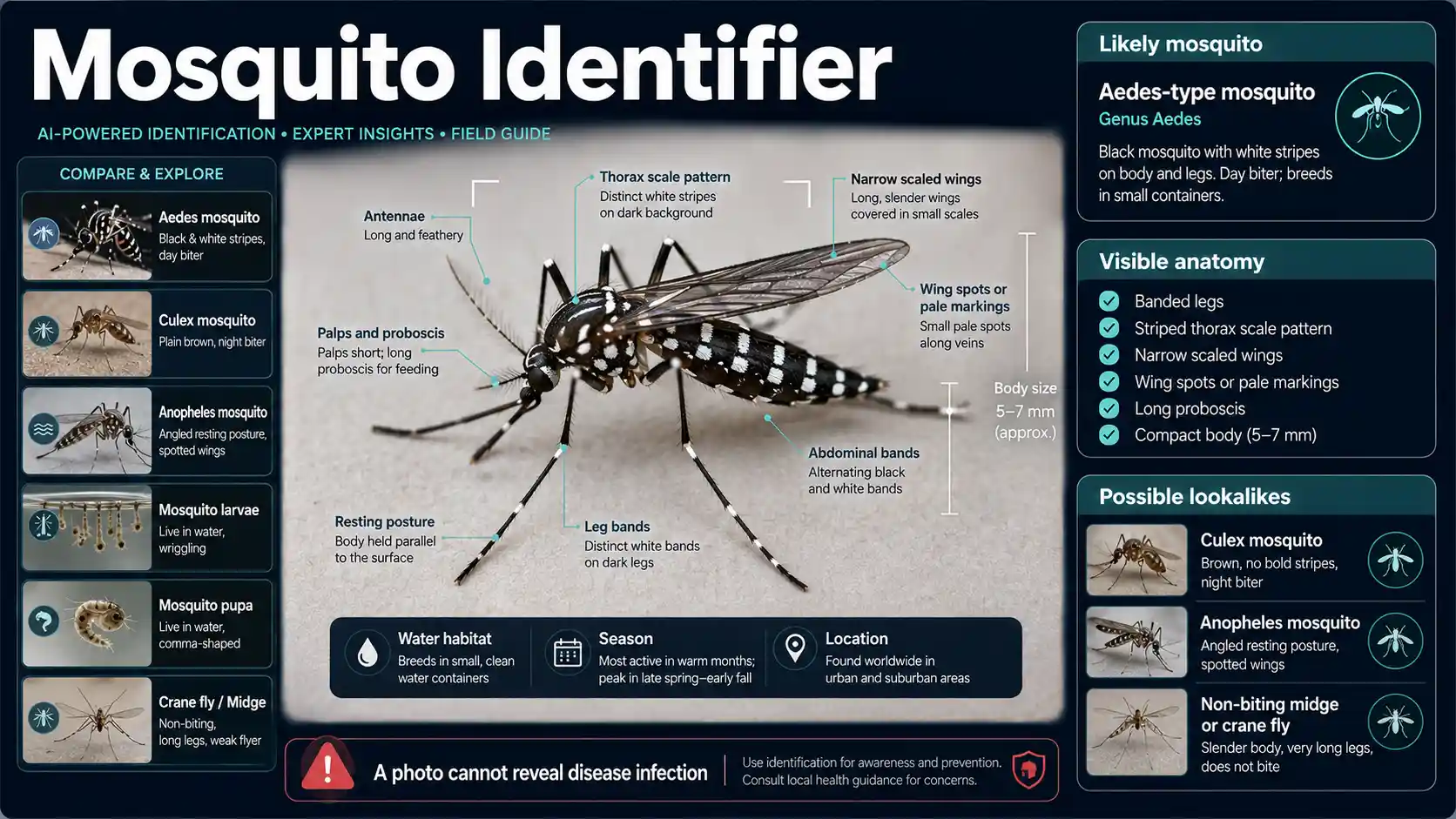
How photo-based mosquito identification works
Wings, scales, palps, legs, markings, posture, life stage, water habitat, season, and geography build the match
A useful result starts by confirming that the subject is a mosquito rather than a non-biting midge, fungus gnat, crane fly, black fly, sand fly, drain fly, caddisfly, or another small insect. The analysis compares the head, antennae, palps, proboscis, thorax, abdomen, narrow scaled wings, legs, markings, measured size, posture, behavior, date, habitat, and geographic region.
Adult mosquito identification can be difficult because decisive scales and patterns are tiny and easily rubbed off. Wings may overlap, pale bands may disappear in glare, blood-fed females change shape, and exact species may require microscopy or expert keys. The result therefore stays at a genus or species-group level when stronger evidence is missing.
Eggs, larvae, and pupae require a different evidence set. Water-surface posture, siphon form, body shape, movement, egg arrangement, container type, organic material, measured size, season, and location can narrow the group. The tool does not treat every aquatic wriggler as a mosquito or ask the user to handle contaminated water.
The result keeps mosquito identity separate from pathogen carriage, disease transmission, bite diagnosis, allergy, local outbreak risk, invasive status, infestation severity, and pesticide decisions. A photograph cannot show whether an individual mosquito is infected or whether a bite transmitted anything.
- 1Upload, take, or paste one image
Choose a file, use your phone camera, click the paste icon, or press Ctrl+V or Command+V.
- 2Add facts that the photo cannot show
Country, environment, approximate size, location, and observed behavior can narrow the answer.
- 3Review the match and its evidence
Check the likely name, confidence bar, visible clues, alternatives, safety note, and recommended next step.
Adult mosquitoes, larvae, pupae, eggs, container breeders, house mosquitoes, and fly lookalikes
Identify likely mosquito groups without calling every striped insect an Asian tiger mosquito or every long-legged fly a mosquito
The page covers Aedes-like, Culex-like, Anopheles-like, floodwater, woodland, marsh, coastal, container-breeding, indoor, outdoor, adult, larval, and pupal mosquitoes. It also compares midges, gnats, crane flies, black flies, sand flies, drain flies, caddisflies, and other lookalikes.
Culex-like house and standing-water mosquitoes using body pattern, wings, legs, resting posture, habitat, activity, and geographic context
Anopheles-like mosquitoes using palps, wing spots, resting angle, body pattern, region, and other visible evidence without making disease claims
Floodwater, woodland, marsh, coastal, saltmarsh, tree-hole, container, and other habitat-associated mosquito groups when both adult and environmental evidence are available
Male and female adult mosquitoes only when antennae, palps, abdomen, and other visible characters support a cautious distinction
Mosquito eggs, larvae, pupae, shed skins, and aquatic lookalikes at the broadest supported life-stage or genus-group level
Mosquito lookalikes including non-biting midges, fungus gnats, crane flies, black flies, sand flies, drain flies, caddisflies, and small moths
Mosquito evidence that matters
Read the head, wings, scales, legs, abdomen, posture, life stage, water source, season, and range together
No single stripe, resting angle, room, water container, or biting time proves a species. A stronger result combines several independent features and remains broad when scales or microscopic characters are missing.
Photograph one intact mosquito from the side and above when possible without allowing it to bite. Show the head, antennae, proboscis, palps, thorax, abdomen, wings, and all six legs. Include a ruler or measured body length, record the date and location, and photograph the standing-water container or larval habitat separately without touching sewage, stagnant water, or unknown chemicals.
- Use macro mode and fill the frame with one intact mosquito without allowing it to bite or handling it with bare fingers.
- Take a side view showing the proboscis, palps, antennae, thorax, abdomen, wings, legs, and resting angle.
- Add a top view showing thorax markings, abdominal bands, wing pattern, and pale or dark leg bands.
- Include a ruler or provide a measured body length because crane flies, midges, gnats, and mosquitoes can look similar without scale.
- Use neutral light and avoid glare because reflective scales and pale bands can disappear or look artificially bright.
- Record the date, country, state or province, indoor or outdoor setting, biting time, weather, and nearby standing water.
- For larvae, photograph the entire body at the water surface, the siphon or rear end when visible, movement, measured length, and the container or habitat separately.
- For pupae or eggs, show several sharp angles, scale, water surface, container type, and whether eggs are single, clustered, or raft-like without touching contaminated water.
- Avoid crushed, blood-smeared, pesticide-covered, glue-obscured, or missing-leg specimens because scales, palps, leg bands, and posture may be lost.
What a responsible mosquito result includes
A likely group, visible evidence, realistic lookalikes, uncertainty, bite-prevention guidance, and next verification step
The result explains the leading adult or immature-stage match, the exact visible features that support it, the nearest alternatives, missing evidence, confidence limits, and a safe next step. It does not make unsupported disease, infection, outbreak, bite, or pesticide claims.
- The most likely mosquito common name and scientific group when visible evidence supports them
- A broader genus, species group, or mosquito-like fly category when decisive scale or microscopic characters are missing
- A high, moderate, or low confidence label without false numerical precision
- Visible evidence such as wing scales, thorax pattern, abdominal bands, legs, antennae, palps, proboscis, size, and resting posture
- The apparent life stage, including egg, larva, pupa, adult, or shed skin when supported
- Realistic mosquito and non-mosquito lookalikes with the feature that would help separate them
- Relevant context such as container water, marsh, woodland, indoor setting, biting time, season, and geographic range
- A practical next step, bite-prevention guidance, better-photo suggestions, and local-verification advice without unsupported disease claims
Mosquito lookalikes and difficult comparisons
Separate mosquitoes from midges, crane flies, gnats, black flies, and visually similar mosquito genera
Many small flies share long legs, narrow bodies, aquatic larvae, or indoor behavior. These comparisons show why measured size, proboscis, antennae, wing scales, palps, posture, life stage, habitat, and geography matter.
Mosquito or non-biting midge
Both may be small, slender, and associated with water. A mosquito usually shows a long proboscis and scaled wings, while many midges lack the same piercing mouthpart and may hold the front legs differently. Sharp head and wing views are essential.
Mosquito or crane fly
Crane flies are generally much larger with extremely long fragile legs and different head, wing, and abdomen proportions. A measured body length prevents the common giant-mosquito mistake.
Mosquito or fungus gnat
Fungus gnats are small dark flies associated with moist potting mix. Head shape, antennae, wing venation, proboscis, leg proportions, indoor source, and measured size separate them from mosquitoes.
Aedes-like or Culex-like mosquito
Leg bands, thorax pattern, abdomen, wing markings, resting posture, container or water habitat, activity, season, and region may support a genus-level distinction. Color alone is unreliable.
Anopheles-like or other mosquito
Palp length, spotted wings, resting angle, abdomen alignment, legs, intact scales, habitat, and geography can support an Anopheles-like match, but exact identification often needs specialist keys.
Mosquito larva or other aquatic larva
Mosquito larvae show an enlarged thorax and characteristic surface posture, with siphon differences among groups. Midges and other aquatic insects can look similar when the rear end, movement, and scale are hidden.
Why mosquito identification can fail
Missing scales, no size reference, blood-fed distortion, blurry larvae, color shortcuts, and disease assumptions reduce confidence
Mosquitoes are small, delicate, and easily damaged. Leg bands and thorax scales rub away, wings overlap, glue hides palps, blood meals change the abdomen, and larvae are difficult through reflective water. A responsible result stays broad when the specimen, life stage, scale, date, habitat, or location is unclear.
- The mosquito occupies only a tiny part of the image and the wing scales, palps, antennae, and leg bands cannot be examined.
- The specimen is crushed, blood-fed, wet, covered with pesticide, or stuck to opaque glue.
- Only a bite, rash, standing-water container, or larval habitat is photographed without a clear insect or larva.
- Every black-and-white striped mosquito is called an Asian tiger mosquito without comparing thorax pattern, legs, abdomen, size, and region.
- Every long-legged fly is called a mosquito without checking wing shape, proboscis, body proportions, antennae, and measured size.
- A disease-vector label is assigned from appearance without current regional and laboratory evidence.
- No measured size, date, geographic location, biting time, or habitat is provided.
- A blood-filled abdomen changes the body shape and color, but the distortion is ignored.
- Aquatic larvae are identified from a distant water photo without showing the head, thorax, abdomen, siphon, posture, or movement.
- One mosquito indoors is treated as proof of a breeding site, infestation, disease exposure, or public-health emergency.
Worked mosquito-identification examples
Adult anatomy, larval posture, water habitat, measured size, season, and geography narrow the match
Each case combines visible morphology with context to separate striped Aedes-like mosquitoes, plain Culex-like mosquitoes, Anopheles-like adults, aquatic larvae, and crane-fly lookalikes.
Black mosquito with white leg bands near a patio container
Compare thorax stripe pattern, abdominal markings, leg bands, body size, wings, activity time, container habitat, season, and geographic range before narrowing an Aedes-like mosquito. Striped legs alone do not prove an Asian tiger mosquito.
Plain brown mosquito resting indoors at night
Use thorax and abdomen pattern, unbanded or banded legs, wings, palps, resting posture, measured size, indoor activity, nearby water, season, and region to compare Culex-like mosquitoes with other small flies.
Long-palped mosquito resting at an angle
Compare palp length, wing spots, body angle, leg pattern, abdomen, intact scales, date, habitat, and region to support or reject an Anopheles-like group without making a malaria-risk claim.
Wriggling larvae in a rain barrel or plant saucer
Examine the head, enlarged thorax, abdomen, surface posture, siphon length and angle when visible, movement, water container, organic debris, measured length, date, and location. Several aquatic insects can resemble mosquito larvae from a distance.
Very large long-legged insect called a giant mosquito
Use measured size, proboscis, antennae, wing shape, leg proportions, body thickness, resting posture, and flight behavior to compare a crane fly, midge, robber fly, or true mosquito.
Prevent bites and observe water habitats without direct contact
A photograph cannot reveal pathogen carriage, diagnose illness, or measure local outbreak risk
A photo cannot determine whether a mosquito carries or transmitted a pathogen. Avoid bites, do not handle stagnant or contaminated water, and follow current local public-health guidance. Seek medical care for concerning illness after mosquito exposure or travel.
Do not allow an unknown mosquito to bite for identification. Avoid bare-hand contact with stagnant water, sewage, septic water, animal waste, or pesticide-treated water. Use current local guidance, screens, protective clothing, and EPA-registered repellents according to the label. Empty, scrub, cover, or maintain small water-holding containers regularly when safe. Seek medical advice for concerning illness after exposure or travel, and emergency care for severe or rapidly worsening symptoms.
Choose the next identification step
Use the fly, broader insect, or complete-scene workflow when it provides stronger evidence
Questions about identifying mosquitoes from pictures
Direct answers before you upload a mosquito photo
Can a mosquito be identified from a photo?
Often to a useful genus or species group. Exact species may require intact scales, wing details, palps, genital structures, larval characters, microscopy, and expert confirmation.
What photo gives the best mosquito identification?
Provide sharp side and top views of one intact mosquito, measured size, head, antennae, palps, proboscis, thorax, abdomen, wings, legs, date, location, and habitat.
Can it identify an Asian tiger mosquito?
It can compare an Aedes-like mosquito using the thorax stripe, leg bands, abdomen, size, behavior, container habitat, season, and regional range. Striped legs alone are not enough.
Can it distinguish Aedes, Culex, and Anopheles?
Sometimes at genus level. Thorax and leg markings, palps, wing spots, resting posture, habitat, date, and region must agree, and unclear photos receive a broader result.
Can a photo show whether a mosquito carries disease?
No. A photo cannot reveal infection, pathogen carriage, or whether transmission occurred. Species associations and current local public-health information are separate questions.
Does every mosquito bite people?
No. Male mosquitoes do not take blood meals. Female biting preferences also vary by species, but a photo should not predict behavior unless sex and group are supported.
Can it identify a male or female mosquito?
Sometimes. Plumose antennae often support a male, while female antennae are usually less feathery, but angle, blur, and species variation can hide the distinction.
Can it identify mosquito larvae?
Often to a broad mosquito or genus group when the full larva, surface posture, siphon, movement, measured size, water habitat, date, and region are visible.
Are all wrigglers in standing water mosquito larvae?
No. Midges and other aquatic insects can look similar. Photograph the entire larva, rear end, water-surface posture, movement, scale, and habitat.
Is a crane fly a giant mosquito?
No. Crane flies are a different fly group and are usually much larger, with extremely long legs and different head and wing proportions.
Can it identify a mosquito from a bite or rash?
No. Skin reactions do not identify the insect or diagnose disease. Upload the insect itself and seek medical advice for concerning symptoms.
Does one mosquito indoors prove indoor breeding?
No. One adult may enter through a door or screen. Repeated adults, larvae, pupae, and a confirmed water source provide stronger evidence.
Can the tool tell whether local disease risk is high?
No. Local disease risk changes with place and time and must come from current health-department or mosquito-control surveillance, not a single photo.
Should I spray after seeing one mosquito?
Not automatically. Prevent bites, repair screens, remove or maintain small standing-water containers, and follow current local guidance before using any pesticide.
What repellent should I use?
Use an EPA-registered insect repellent that fits your needs and follow its label. The identifier does not recommend unregistered mixtures or off-label pesticide use.
Can it confirm a mosquito is invasive or reportable?
Not from appearance alone. Confirm the species and current regional status with local mosquito-control, extension, or public-health authorities.
Can I use the Mosquito Identifier without installing an app?
Yes. Open the page in a browser, choose an image from your device or take a photo, add optional context, and review the likely match and evidence.
Authoritative mosquito anatomy, life-cycle, bite-prevention, and standing-water references
Verify adult and larval anatomy, nuisance-versus-vector limits, life stages, water habitats, and safe prevention
These CDC and EPA references explain mosquito anatomy, biting biology, life stages, water-breeding habitats, nuisance and vector distinctions, EPA-registered repellents, screens, protective clothing, and household standing-water prevention.
- Centers for Disease Control and Prevention — About Mosquitoes
Official overview of adult mosquito anatomy, antennae, palps, proboscis, wings, legs, biting biology, life span, and the distinction between nuisance and vector mosquitoes.
- U.S. Environmental Protection Agency — General Information about Mosquitoes
Current federal information on the egg, larva, pupa, and adult life cycle, standing-water habitats, household breeding containers, and integrated prevention.
- Centers for Disease Control and Prevention — Preventing Mosquito Bites
Public-health guidance on EPA-registered repellents, protective clothing, screens, and weekly removal or maintenance of water-holding containers.