Common indoor and outdoor muscoid flies such as house, stable, cluster, face, flesh, blow, bottle, lesser house, and related groups when visible and regional evidence supports them
Identify household, drain, fruit, flower, biting, and garden flies from one photo
Fly Identifier for Indoor and Garden Species
Upload a clear photo to compare a likely fly with house flies, blow flies, flesh flies, cluster flies, fruit and vinegar flies, drain flies, fungus gnats, phorid flies, hoverflies, bee flies, robber flies, crane flies, horse flies, mosquitoes, moths, bees, wasps, and other lookalikes. The tool evaluates one functional wing pair, halteres when visible, eye size, antennae, mouthparts, thorax, abdomen, legs, wing veins, markings, measured size, movement, breeding source, season, and geographic region. It stays at a broader family or fly group when a phone photo cannot show the tiny bristles, vein intersections, genital structures, or microscopic characters required for a responsible species-level answer.
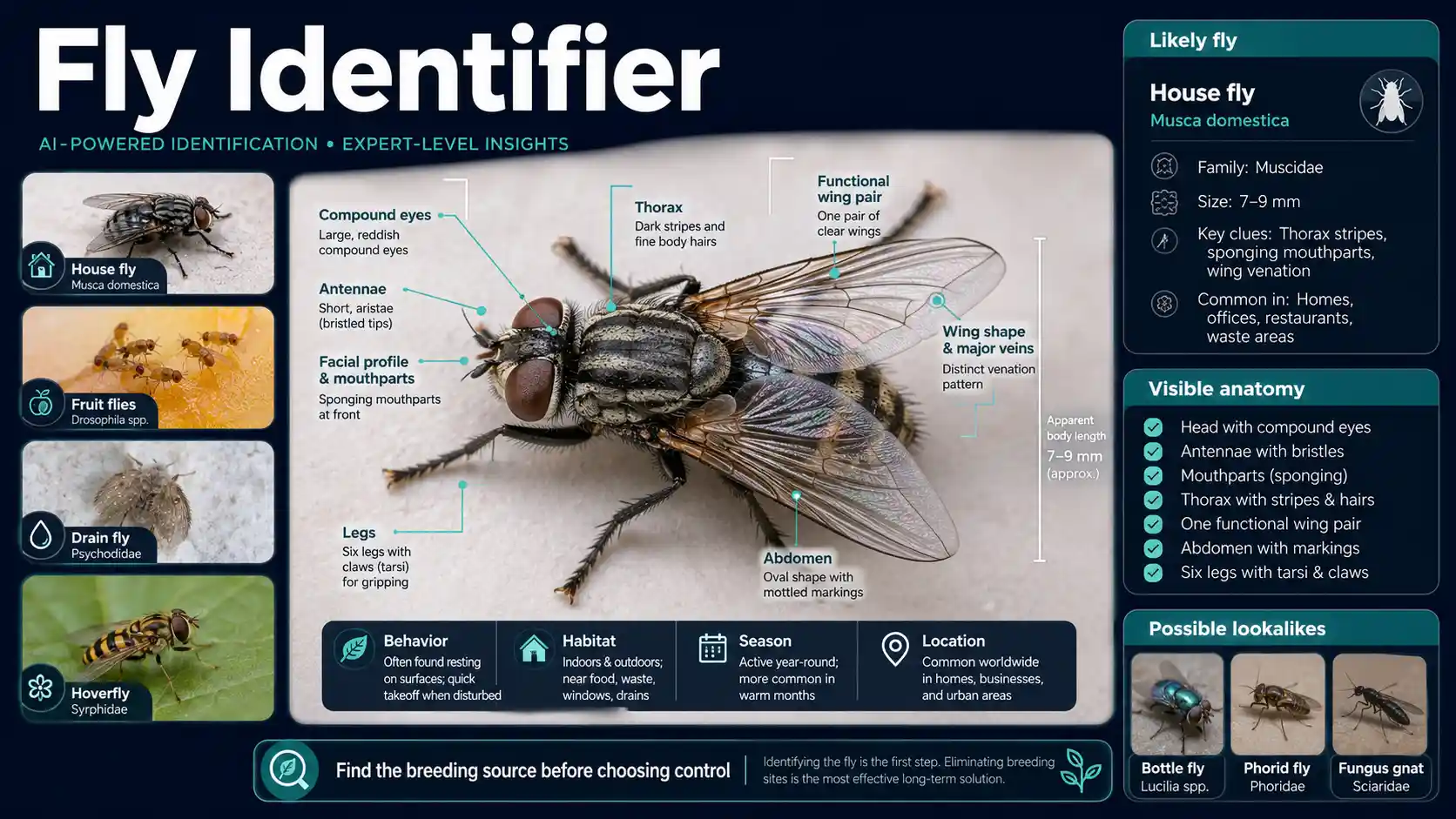
How photo-based fly identification works
Wings, eyes, antennae, thorax, abdomen, measured size, behavior, source, season, and geography build the match
A useful fly result starts by confirming that the subject is a true fly rather than a bee, wasp, moth, mosquito, winged ant, caddisfly, beetle, or another insect. The analysis checks the functional wing pair, halteres when visible, eyes, antennae, facial profile, mouthparts, thorax, abdomen, legs, wing shape, markings, body hair, measured size, behavior, date, habitat, and geographic region.
Fly identification can be difficult from a phone photo because decisive characters may be tiny. Wing-vein intersections, thoracic bristles, antenna segments, mouthparts, and reproductive structures may require a microscope. Wings may overlap, halteres may remain hidden, and dead specimens often lose their eye or body color. The result therefore stays at a broader family or fly group when stronger evidence is missing.
The suspected breeding source can be as important as the adult. Fermenting produce, wet drain film, moist potting mix, garbage, manure, carrion, sewage, animal areas, aquatic habitat, flowers, and overwintering wall spaces support different fly groups. Context strengthens the comparison but does not independently prove a species, contamination event, sewer defect, hidden carcass, or infestation.
The result keeps fly identity separate from biting risk, pathogen carriage, allergy, food safety, infestation severity, plumbing failure, and treatment decisions. Those questions require direct evidence, current local guidance, and sometimes medical, sanitation, plumbing, veterinary, or pest-professional assessment.
- 1Upload, take, or paste one image
Choose a file, use your phone camera, click the paste icon, or press Ctrl+V or Command+V.
- 2Add facts that the photo cannot show
Country, environment, approximate size, location, and observed behavior can narrow the answer.
- 3Review the match and its evidence
Check the likely name, confidence bar, visible clues, alternatives, safety note, and recommended next step.
Household flies, drain flies, fruit flies, flower flies, biting flies, larvae, and fly mimics
Identify likely fly groups without calling every tiny kitchen insect a fruit fly or every yellow mimic a bee
The tool can compare adults, larvae, pupae, puparia, indoor breeding sources, flower visitors, animal-associated flies, biting-fly candidates, seasonal nuisance flies, and bee or wasp mimics. It returns a broader family or fly-versus-non-fly comparison when wing veins, bristles, mouthparts, scale, source, date, or regional context is missing.
Small indoor flies including fruit or vinegar flies, drain or moth flies, phorid or humpbacked flies, fungus gnats, eye gnats, and related groups using anatomy and breeding-source context
Flower-visiting and beneficial flies such as hoverflies, bee flies, tachinid flies, robber flies, long-legged flies, and other bee or wasp mimics
Biting or blood-feeding fly groups such as horse flies, deer flies, black flies, stable flies, sand flies, biting midges, and mosquitoes only to the safest supported level
Aquatic, plant-associated, livestock-associated, carrion-associated, and seasonal nuisance flies when the specimen and habitat are both visible
Fly larvae, maggots, pupae, puparia, shed cases, and non-fly lookalikes when the image supports a broad life-stage or family-level distinction
Photo evidence that separates fly groups
Show the eyes, antennae, wings, thorax, abdomen, legs, mouthpart area, measured size, and source
A sharp top view reveals wing shape, thorax markings, abdomen pattern, and overall proportions. Side and front views reveal eye separation, facial profile, antennae, mouthparts, body hair, and leg structure. Add measured size, date, exact location, behavior, and a separate photo of the suspected source.
Photograph one intact fly from directly above and from the side when it is safe. Show both wings, eyes, antennae, thorax, abdomen, legs, and mouthpart area. Include a ruler or measured length, record the date and location, and photograph the drain, fruit, plant, waste source, animal area, window, or other setting separately without handling contaminated material.
- Use macro mode and fill the frame with one intact fly without touching a potentially biting or contaminated specimen.
- Take a direct top view that shows both wings, thorax markings, abdomen pattern, legs, and overall shape.
- Add a side or front view to show eye separation, antennae, facial profile, mouthparts, body hair, and leg structure.
- Include a ruler or provide a measured body length because many indoor flies overlap in color but differ greatly in size.
- Photograph the wings sharply enough to show spots, bands, shape, and major veins without glare or motion blur.
- Record the date, country, state or province, room or habitat, activity, and whether the fly hovers, runs, bites, clusters, or rests on drains, windows, plants, food, or animals.
- Photograph the suspected source separately, such as fermenting fruit, a drain, moist potting mix, waste, manure, or a wall emergence point, without handling contaminated material.
- For larvae, show the entire body, both ends, breathing tube or projections when visible, substrate, measured length, and source container without touching the specimen.
- Avoid crushed, wet, pesticide-covered, backlit, glue-obscured, or distant flies because eyes, antennae, thorax stripes, wing veins, and mouthparts disappear.
What the fly result explains
A responsible answer identifies the likely fly group and shows which visible evidence supports it
The result should state whether the specimen is likely a true fly, the narrowest supported taxonomic level, visible anatomy, apparent life stage, realistic fly and non-fly alternatives, relevant behavior and source context, and the next safe observation needed. It should never convert appearance into a contamination claim, medical diagnosis, hidden-source certainty, or pesticide instruction.
- The most likely fly common name and scientific group when the visible evidence supports them
- A broader family, genus, species group, or indoor-fly category when decisive bristles or wing-vein details are missing
- A high, moderate, or low confidence label without false numerical precision
- Visible evidence such as one wing pair, eyes, antennae, thorax, abdomen, legs, hair, markings, wing pattern, and measured size
- The apparent life stage, including adult, larva, pupa, puparium, or empty case when supported
- Realistic fly and non-fly lookalikes with the feature that would separate them
- Relevant context such as hovering, running, biting reports, plant association, drain, fruit, waste, animal, season, and geographic range
- A practical next step, safer source-checking guidance, and better-photo suggestions without unsupported medical or pesticide claims
Common fly lookalikes and closely related groups
Wings, eyes, antennae, body hair, mouthparts, movement, source, measured size, and region separate similar insects
Tiny size, dark color, fuzzy wings, metallic bodies, yellow-and-black mimicry, hovering, indoor occurrence, and legless larvae appear across many fly families and other insects. These comparisons show why one color, room, flower, drain, or behavior cannot establish an exact species.
Hoverfly or bee
Hoverflies usually show one functional wing pair, large compound eyes, shorter antennae, no bee-style pollen structures, and hovering flight. Bees have two wing pairs, longer antennae, different body hair, and often pollen-carrying structures. The wings may overlap in photographs.
Fruit fly, phorid fly, or drain fly
Fruit or vinegar flies are often tan with prominent eyes near fermenting material. Phorid flies have a humpbacked profile and often run erratically. Drain flies are fuzzy with broad hairy wings. Measured size and a confirmed breeding source are crucial.
House fly, stable fly, or cluster fly
House flies show four thorax stripes and sponging mouthparts. Stable flies have a forward-projecting piercing proboscis and can bite. Cluster flies are often slower with golden thoracic hairs and seasonal wall associations. Sharp side views help.
Blow fly or flesh fly
Blow flies often have metallic blue, green, or bronze bodies. Flesh flies are commonly gray with thorax stripes and a checkered abdomen. Size, face, bristles, abdomen, source, date, and region matter.
Fungus gnat or mosquito
Both may be slender and long-legged. Fungus gnats are usually associated with moist potting mix and have different antennae, wing veins, and mouthparts. Mosquitoes have a distinctive proboscis and scale-covered wings, but tiny photos may not resolve them.
Maggot, caterpillar, beetle larva, or sawfly larva
Typical fly maggots are legless and often lack an obvious hardened head capsule. Caterpillars and sawfly larvae have true legs and prolegs, while many beetle larvae have a visible head and thoracic legs. The source and both body ends are important.
Why fly identification can fail
Motion blur, missing scale, hidden wing details, source assumptions, and contamination claims reduce confidence
Flies are small, fast, reflective, and structurally diverse. Important wing veins, bristles, antennae, mouthparts, eye spacing, and larval structures may require macro photography or microscopy. Many families share the same color or indoor setting. A responsible result stays broad when the specimen, scale, source, date, behavior, or location is unclear.
- The fly occupies only a tiny part of the image and the eyes, antennae, wings, and thorax cannot be examined.
- The specimen is crushed, wet, covered with pesticide, or hidden beneath glue or trap material.
- A sink, drain, fruit bowl, bite, animal, or food item is photographed without a clear fly specimen.
- A yellow-and-black hoverfly is assumed to be a bee or wasp from color alone.
- Every tiny kitchen fly is called a fruit fly without comparing body shape, wing posture, running behavior, and source.
- Every fuzzy fly near a bathroom is called a drain fly without finding a breeding source.
- No measured size, date, room, habitat, or geographic location is provided.
- Overlapping wings are mistaken for two pairs, or hidden wings are counted incorrectly from one angle.
- A maggot is identified to species without showing the source, body ends, breathing structures, or scale.
- One indoor fly is treated as proof of contamination, a sewer break, a dead animal, or a major infestation.
Worked fly-identification examples
Anatomy, measured size, movement, breeding source, season, and geography narrow the match
Each case combines a close specimen photograph with environmental context that separates fermenting-fruit flies, drain-associated flies, bee mimics, metallic carrion-associated flies, and humpbacked indoor runners.
Tiny tan flies hovering around overripe fruit
Compare measured size, red or dark eyes, tan body, abdomen bands, wing shape, hovering or short flights, fermenting produce, beverage residue, trash, date, and room to distinguish fruit or vinegar flies from phorid and drain flies.
Fuzzy dark flies resting near a bathroom drain
Use the hairy body, broad leaf-shaped wings, roof-like resting posture, measured size, repeated drain association, and wet organic film to support a drain-fly group without claiming a sewer break from the insect alone.
Yellow-and-black insect hovering over flowers
Compare one functional wing pair, large eyes, short antennae, body hair, waist, leg pollen structures, wing posture, hovering behavior, flower, season, and location to separate a hoverfly from a bee or wasp.
Large metallic blue-green fly appearing indoors
Compare body size, metallic sheen, thorax, abdomen, face, bristles, wing base, number appearing, season, waste or carrion association, and building context. Several sudden adults may justify source inspection, but one photo cannot locate a hidden source.
Small dark humpbacked flies running across a counter
Use the arched thorax, short wings with reduced venation, rapid running behavior, measured size, drain or decaying-organic source, room, date, and region to compare phorid flies with fruit flies and fungus gnats.
Photograph flies and suspected breeding sources without handling contaminated material
A photo cannot prove pathogen carriage, food contamination, a sewer defect, a hidden carcass, or infestation severity
Avoid handling unknown biting flies, maggots, contaminated food, sewage, carrion, or animal waste. A photo cannot confirm disease transmission, food contamination, a sewer break, a hidden carcass, or infestation severity. Seek medical care for serious symptoms or larvae in a wound.
Do not handle unknown biting flies, maggots, carrion, sewage, animal waste, contaminated food, or drain slime for a closer picture. Do not pour pesticides or unlabelled chemicals into drains or spray food-preparation areas indiscriminately. Keep food covered, clean contaminated surfaces, remove obvious breeding material safely, and seek qualified help for persistent flies, plumbing concerns, animal wounds, or medical symptoms.
Choose the next identification step
Use the bee, broader insect, or food workflow when it provides stronger evidence
Questions about identifying flies from pictures
Direct answers before you upload a fly photo
Can a fly be identified from a photo?
Often to a useful family, genus, or common group. Exact species may require microscopic bristles, wing venation, mouthparts, or reproductive structures that a phone image cannot show.
What photo gives the best fly identification?
Provide sharp top, side, and front views of one intact fly, a measured size, both wings, eyes, antennae, thorax, abdomen, legs, date, location, behavior, and suspected source.
Do true flies have one pair of wings?
Adult true flies use one functional wing pair. The hind pair is modified into small balancing organs called halteres, although they may be hidden in ordinary photographs.
Can it identify tiny flies in my kitchen?
Yes, but photograph the fly and the exact source. Fruit, drains, trash, moist soil, sewage leaks, and decaying material support different groups.
Are all tiny kitchen flies fruit flies?
No. Phorid flies, drain flies, fungus gnats and other small flies can occur indoors. Body form, wings, movement, measured size, and breeding source matter.
Can a photo confirm drain flies?
A fuzzy body, hairy broad wings and repeated drain association can support the group. The photo cannot by itself confirm the breeding film, plumbing defect, or sewer break.
Can it distinguish a hoverfly from a bee?
Often. Hoverflies usually show one functional wing pair, large eyes, shorter antennae, no bee-style pollen structures, and characteristic hovering, but several features should agree.
Do hoverflies sting?
Hoverflies do not have a bee or wasp stinger. However, confirm that the insect is actually a hoverfly before approaching or handling it.
Can it identify a biting fly?
It can compare likely biting-fly groups from anatomy and context, but it cannot predict whether one individual will bite or diagnose a skin reaction or disease.
Can it identify a maggot from a picture?
Sometimes to a broad fly group or life stage. Exact larval identification often requires the source, body ends, breathing structures, measured size, and expert examination.
Does one fly indoors prove an infestation?
No. A single fly may enter from outdoors. Repeated adults, larvae, pupae, a consistent emergence point, and a confirmed breeding source provide stronger evidence.
Can a fly photo prove food contamination?
No. Identification cannot determine where the fly previously landed or whether food contains harmful organisms. Follow normal food-safety practices and discard food when contamination is reasonably suspected.
Can it tell whether a fly spreads disease?
It can explain known associations of a likely group, but a photo cannot show whether that individual carries a pathogen or transmitted anything.
Do house flies bite?
House flies have sponging mouthparts and do not bite. Stable flies and several other fly groups can bite, so a clear specimen photo is important.
Should I spray flies before identifying the source?
Avoid random spraying. Long-term control usually depends on finding and removing the breeding material, improving sanitation, fixing moisture, and excluding entry.
Can it diagnose a fly bite or larvae in a wound?
No. The tool identifies insects, not medical conditions. Severe symptoms, eye involvement, worsening pain, infection signs, or larvae in a wound require prompt medical care.
Can I use the Fly Identifier without installing an app?
Yes. Open the page in a browser, choose an image from your device or take a photo, add optional context, and review the likely match and evidence.
Authoritative fly anatomy, household-source, beneficial-insect, and sanitation references
Verify difficult fly groups, indoor breeding sources, bee mimics, larvae, and safe source management
These Smithsonian and university-extension resources explain true-fly anatomy, the functional wing pair and halteres, house and drain flies, indoor breeding materials, hoverfly mimicry, beneficial larvae, and why identification should precede management claims.
- Smithsonian Institution — True Flies (Diptera)
Overview of true-fly anatomy, the single functional wing pair, halteres, maggot-like larvae, and bee, wasp, and other fly mimics.
- University of Minnesota Extension — Flies
Identification and source guidance for house flies, drain flies, blow flies, flesh flies, cluster flies, larvae, sanitation, and indoor management.
- Colorado State University Extension — Beneficial insects and other arthropods
Identification context for beneficial hoverflies, their bee-like appearance, flower visiting, and predatory larvae that feed on soft-bodied insects.