Common garden, woodland, meadow, wetland, desert, mountain, coastal, and urban moths using wing pattern, body form, size, posture, date, and range
Identify garden moths, household moths, caterpillars, cocoons, and butterfly lookalikes
Moth Identifier with Wing and Habitat Clues
Use this Moth Identifier when you are asking what moth is this, comparing a large green moth, brown patterned moth, hummingbird-like moth, pantry moth, clothes moth, or hairy caterpillar from a picture. Upload a sharp photo and add the location, date, habitat, approximate wingspan, resting position, behavior, host plant, and whether the image shows an adult, caterpillar, cocoon, pupa, egg mass, or empty case. The tool compares forewing shape, hindwing exposure, pattern placement, antennae, palps, body proportions, scales, posture, life stage, season, indoor source, and geographic range before suggesting the most defensible match.
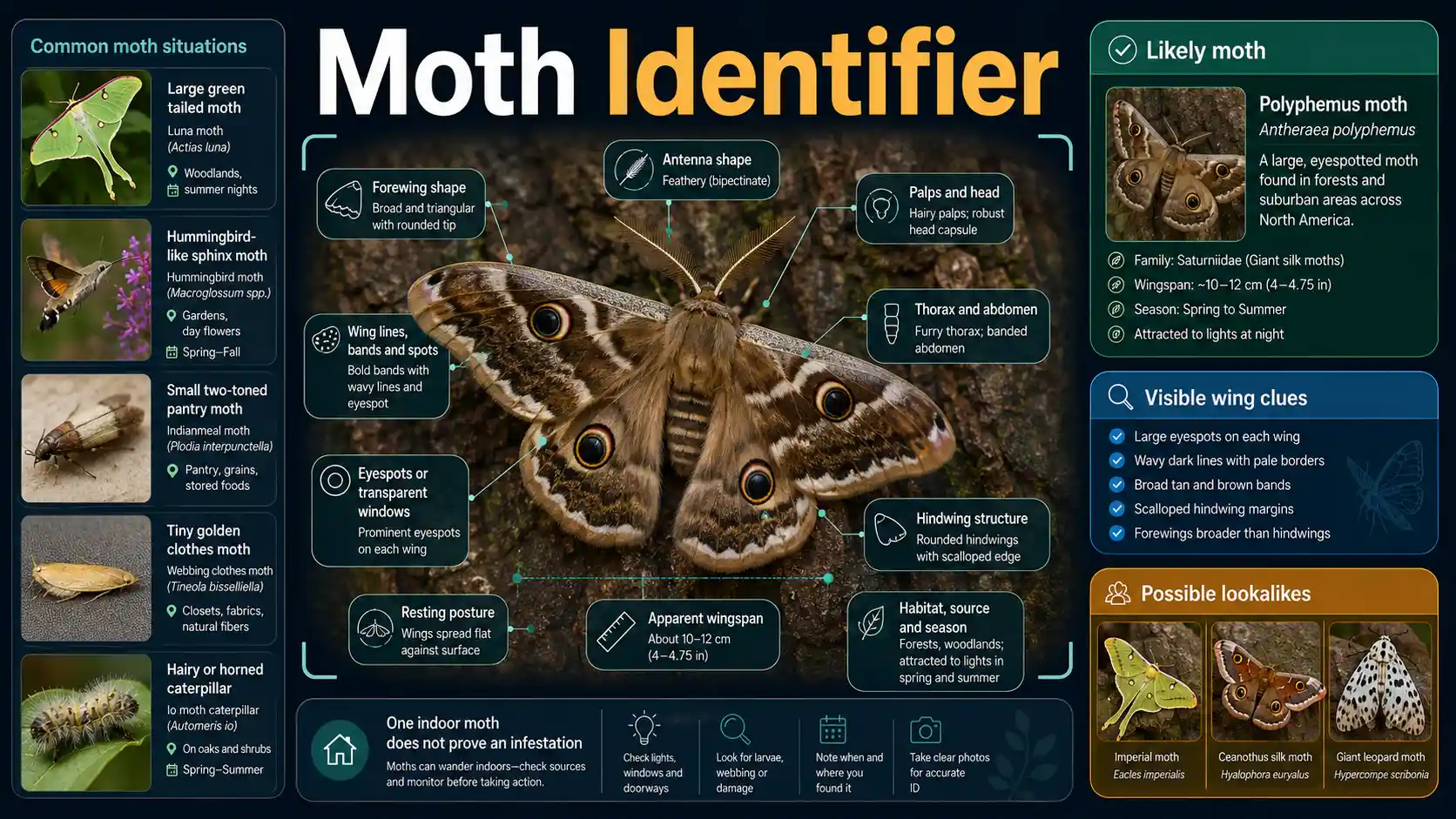
How moth identification works
Wing pattern, antennae, body, posture, life stage, source, and place build the match
Adult moth identification begins with the complete forewing outline and the exact placement of lines, bands, spots, eyespots, transparent windows, tails, margins, and color fields. The tool also compares antenna shape, palps, thorax and abdomen proportions, resting posture, apparent wingspan, scales, behavior, and whether the subject better fits a moth, butterfly, skipper, caddisfly, or another winged insect.
Date and location can eliminate many attractive but impossible matches. Indoor context also matters: a moth at a porch light, one repeatedly emerging from dry food, and a small case-bearing larva on wool present three different evidence problems. Caterpillars, cocoons, pupae, cases, and egg masses require separate life-stage comparisons and often deserve broader results than adults.
- 1Upload, take, or paste one image
Choose a file, use your phone camera, click the paste icon, or press Ctrl+V or Command+V.
- 2Add facts that the photo cannot show
Country, environment, approximate size, location, and observed behavior can narrow the answer.
- 3Review the match and its evidence
Check the likely name, confidence bar, visible clues, alternatives, safety note, and recommended next step.
Moth identification coverage
Identify garden moths, giant silkmoths, sphinx moths, household moths, caterpillars, and cocoons
The identifier covers many recognizable adult moths and broader larval, pupal, cocoon, or case-bearing groups. It stays at family, genus, species group, or uncertain Lepidoptera level when tiny scale patterns, genital characters, rearing history, host records, microscopic structures, or specialist regional comparison would be required.
Hawk and sphinx moths using streamlined wings, robust tapered bodies, hovering behavior, markings, wingspan, season, and region
Giant silkmoths such as luna-, cecropia-, polyphemus-, atlas-, emperor-, and related moth groups when eyespots, windows, tails, body, and antennae are visible
Tiger, underwing, geometer, owlet, snout, plume, clearwing, bagworm, and other recognizable moth families at a cautious level
Pantry and stored-product moths using adult pattern, larvae, webbing, food association, packaging evidence, and repeated indoor observations
Clothes moths and case-bearing larvae using adult size, head tuft, wing pattern, portable case, fibers, animal-derived material, and hidden feeding sites
Moth caterpillars, pupae, cocoons, egg masses, portable cases, shed skins, and empty cases when structure, host, source, season, and region are visible
Butterflies, skippers, caddisflies, drain flies, lacewings, artificial decorations, leaf fragments, and other moth lookalikes
Moth features that matter
Show wings, antennae, body, posture, size, source, date, and location
Color and night activity are weak evidence by themselves. Wear, sex, seasonal form, lighting, temperature, emergence, wing position, and regional variation can change appearance. A stronger match combines exact pattern placement and anatomy with measured size, behavior, life stage, host or source, season, and geographic range.
Photograph the moth without touching or forcing its wings open. Capture a clear top view, a side view, and the underside only when it appears naturally. Include a size reference, the wall, plant, fabric, food package, light, or habitat where it was found. For caterpillars, cocoons, or cases, show the complete structure, attachment, host material, markings, hairs, spines, and exact location.
- Fill most of the frame with one moth while keeping the forewings, visible hindwings, antennae, body, legs, and resting posture in view.
- Capture a direct top view and a side view because wing angle, body shape, palps, and antennae may separate close families.
- Photograph any naturally visible underside or hindwing pattern without touching the moth or forcing the wings open.
- Include a ruler, coin, window-frame width, leaf, or other nonintrusive size reference.
- Record the country, state or province, exact date, habitat, elevation, weather, time of day, and whether the moth came to a light.
- Show the host plant, flower, bark, wall, fabric, stored-food package, webbing, portable case, or other source directly associated with the specimen.
- For a caterpillar, show the head, back, side, tail, true legs, prolegs, hairs, spines, horns, shelter, droppings, and host plant.
- For a cocoon, pupa, case, or egg mass, show its attachment, construction, dimensions, substrate, nearby material, and surrounding habitat without opening it.
- Avoid flash glare on pale scales, digital zoom, crushed specimens, sticky-trap distortion, and photographs through dirty glass.
What the moth result contains
A useful match explains the anatomy, life stage, source, lookalikes, and uncertainty
The answer should state what moth or broader group best fits, which visible marks support it, what alternatives remain, and which second view, source check, host plant, or regional fact would improve confidence. It should not turn one indoor adult or a familiar wing pattern into unsupported claims about infestation, danger, rarity, migration, or legal status.
- The most likely moth common name, family, genus, or species when the visible evidence supports that precision
- A broader moth family, species group, uncertain Lepidoptera, or non-moth result when key characters are hidden
- An adult, caterpillar, pupa, cocoon, case, egg mass, shed skin, wing fragment, or uncertain life-stage assessment
- Visible evidence from wing shape, pattern placement, antennae, palps, body, scales, posture, size, behavior, and life-stage anatomy
- Relevant host plant, indoor source, habitat, elevation, date, season, time of day, light attraction, and geographic-range clues
- Plausible lookalikes and the specific wing, antenna, body, source, host, or regional clue that could separate them
- A cautious household-pest interpretation that distinguishes an incidental visitor from evidence of pantry, fabric, or plant activity
- A practical next step, safer observation guidance, and suggestions for a stronger photograph or expert verification
Common moth lookalikes
Anatomy, posture, source, and life stage separate moths from close mimics
These comparisons show why brown color, nighttime flight, wing posture, fuzziness, or an indoor location cannot identify a moth by itself.
Moth or butterfly
Many moths have threadlike or feathery antennae, while butterflies commonly have clubbed antennae. Wing scales, body, palps, antennae, resting posture, exact pattern, and life stage together are more useful than day-versus-night activity.
Hummingbird moth or bee fly
Both can hover at flowers. Check wing transparency, scale pattern, antennae, proboscis, abdomen bands, tail tuft, legs, body shape, flight behavior, size, and regional range.
Pantry moth or outdoor visitor
A two-toned adult can support Indianmeal moth, but direct stored-food association, larvae, silk webbing, repeated adults, and contaminated products are needed before concluding there is a pantry source.
Clothes moth or carpet beetle damage
Clothes-moth larvae may leave silk, cases, grazing, and damage on animal fibers. Carpet beetle larvae, physical wear, and other causes can create holes, so the insect and fresh source evidence matter.
Moth caterpillar or sawfly larva
Both can be striped, hairy, spiny, and plant-feeding. Show the head, true legs, prolegs, body posture, host plant, shelter, and feeding pattern before selecting a broader larval group.
Cocoon or portable case
A fixed silk cocoon, exposed pupa, bagworm case, clothes-moth case, caddisfly case, spider egg sac, plant gall, and debris bundle can look similar. Construction, attachment, habitat, contents, and movement are key.
Why moth identification can fail
Worn scales, hidden antennae, missing size, and weak source evidence can hide the answer
Moths can change appearance through wear, sex, seasonal form, emergence, lighting, and viewing angle. Many small species also share nearly identical forewings. A responsible result stays broad when antennae, hindwings, body, exact size, date, location, host, or household-source evidence is missing.
- The moth occupies only a tiny part of the frame and the wing lines, scales, antennae, and body cannot be resolved.
- The photograph shows only a front or side silhouette while the top-wing pattern is hidden.
- Flash glare, window glass, a sticky trap, or digital zoom changes the color and obscures scales.
- A worn, rubbed, wet, newly emerged, or damaged moth is compared with a perfect field-guide specimen.
- The date and geographic location are omitted even though many close species have different ranges and flight periods.
- Nighttime activity, dull color, fuzzy body, or wings held flat is treated as proof that the insect is a moth.
- One adult near a kitchen or closet is treated as proof of a pantry or fabric infestation without larvae, webbing, damage, or a source.
- A caterpillar is named from color without showing the head, prolegs, hairs, spines, horns, host plant, and complete body pattern.
- An empty cocoon, portable case, egg mass, wing fragment, or webbing is treated as enough evidence for an exact adult species.
- A hummingbird-like moth, giant green moth, or brown patterned moth is named from one familiar resemblance without checking anatomy, size, date, and range.
Worked moth-identification examples
Wing pattern, body form, life stage, source, date, and region narrow the match
Each case combines a close specimen photograph with measured size and the contextual facts that separate giant moths, sphinx moths, household moths, caterpillars, cocoons, and common lookalikes.
Large green moth with tails near an outdoor light
Show both wings, tail length, eyespots or transparent windows, body color, antennae, wingspan, date, and region. Luna-, moon-, swallowtail-, and other green moth lookalikes can differ in hindwing tails, discal marks, margins, and geographic range.
Hummingbird-like moth hovering at flowers
A sharp frame showing transparent or scaled wings, abdominal bands, tail tuft, antennae, proboscis, hovering posture, flower, size, date, and region can compare hummingbird clearwings, other sphinx moths, carpenter bees, bee flies, and actual hummingbirds.
Small two-toned moth flying in a kitchen
Photograph the folded forewings, head, antennae, size, and any larvae or webbing directly inside dried food. A small moth in a kitchen is not automatically an Indianmeal moth unless the pattern and stored-product source agree.
Tiny golden moth or portable case in a closet
Compare adult head tuft, wing spots, size, running behavior, larval case, silk, hairs, wool, fur, feathers, or other animal-derived material. Fabric holes without an insect may also come from carpet beetles or physical wear.
Hairy or horned caterpillar on a garden plant
Show the complete body, head capsule, hairs, spines, horns, prolegs, stripes, spots, shelter, droppings, exact host plant, measured length, date, and region. Avoid bare-skin contact because some larvae can irritate skin.
Observe without harming the insect or treating the wrong source
Avoid handling unknown caterpillars and confirm an indoor source before control
Do not touch an unknown hairy or spiny caterpillar with bare skin, force open a cocoon, or handle delicate moth wings. One adult indoors does not prove a pantry or clothes-moth infestation. Confirm the insect and active source before applying pesticides, discarding food, or treating fabrics.
Wait for natural wing positions, photograph from several angles, and leave cocoons, pupae, and egg masses attached unless a qualified local expert directs otherwise. Avoid bare-skin contact with unknown hairy or spiny larvae. One moth indoors may be an incidental visitor, so identify the insect and active source before applying pesticides, moth-control products, discarding food, or treating fabrics.
Choose the next identification step
Use another workflow when the subject or evidence is broader than a moth
Questions about identifying moths by photo
Direct answers before you upload a moth picture
Can I identify a moth from a photo online?
Yes. A sharp top and side view, location, date, wingspan, resting posture, habitat, behavior, and host or indoor source can often support a family, genus, or species suggestion.
What moth is this?
Start with wing shape, pattern placement, antennae, palps, body form, size, posture, date, habitat, and location. Several independent clues are stronger than color alone.
How can I tell a moth from a butterfly?
Use several features together. Many moths have threadlike or feathery antennae, while butterflies commonly have clubbed antennae, but activity time, color, body hair, and resting posture are not universal rules.
Can a large green moth be identified as a luna moth from color alone?
No. Compare hindwing tails, eyespots, transparent windows, margins, body, antennae, wingspan, date, and geographic range before choosing a luna or related moth.
Can the tool identify a hummingbird moth?
It can compare likely sphinx or clearwing moths using wing transparency, body bands, tail tuft, antennae, proboscis, hovering behavior, flower use, size, season, and range.
Can it identify a small brown moth?
Sometimes, but many small brown moths require close wing lines, antennae, palps, body shape, measured size, date, region, and direct host or source evidence.
Does one moth in my kitchen prove a pantry infestation?
No. Look for larvae, silk webbing, contaminated dry food, repeated adults, or a specimen directly associated with a package before concluding that stored food is infested.
How do I identify an Indianmeal moth?
Adults often show pale gray or tan at the wing base and a reddish-brown or coppery outer section. Confirm the match with size, folded-wing pattern, larvae, webbing, and a stored-food source.
Does one moth in a closet prove clothes-moth damage?
No. Confirm the adult or larva and inspect wool, fur, feathers, hair, silk cases, webbing, hidden feeding sites, and fresh damage. Carpet beetles and wear can create similar holes.
Can the tool identify a clothes moth?
It can compare webbing and casemaking clothes moths using adult size, golden or spotted wings, head tuft, larval case, silk, feeding material, and indoor location.
Can it identify a moth caterpillar?
Sometimes. Show the head, body markings, hairs, spines, horns, true legs, prolegs, exact host plant, measured length, date, and location. Many larvae remain difficult from photos.
Can it identify a cocoon, pupa, or bagworm case?
It may narrow a group using construction, fibers, incorporated debris, shape, attachment, substrate, host, season, and region. An exact adult species may not be defensible.
Are moths always active at night?
No. Many moths fly during daylight or twilight, and some butterflies rest or fly in dim conditions. Activity time is context, not a universal identification rule.
Can a photo confirm that a moth is rare, protected, or invasive?
No. A likely match can justify expert review, but legal, conservation, and invasive status require confirmed identity, exact locality, date, and current regional information.
Should I use pesticide as soon as I find a moth indoors?
No. Identify the moth and active source first. Outdoor visitors, pantry moths, clothes moths, drain flies, and other small insects require different responses.
Why did the Moth Identifier return low confidence?
Low confidence usually means the moth is blurred, worn, tiny, partly hidden, photographed through glass or a trap, missing antennae, or belongs to a group separated by microscopic or specialist characters.
Are uploaded moth photos permanently stored by SnapIdentify?
SnapIdentify processes the normalized image for the request and does not intentionally write it to local disk. The configured AI provider processes the image under its service terms.
Authoritative moth anatomy and identification references
Verify difficult moth, caterpillar, cocoon, and household-source matches
These museum, observation, and extension resources explain moth anatomy, scaled wing patterns, antennae, major families, date and location records, host plants, and the evidence needed before calling an indoor moth a pantry pest.
- Smithsonian Institution — Moths
The Smithsonian explains moth wing scales, coiled feeding tubes, common antenna differences, major moth families, and the wide variety of moth colors, patterns, sizes, and life histories.
- Butterflies and Moths of North America — Identify a Butterfly, Moth, or Caterpillar
BAMONA emphasizes date, location, regional records, photographs, and host-plant information, and notes that many caterpillar stages remain difficult to identify from images.
- University of Minnesota Extension — Pantry Pests in Stored Food
UMN Extension explains Indianmeal moth appearance, larvae, silk webbing, stored-food associations, and why not every small moth found indoors is a pantry pest.