Gilled mushrooms through cap, gill, stem, veil, base, bruising, spore, habitat, and geographic clues
Compare mushroom anatomy, habitat, substrate, and lookalikes from one photo
Free AI Mushroom Identifier by Picture
Upload or paste clear photographs of one intact mushroom. This free mushroom identifier by picture compares the cap, underside, gills, pores or teeth, stem, ring, complete base, bruising, growth pattern, substrate, season, and location. It returns the most defensible taxonomic match, explains the visible evidence, and highlights lookalikes without claiming that the mushroom is edible or safe.
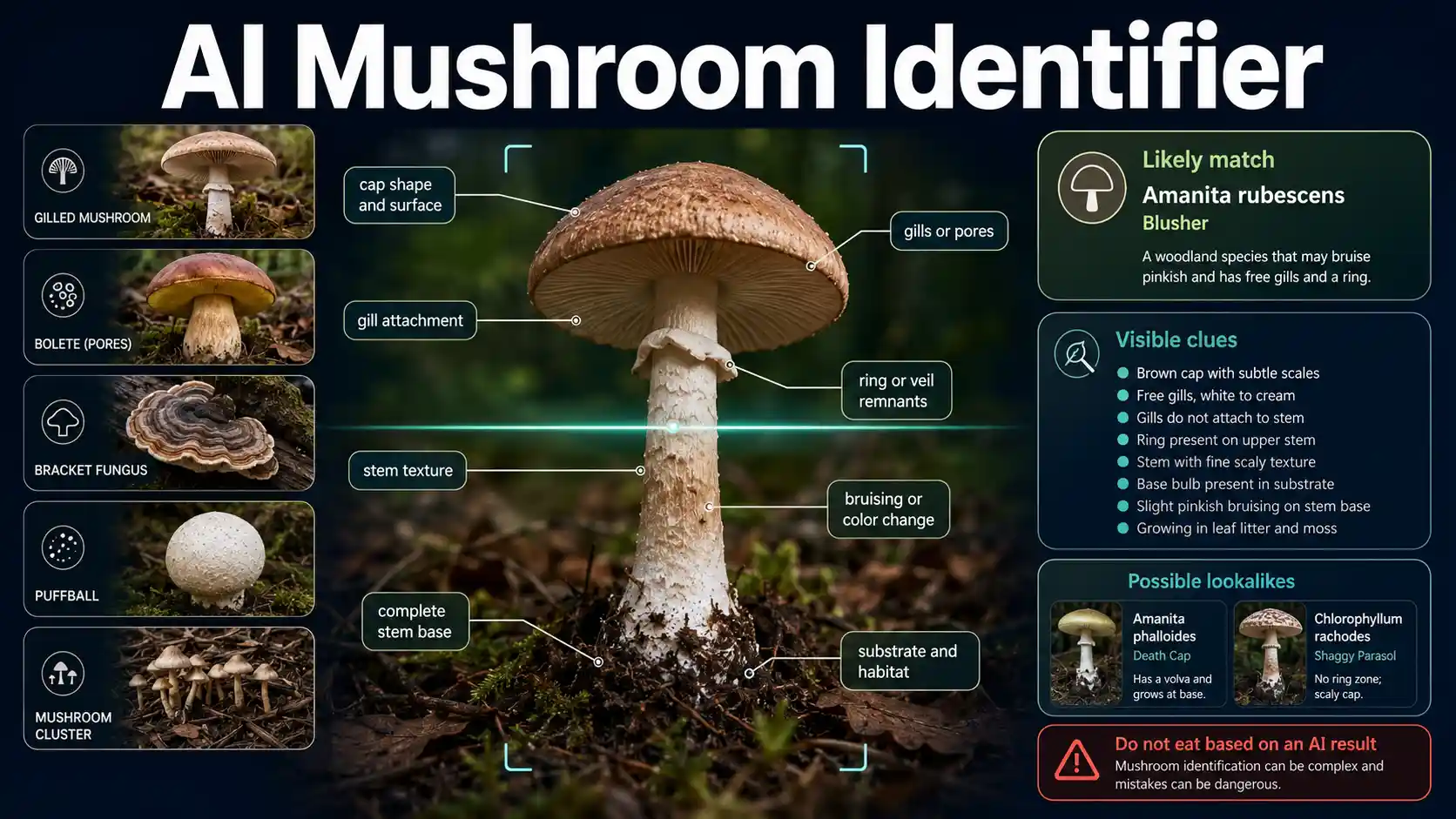
How mushroom identification works
Several independent fungal features must support the same match
The analysis begins with the mushroom's overall form, then checks the cap, underside, stem, veil structures, complete base, bruising, spore evidence, substrate, growth pattern, and maturity. One attractive cap photograph rarely contains enough evidence for a species-level answer.
A person who wants to identify a mushroom from a photo online should also provide the country or region, habitat, season, associated trees, exact substrate, and approximate size. These facts can remove candidates that look similar but do not occur or grow in the same setting.
- 1Upload, take, or paste one image
Choose a file, use your phone camera, click the paste icon, or press Ctrl+V or Command+V.
- 2Add facts that the photo cannot show
Country, environment, approximate size, location, and observed behavior can narrow the answer.
- 3Review the match and its evidence
Check the likely name, confidence bar, visible clues, alternatives, safety note, and recommended next step.
Fungal identification coverage
Compare gilled mushrooms, boletes, brackets, puffballs, and other fungi
The tool supports wild mushroom identification from photos of intact specimens and their habitat. It returns a broader group when maturity, microscopic traits, chemistry, DNA, or expert field examination is needed for a responsible species name.
Boletes and other pored mushrooms through pore color, tube layer, staining, stem texture, cap surface, and associated trees
Bracket fungi and polypores growing on logs, trunks, stumps, roots, buried wood, or living trees
Puffballs, earthballs, earthstars, stinkhorns, cup fungi, coral fungi, jelly fungi, and other distinctive fruiting forms
Common lawn, mulch, woodland, grassland, garden, compost, and wood-decay mushroom groups
Broader genus, family, or morphological groups when a precise species cannot be separated without microscopy, chemistry, or DNA evidence
Non-mushroom lookalikes such as lichens, slime molds, plant galls, insect structures, foam, and decaying organic material
Mushroom features that matter
Photograph the underside, stem, complete base, substrate, and habitat
Color can change with age, moisture, handling, and light. A stronger match combines independent structures and ecological context from the same intact specimen.
Photograph the mushroom where it is growing before moving it. Include the cap from above, the entire underside, a side view, the complete stem base with surrounding soil or wood, nearby specimens at different ages, and the substrate. Add approximate size, country or region, habitat, season, odor without tasting, bruising changes, and an optional spore-print color.
- Photograph the mushroom in place before removing or disturbing it.
- Show the cap from directly above in neutral daylight without filters or flash glare.
- Photograph the complete underside so gills, pores, teeth, ridges, and their attachment are visible.
- Include the full stem and carefully expose the complete base; a buried cup, bulb, or rooting section can be decisive.
- Show young, mature, and older specimens when several stages grow together, but keep different species separate.
- Include the exact substrate, such as soil, lawn, mulch, dung, living tree, dead log, stump, cone, or buried wood.
- Add a ruler or familiar object for cap width and stem length without obscuring the specimen.
- Record the country or broad region, habitat, recent weather, season, associated trees, odor without tasting, and any bruising change.
- An optional spore print can add evidence, but spore color alone cannot establish identity or edibility.
What the mushroom result contains
A responsible result explains the match without deciding edibility
The answer should identify only to the level supported by the photograph, explain which structures fit, list realistic lookalikes, request missing evidence, and keep food-safety decisions outside the AI result.
- The most likely common and scientific name only when the visible evidence supports that level
- A broader genus, family, order, or morphological group when species-level evidence is missing
- A high, moderate, or low qualitative confidence label without false numerical precision
- Visible evidence from the cap, underside, stem, ring, veil, complete base, bruising, substrate, and growth form
- Plausible lookalikes and the exact feature or test that would help separate them
- The apparent developmental stage and whether missing maturity may be hiding important structures
- A request for a better underside, base, habitat, scale, spore print, or expert examination when needed
- The mandatory warning that an online or AI result cannot establish whether a mushroom is safe to eat
Mushroom lookalike comparisons
Edible and toxic fungi can share the same general appearance
A mushroom lookalike identifier must compare several features together. These examples explain why one cap color, one folk rule, or one distant photograph cannot establish identity or safety.
True morel or false morel
Cap attachment, internal chambers, whether the specimen is hollow, folds versus pits, stem structure, and region help separate groups. An image result must not approve either for eating.
Chanterelle-like mushroom or false chanterelle and jack-o'-lantern
Blunt forked ridges differ from thin blade-like gills, while growth from soil or buried roots differs from dense clusters on wood. Color alone is not reliable.
Puffball, earthball, or immature Amanita
A true puffball should show a uniform internal spore mass at the correct stage. Cutting an immature Amanita can reveal developing cap, gills, and stem inside; do not consume a specimen based on a photograph or simple cut test.
Honey-mushroom group or deadly Galerina and other brown wood fungi
Gill color, ring, cap surface, stem texture, clustering, substrate, spore print, season, and microscopy may be needed. Small brown mushrooms should be treated as unresolved when key features are missing.
Parasol-like mushroom, false parasol, or Amanita
Cap scales, movable or fixed ring, gill color, stem pattern, complete base, spore color, bruising, and maturity matter. The missing base can hide the most important feature.
Oyster-like shelf mushroom or another pale wood fungus
Attachment, stem position, gill structure, cap texture, substrate, growth season, spore evidence, and microscopic traits can separate several pale overlapping fungi.
Why mushroom identification can fail
The most decisive structure is often the part left out of the photo
Mushroom appearance changes quickly with age, rain, drying, damage, and development. Missing the underside, complete base, substrate, or geographic context can turn a plausible species suggestion into an unsafe guess.
- Only the top of the cap is photographed while the underside, stem, and base remain hidden.
- The mushroom is cut at ground level, removing a bulb, volva, cup, rooting base, or substrate attachment.
- Several different mushroom species are mixed in one basket or image without identifying the intended subject.
- The specimen is an immature button whose gills, pores, veil, cap shape, and mature colors have not developed.
- A cooked, dried, crushed, frozen, peeled, or partially eaten mushroom is submitted after key structures are lost.
- Artificial light, filters, wet surfaces, or overexposure distort cap, gill, pore, bruise, and spore colors.
- No geographic region, habitat, substrate, associated tree, season, or accurate size is provided.
- A spore print, folk test, cap color, odor, animal feeding, or prior experience is treated as proof of edibility.
- The upload shows symptoms after ingestion rather than the remaining intact mushroom specimen and exposure details.
Worked mushroom-identification scenarios
Real field situations show how visual clues and context work together
Each scenario uses a natural mushroom question and then identifies the additional photographs, habitat facts, and safety limits needed for a useful answer.
Unknown gilled mushroom in woodland soil
Someone asking what mushroom is this by picture should show the cap, gill attachment, ring, full stem base, surrounding leaf litter, nearby trees, size, and region. A top-only brown cap cannot separate many harmless and dangerous lookalikes.
Small brown mushrooms growing through mulch
A mushroom lookalike identifier needs close views of several developmental stages, gill color, stem texture, veil remnants, spore print, clustering pattern, and the wood-rich substrate. Many unrelated species fit the label small brown mushroom.
Morel-shaped fungus collected in spring
Wild mushroom identification from a photo should include a lengthwise section showing whether the cap and stem are hollow, how the cap attaches, the chamber structure, substrate, trees, and region. Those details help compare true morels with false morels without making an edibility decision.
Shelf fungus attached to a dead log
Photograph the upper surface, pore or gill-like underside, attachment point, thickness, texture, bruising, log species when known, and several age stages. A side-on distance shot usually supports only a broad polypore group.
Mushrooms gathered during a foraging trip
A mushroom identifier for foraging can organize visible clues and suggest taxonomic possibilities, but it cannot approve the collection for food. Keep each species separate, preserve the base, record the habitat, and obtain qualified local verification before any culinary decision.
Mandatory mushroom safety boundary
A mushroom identifier for foraging cannot approve food
Do not eat a mushroom based only on an online or AI identification. Toxic species can closely resemble edible species, and a photograph cannot prove culinary safety. If a person or animal may have swallowed an unknown mushroom, contact an appropriate poison, emergency, medical, or veterinary service immediately.
Cooking, peeling, soaking, silver-spoon tests, animal feeding, smell, taste, and prior experience do not reliably establish safety. Obtain qualified local mycological confirmation for any culinary decision. After a suspected ingestion, contact an appropriate poison, emergency, medical, veterinary, or animal poison service immediately and preserve specimens when possible.
Choose the workflow that matches the subject
Separate fungi from plant symptoms and other lookalikes
Questions about mushroom identification by photo
Direct answers before you upload a mushroom picture
Can I identify a mushroom from a photo online?
Yes. Clear photographs can support a likely genus, family, species group, or species when the cap, underside, stem, base, substrate, size, and location are visible.
Is this AI mushroom identifier free to use?
Yes. The current browser tool accepts a supported photo and returns a likely match, visible clues, lookalikes, confidence, and a safer next step without requiring an app installation.
Can I use the mushroom identifier online without an app?
Yes. Choose a file, take a phone photo, drag an image into the uploader, or paste an image from the clipboard in a modern browser.
Can an edible mushroom identifier by photo confirm that it is safe?
No. Do not eat a mushroom based only on an online or AI identification. Toxic species can closely resemble edible species, and important evidence may be invisible in a photograph.
Can a poisonous mushroom identifier by picture prove toxicity?
No. A photo may flag a potentially dangerous group or lookalike, but toxicity and exposure risk require expert identification and, in some cases, specialist testing.
What photographs give the best mushroom identification?
Show the cap top, complete underside, side profile, full stem and base, nearby age stages, substrate, habitat, scale, and any bruising or staining in natural light.
Why is the complete stem base important?
A buried cup, bulb, rim, rooting section, mycelial attachment, or substrate connection can distinguish groups that otherwise have similar caps and gills.
Does a spore print identify a mushroom?
A spore print adds useful color evidence, but it rarely proves a species by itself and never establishes edibility. Combine it with anatomy, substrate, habitat, and expert review.
Can the tool identify a mushroom from the cap alone?
Usually not reliably. Many species share cap colors and shapes, while the underside, stem, ring, base, bruising, spores, habitat, and age carry decisive clues.
Do location and substrate improve the result?
Yes. Country, region, season, habitat, associated trees, and whether the fungus grows on soil, lawn, dung, mulch, living wood, or dead wood can remove many lookalikes.
Can a cooked or dried mushroom still be identified?
Sometimes only broadly. Cooking, drying, cutting, and cleaning can remove colors, odors, gills, veil remnants, the stem base, and other structures required for a reliable match.
What should I do if someone ate an unknown mushroom?
Contact an appropriate local poison center or emergency medical service immediately. Do not wait for symptoms, and preserve remaining uncooked specimens and photographs for professional identification.
What should I do if a pet ate a wild mushroom?
Contact a veterinarian or animal poison service promptly. Save an intact specimen and habitat photos when this can be done safely, but do not delay professional advice for an online result.
Why did the mushroom result return low confidence?
Low confidence usually means the image hides the underside or base, shows an immature or damaged specimen, mixes species, lacks scale or habitat, or requires microscopy or chemistry.
Are uploaded mushroom photos permanently stored by SnapIdentify?
SnapIdentify processes the normalized image for the request and does not intentionally write it to local disk. The configured AI provider processes it under its service terms.
Authoritative mushroom and poison guidance
Verify fungal identity and respond quickly to possible ingestion
These mycological, poison-information, and public-health resources explain identification evidence, spore prints, dangerous lookalikes, and the need for expert or poison-center involvement.
- Poison Control — Wild Mushroom Warning
Poison Control explains that toxic and edible mushrooms can look alike and lists cap, underside, stalk, base, spore, growth pattern, and substrate features used by experts.
- North American Mycological Association — How to Make a Spore Print
NAMA explains how spores are deposited from gills and pores and how a spore print can reveal supporting color evidence for identification.
- CDC MMWR — Amanita Mushroom Poisonings, 2025–2026
CDC documents severe and fatal poisonings caused by toxic mushrooms resembling edible species and emphasizes expert identification and poison-center response.