Visual resemblance to recognized shorthaired, longhaired, rex-coated, hairless, colorpoint, bobtailed, curled-ear, folded-ear, and naturally spotted breed profiles
Compare domestic cat breed traits from one clear full-body photo
Cat Breed Identifier with Visual Breed Clues
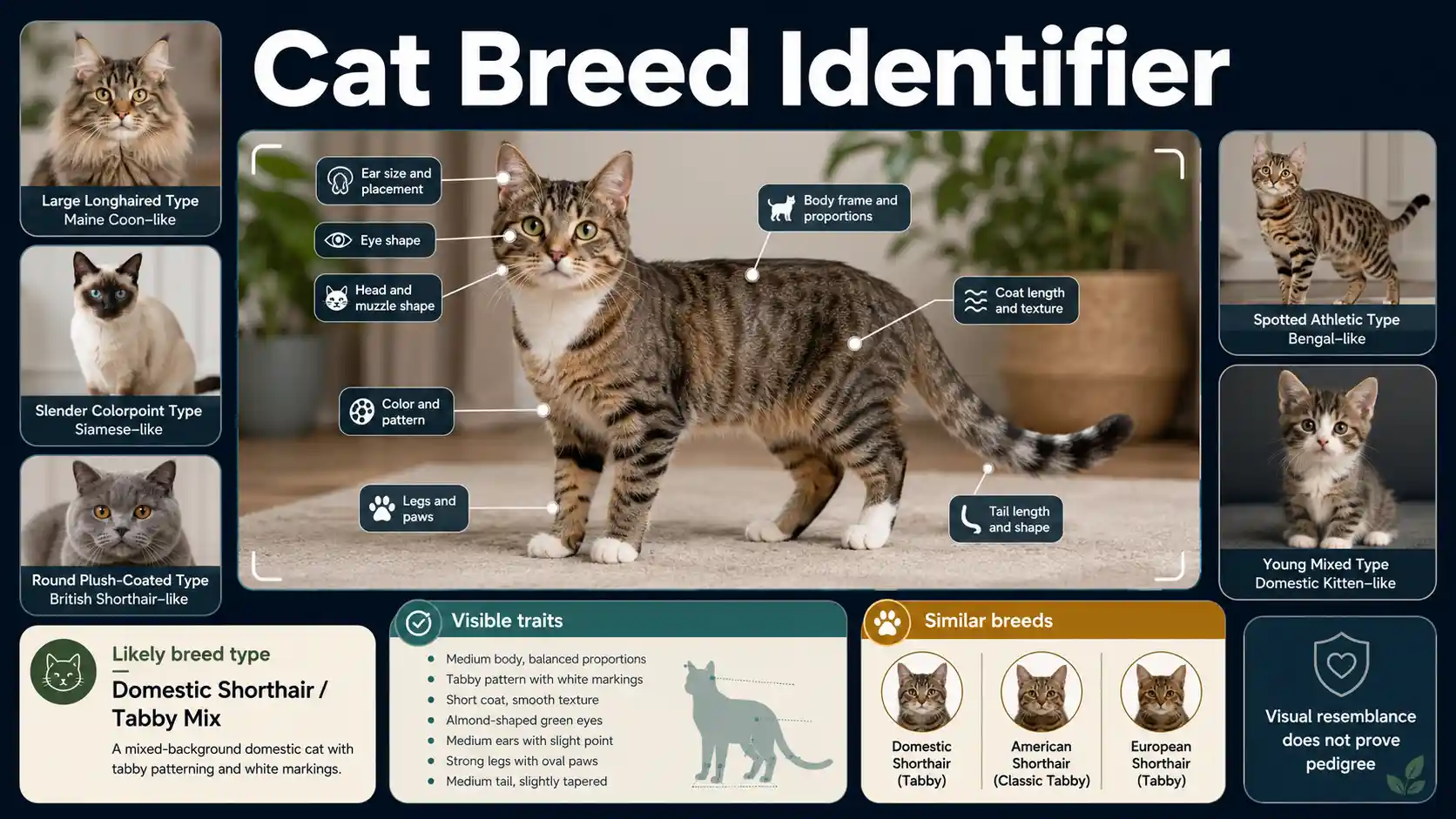
Upload or paste a clear picture of one cat. This Cat Breed Identifier compares body frame, head and muzzle shape, ear set, eye shape, coat length and texture, color pattern, legs, paws, and tail with recognized breed profiles. It returns the most defensible visual resemblance, explains the supporting traits, and keeps domestic mixed-breed, pedigree, ancestry, health, and temperament limits clear.
How visual cat breed comparison works
Body frame, head, coat, and tail suggest resemblance rather than pedigree
The tool first confirms that the subject appears to be one domestic cat. It then compares the complete body frame, head and muzzle, ears, eyes, coat, markings, legs, paws, and tail with recognized breed standards and broader domestic-cat types.
A distinctive pedigreed adult may resemble one breed strongly. A rescue, shelter, or mixed-background cat often shares traits with several breeds, so the responsible answer explains visual similarity without inventing parent breeds, pedigree, or ancestry percentages.
Age, grooming, seasonal coat, body condition, pregnancy, illness, wide-angle distortion, and unusual posture can change the visible silhouette. A full standing side view and a clear front-facing head photograph reduce those errors.
Visual breed matching is most useful as a starting point, especially for rescue and mixed-background cats. For a second photo-based perspective, you can ask What breed is my cat and compare the suggested physical traits with your cat’s full-body build, coat, head, ears, eyes, and tail. Treat either result as visual guidance rather than proof of pedigree or genetic ancestry.
- 1Upload, take, or paste one image
Choose a file, use your phone camera, click the paste icon, or press Ctrl+V or Command+V.
- 2Add facts that the photo cannot show
Country, environment, approximate size, location, and observed behavior can narrow the answer.
- 3Review the match and its evidence
Check the likely name, confidence bar, visible clues, alternatives, safety note, and recommended next step.
Cat breed and domestic-cat coverage
Compare recognized breed profiles, mixed cats, rescues, and kittens
Cat Breed Identifier supports cautious comparison across recognized breeds and common domestic-cat classifications. It returns a broader body or coat type when the photograph does not justify one exact breed.
Domestic shorthair, domestic mediumhair, domestic longhair, random-bred, rescue, shelter, and mixed-background cats that do not fit one pedigree standard
Kittens and adolescents when age-related uncertainty is kept explicit and a later adult comparison may be needed
Broad body types such as slender oriental, moderate, semi-cobby, cobby, substantial forest-cat, muscular, long-bodied, and short-legged profiles
Coat types including short, plush, long, semi-long, curly, wavy, wire-like, sparse, hairless, double-coated, and heavily furnished coats
Color and pattern traits such as tabby, tortoiseshell, calico, tuxedo, bicolor, colorpoint, smoke, shaded, tipped, solid, rosetted, spotted, and dilute patterns without treating them as breeds
Wild-felid-like, dog-like, toy, sculpture, and multi-animal images at a broader category level when the subject is not clearly one domestic cat
Feline features that matter
Show the full body, head, coat, paws, and tail
One coat color or facial trait rarely establishes a breed. Stronger comparisons combine several independent features visible on the same cat.
Photograph the cat standing naturally from the side, then add a front view of the face and a clear image of the coat and tail. Use daylight, keep the full body visible, and state the known age, measured weight if available, grooming history, and whether pedigree records exist.
- Use one sharp full-body side view with the cat standing naturally and all four legs visible.
- Add a front-facing head photo that shows the skull, muzzle, nose profile, chin, ears, and eye shape.
- Photograph the tail from base to tip without forcing the cat into position.
- Use neutral daylight so coat color, ticking, points, tabby markings, and eye color are not distorted.
- Brush aside loose surface hair only if the cat is comfortable; do not shave or wet the coat for identification.
- Include a measured weight or a familiar object for scale instead of guessing size from perspective.
- State the cat's known age because kittens can have different proportions, coat texture, and eye color from adults.
- Mention recent grooming, clipping, matting, illness, pregnancy, or weight change when it affects the silhouette.
- Provide pedigree or adoption records separately when available, but do not assume a shelter label proves ancestry.
What the cat breed result contains
A useful result explains resemblance, alternatives, and ancestry limits
The answer should state which physical traits support the leading visual match, which breeds or domestic-cat types remain plausible, what may be altered by age or grooming, and why appearance does not establish pedigree.
- The most likely visual breed resemblance or broader domestic-cat type
- A high, moderate, or low confidence label without fabricated percentages
- Visible evidence from body frame, head, ears, eyes, coat, pattern, legs, paws, and tail
- Realistic alternative breeds or domestic-cat classifications that share the same appearance
- An explanation of which traits are coat colors or patterns rather than breed-defining evidence
- Life-stage, grooming, body-condition, and camera-angle factors that may change the comparison
- A clear distinction between appearance, pedigree, registered lineage, parentage, and genetic testing
- A practical next step such as better photos, record review, breeder documentation, or veterinary consultation
Common cat breed lookalikes
Shared coats and body types can connect unrelated cats
These comparisons show why several independent traits and reliable records matter more than one familiar color, pattern, or popular label.
Maine Coon, Norwegian Forest Cat, or Siberian
All can be large and longhaired. Head profile, muzzle, ear set, body proportions, coat texture, chest, paws, tail, seasonal coat, and pedigree documentation separate the standards; a domestic longhair may resemble all three.
Siamese, Thai, Tonkinese, or mixed colorpoint
Blue eyes and dark points are not enough. Head shape, ear size, body length, coat, point contrast, eye shape, tail, and verified lineage matter.
British Shorthair, Chartreux, Russian Blue, or Korat
Blue-gray color overlaps. Skull, muzzle, ear placement, eye color, body substance, coat density, tail, and accepted standard traits provide better evidence.
Bengal, Egyptian Mau, Ocicat, or spotted tabby
Spots alone do not prove a breed. Rosette structure, coat texture, body, head, ears, belly pattern, tail, lineage, and documented breeding history are important.
Persian, Exotic Shorthair, or domestic cat with a short muzzle
Face depth, nose placement, skull, ears, eyes, body, coat length, tail, breathing comfort, and pedigree separate them; facial appearance should never be used to diagnose health.
Manx, Japanese Bobtail, American Bobtail, or injured tail
Tail length and shape, vertebral structure, body type, hindquarters, gait, coat, records, and veterinary history matter. A short or absent tail alone does not prove a breed.
Why cat breed identification can fail
A coat pattern can be common even when the breed is rare
Visual labels become unreliable when the image hides the body, the cat is young, grooming changes the coat, or a common color pattern is mistaken for one pedigree breed.
- Only the face is visible, so body frame, legs, paws, coat length, and tail cannot be compared.
- A tabby, tuxedo, calico, tortoiseshell, black, white, orange, or colorpoint pattern is treated as a breed.
- Long hair and a large body are assumed to prove Maine Coon ancestry.
- Blue eyes and dark points are assumed to prove Siamese ancestry.
- One unusual trait such as folded ears, curled ears, a bobtail, extra toes, or sparse hair is treated as sufficient proof.
- The cat is a young kitten whose adult body, ears, coat, eye color, and tail proportions are still developing.
- Heavy grooming, shaving, matting, wet fur, obesity, pregnancy, or illness changes the natural outline.
- A shelter, marketplace, or social-media label is repeated as though it were verified pedigree documentation.
- A close wide-angle phone photo enlarges the face or nose and hides the cat's true proportions.
- The result is used to predict temperament, health, allergen production, care needs, or compatibility.
Worked cat breed-identification scenarios
Full-body structure and records make the comparison more responsible
Each scenario combines visible morphology with age, grooming, scale, and documentation while avoiding unsupported pedigree, ancestry, personality, or health claims.
Large longhaired rescue cat with ear tufts
A full standing profile, muzzle shape, ear set, chest, paw size, coat texture, tail plume, measured weight, and age can compare Maine Coon, Norwegian Forest Cat, Siberian, and domestic longhair resemblance without declaring pedigree.
Slender colorpoint cat with blue eyes
Head wedge, ear size, body length, legs, tail, coat length, point contrast, voice only if independently observed, and records help compare Siamese, Balinese, Thai, Tonkinese, Colorpoint Shorthair, and mixed colorpoint cats.
Round-faced plush blue cat
Skull roundness, muzzle, nose profile, ear placement, eye color, body substance, coat density, tail, and verified lineage can separate British Shorthair, Chartreux, Russian Blue, Korat, and blue domestic shorthair lookalikes.
Spotted or rosetted shelter cat
True rosettes, spotting pattern, body type, head, ears, tail, coat sheen, belly markings, behavior context, and documentation can compare Bengal-like resemblance with Egyptian Mau, Ocicat, tabby, and mixed domestic cats.
Young kitten with uncertain adult traits
A kitten breed identifier should use current coat, head, ears, paws, tail, litter information, and known parentage cautiously, then recommend another comparison after adult proportions and coat develop.
Use the breed result responsibly
Breed resemblance is not a medical, behavior, or pedigree determination
A photograph can suggest which established breeds or body types a cat resembles, but it cannot prove pedigree, ancestry percentages, temperament, health, or future care needs. Use veterinary records, registration documents, verified parentage, and appropriate genetic tests when those questions matter.
Do not use a visual result to diagnose disease, select medication, predict temperament, choose breeding pairs, advertise a cat as purebred, set a sale price, or make housing and insurance decisions. A veterinarian can assess health, while pedigree records and verified parentage address lineage questions.
Choose the correct identification path
Wild felids, dogs, and unclear scenes need a different specialist
Questions about cat breed identification by photo
Direct answers before you upload a cat picture
Can a cat breed be identified from a photo?
A photo can suggest which breeds or body types a cat resembles. It cannot prove pedigree, parentage, or exact genetic ancestry.
What breed is my cat if it came from a shelter?
Many shelter cats are domestic shorthairs, mediumhairs, longhairs, or mixed-background cats. Compare visible traits, but treat an unverified shelter breed label as a description rather than pedigree.
Can the tool identify a mixed-breed cat?
It can describe a mixed cat's visible breed-like traits and alternatives, but it should not invent parent breeds or ancestry percentages from appearance.
Can it identify a kitten's breed?
It can suggest likely types, but kitten proportions, eye color, coat density, markings, and ear size can change. An adult follow-up photo is often more reliable.
Is domestic shorthair a specific pedigree breed?
No. Domestic shorthair usually describes a non-pedigreed shorthaired cat rather than one standardized breed.
Is tabby a cat breed?
No. Tabby describes a family of coat patterns that occurs in many recognized breeds and mixed domestic cats.
Is a tuxedo cat a breed?
No. Tuxedo describes a black-and-white bicolor pattern, not a single breed or guaranteed personality type.
Does long hair mean my cat is a Maine Coon?
No. Many domestic longhairs and several recognized breeds have long coats. Body frame, head, muzzle, ears, paws, tail, coat texture, and records must be considered together.
Do blue eyes and dark points prove a Siamese cat?
No. Colorpoint coloring and blue eyes occur in several breeds and mixed cats. Head, body, coat, tail, and documented lineage provide additional evidence.
Can a black cat's breed be identified from color alone?
No. Solid black occurs across many breeds and domestic cats. Build, head, ears, coat texture, eye color, tail, and pedigree evidence matter more.
Can a cat breed be identified from its face only?
A face can narrow possibilities, but a responsible comparison also needs the full body, coat, legs, paws, tail, size, and age.
Can the result provide exact breed percentages?
No. Exact ancestry percentages cannot be calculated reliably from a photograph and should not be fabricated.
Can DNA testing confirm a cat's breed?
Available feline DNA tests may assess parentage, traits, or health variants, but some laboratories explicitly state that they do not offer a general cat breed-composition test. Review the exact test purpose before buying.
Can appearance predict a cat's personality?
No. Breed-like appearance cannot establish affection, aggression, vocality, intelligence, activity, or suitability for a household. Evaluate the individual cat's observed behavior.
Can the tool diagnose breed-related health problems?
No. A visual breed suggestion is not a diagnosis. A veterinarian should assess symptoms and recommend any appropriate examination or testing.
Can grooming change the breed result?
Yes. Shaving, clipping, matting, brushing, wet fur, and seasonal coat can change apparent texture, length, body outline, and tail fullness.
Are uploaded cat photos permanently stored by SnapIdentify?
SnapIdentify processes the normalized image for the request and does not intentionally write it to local disk. The configured AI provider processes it under its service terms.
Breed standards and feline genetic-testing limits
Compare established standards without overstating ancestry
These registry and veterinary-genetics sources describe recognized breed morphology and clarify what feline DNA and parentage tests can and cannot establish.
- TICA Cat Breed Standards
The International Cat Association publishes breed standards that describe recognized feline body, head, ear, eye, coat, color, and tail characteristics.
- UC Davis Veterinary Genetics Laboratory — Cat Testing
The UC Davis laboratory lists feline parentage, health, and coat-trait tests and explicitly notes that it does not offer a general cat breed test.