Dogs that closely resemble a recognized breed when the full body and distinctive structure are visible
Compare visible dog traits without treating appearance as proof of pedigree
Dog Breed Identifier with Visual Breed Clues
Use this Dog Breed Identifier when you have a clear photo of a pet, rescue dog, shelter dog, puppy, or unknown dog and want to compare its visible traits with established breed profiles. The tool examines size, body proportions, head and muzzle shape, ear carriage, coat type, color pattern, tail, legs, paws, and overall outline. It can suggest likely breeds or breed groups, but a picture cannot prove pedigree, assign reliable ancestry percentages, or reveal every breed in a mixed dog.
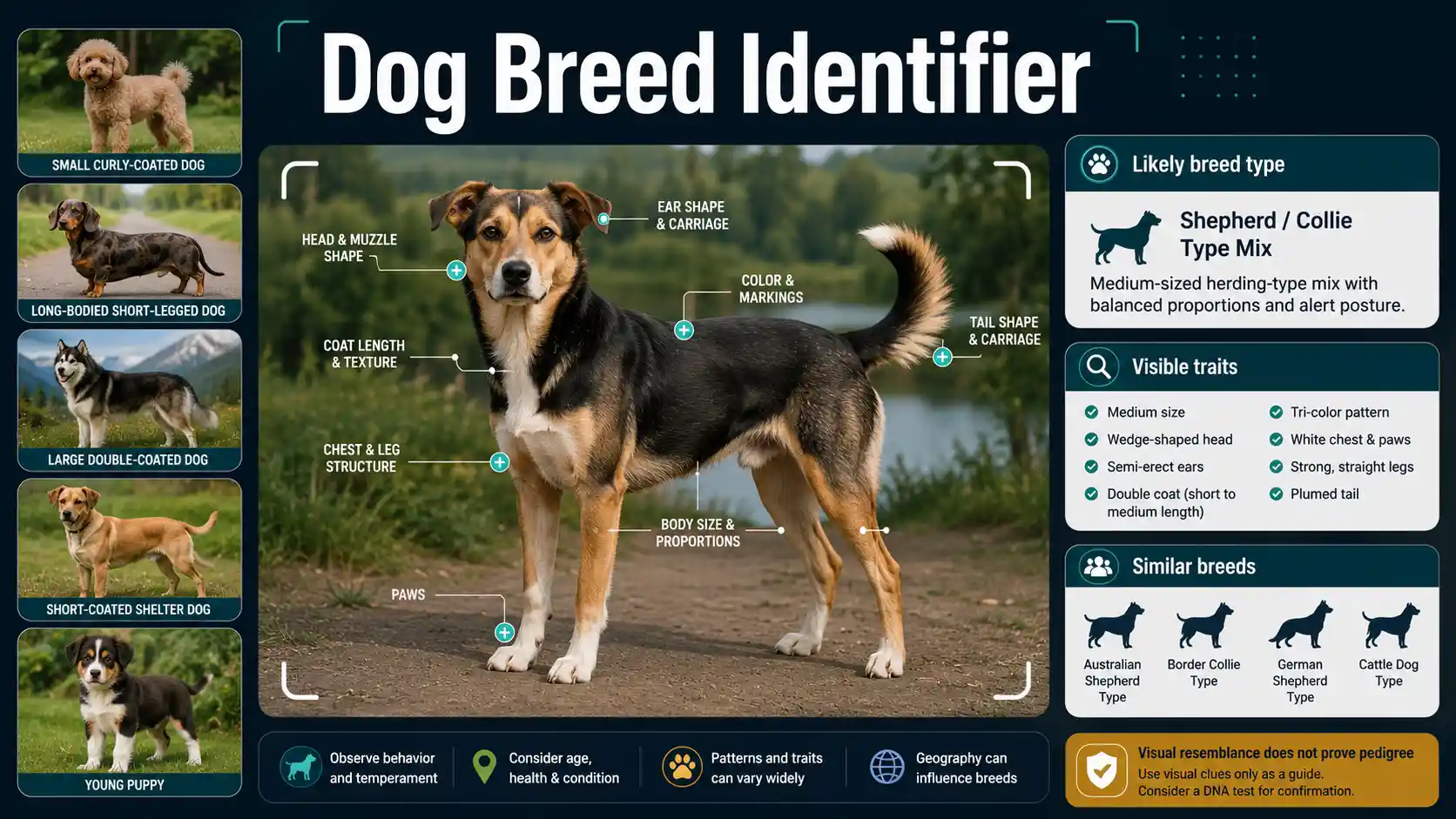
How visual dog breed comparison works
Body structure and coat can suggest a breed type but cannot prove ancestry
The tool first confirms that the subject appears to be a domestic dog. It then compares overall size, body length, bone, chest, head, muzzle, ears, coat, markings, tail, legs, paws, and silhouette with recognized breed profiles and broader dog types.
A distinctive adult purebred may produce one strong visual match. A rescue or mixed-breed dog often fits several possibilities, so the responsible answer describes resemblance and visible influences rather than inventing parent breeds or percentages.
Puppy development, grooming, clipping, body condition, cropped ears, docked tails, camera angle, and wet or matted fur can change the apparent breed clues. These factors lower confidence unless the user provides additional views and context.
- 1Upload, take, or paste one image
Choose a file, use your phone camera, click the paste icon, or press Ctrl+V or Command+V.
- 2Add facts that the photo cannot show
Country, environment, approximate size, location, and observed behavior can narrow the answer.
- 3Review the match and its evidence
Check the likely name, confidence bar, visible clues, alternatives, safety note, and recommended next step.
Dog breed and mixed-breed coverage
Compare purebred-like profiles, mixed dogs, puppies, rescues, and broad breed groups
Dog Breed Identifier supports visual comparison across recognized breeds and broader structural groups. It returns a cautious type-level answer when several breeds share the same coat, head, size, or body proportions.
Mixed-breed dogs through likely breed groups or possible visible influences rather than unsupported ancestry percentages
Puppies at a cautious broad level when juvenile proportions have not yet developed into the adult outline
Small, medium, large, giant, long-bodied, short-legged, deep-chested, lightly built, and heavily built dog types
Short, smooth, wire, curly, corded, double, long, feathered, hairless, and partially clipped coat types
Sporting, hound, working, terrier, toy, non-sporting, herding, guardian, spitz, sighthound, and village-dog visual groups
Shelter and rescue dogs whose labels are unknown or uncertain, while making the limits of visual breed assignment explicit
Broad domestic-dog identification when a wild canid, dog-like animal, toy, statue, or image artifact remains possible
Dog features that matter
Show the full build, head, coat, legs, and tail
A face-only image or one coat color rarely separates similar dogs. The strongest comparison combines the entire standing outline with clear structural and coat details.
Start with a full standing side view taken at the dog's level. Add a front view of the head and chest, then show the coat texture, ears, tail, paws, and any distinctive markings. Include a reliable height or weight estimate, age if known, and whether grooming, clipping, cropped ears, or a docked tail have changed the natural outline.
- Photograph the entire dog standing naturally from the side at body level.
- Add a straight front view that shows the head, muzzle, ears, chest, and front legs without wide-angle distortion.
- Show the coat in neutral daylight so texture, undercoat, feathering, curls, furnishings, and markings remain visible.
- Include the natural tail and ear carriage when present; state whether either has been surgically altered.
- Photograph the paws, leg length, chest depth, back length, and body proportions instead of sending only a face close-up.
- Provide a measured shoulder height or recent weight when available rather than guessing from furniture or camera perspective.
- State the dog's known or estimated age because puppies and adolescents can look very different from mature dogs.
- Remove costumes, bulky harnesses, blankets, and filters that hide the outline or change the coat color.
- Use a second angle if grooming, clipping, wet fur, pregnancy, obesity, or matting changes the dog's natural silhouette.
What the dog breed result contains
A useful result explains resemblance, alternatives, and pedigree limits
The answer should show which physical traits support the leading breed or group, which dogs look similar, what may be altered by age or grooming, and why the conclusion is visual rather than genetic.
- The most likely visual breed, breed group, landrace type, or mixed-breed description supported by the photograph
- A high, moderate, or low confidence label without a fabricated probability or ancestry percentage
- Specific visible evidence from body proportions, head, muzzle, ears, coat, markings, tail, legs, and paws
- Several realistic lookalikes when the same visible traits occur in multiple breeds
- A clear distinction between breed resemblance and verified pedigree or DNA ancestry
- Factors that may distort appearance, including age, grooming, body condition, camera angle, cropped ears, or a docked tail
- A practical next step such as better photographs, records, microchip scanning, DNA testing, or professional assessment
- A reminder that behavior, health, legal status, and suitability cannot be established from breed appearance
Common dog breed lookalikes
Similar coats and outlines can come from unrelated breeds
These comparisons show why several independent features are needed and why mixed-breed dogs may not fit one written standard.
Labrador Retriever or pit bull-type mix
Both may have short coats and broad heads. Muzzle proportions, skull, ears, chest, body length, tail, bone, and overall balance matter, while appearance cannot establish ancestry or legal classification.
Siberian Husky or Alaskan Malamute
Size, bone, head width, ear proportions, tail carriage, coat density, feet, and overall substance are more useful than blue eyes or gray-and-white color alone.
Border Collie or Australian Shepherd
Body proportions, head, ears, coat texture, tail, movement, merle pattern, and verified pedigree help; many mixed herding dogs resemble both.
Poodle mix or another curly-coated breed
Curl, coat density, furnishings, muzzle, ears, body shape, adult size, tail, and grooming history can distinguish poodle influence from bichon, water-dog, terrier, or mixed profiles.
German Shepherd Dog or Belgian Malinois
Body length, topline, head wedge, muzzle, ears, coat, rear angulation, bone, tail, and overall balance matter more than tan-and-black coloring.
Pembroke Welsh Corgi or Cardigan Welsh Corgi
Ear shape, body proportions, bone, feet, chest, tail, accepted colors, and head details separate the standards, but docking can remove one obvious clue.
Why dog breed identification can fail
A familiar-looking trait may occur in dozens of breeds and mixed dogs
Visual breed assignment becomes unreliable when the image hides the body, the dog is young, grooming changes the coat, or one popular label is applied to a broad physical type.
- Only the face is visible, so body length, chest depth, leg proportions, tail, and coat distribution cannot be compared.
- A puppy is matched directly to an adult breed standard even though its proportions and coat are still developing.
- One coat color is treated as proof of a breed despite appearing across many unrelated breeds and mixed dogs.
- A grooming style, shaved coat, wet fur, matting, or seasonal shedding hides the natural coat type.
- The dog is photographed from above with a wide-angle phone lens that enlarges the head and shortens the body.
- Cropped ears or a docked tail are mistaken for natural breed-defining structures.
- Obesity, extreme thinness, pregnancy, or poor posture changes the apparent build and chest shape.
- A blocky head and short coat are used to assign a precise pit bull-type breed or legal label.
- Reported behavior is treated as proof of breed or used to predict aggression, trainability, or family suitability.
- A visual result is described as DNA ancestry, pedigree confirmation, or exact breed percentages.
Worked dog breed-identification scenarios
Full-body structure and life stage make the comparison more responsible
Each scenario shows how owners and shelters can add measurable evidence while avoiding unsupported pedigree, percentage, behavior, or health claims.
Shelter dog with a short coat and blocky head
A side profile, front view, measured height, chest width, muzzle proportions, ears, tail, paws, and full-body build may support several bully-type, mastiff-type, retriever, or mixed-breed possibilities. The result should not turn a broad visual type into one exact breed or a legal classification.
Small curly-coated rescue dog
Coat curl, muzzle length, ear carriage, body proportions, leg length, tail set, adult size, and grooming history can separate poodle-type, bichon-type, water-dog, terrier, and mixed-breed appearances. A recent haircut can remove many of the clues people associate with one breed.
Long-bodied dog with short legs
Back length, chest depth, foreleg shape, foot direction, ear form, head proportions, coat, and tail can distinguish dachshund-like, corgi-like, basset-like, terrier-like, and mixed profiles. Camera angle and body condition can exaggerate the long-and-low appearance.
Large double-coated dog with upright ears
Height, bone, chest, head wedge, muzzle, ear size, tail carriage, coat density, facial mask, and movement can compare northern spitz, shepherd, livestock-guardian, and mixed-breed types. Color alone cannot separate a husky-like dog from a shepherd or malamute influence.
Young puppy with uncertain adult features
Paw size, ear development, muzzle, coat texture, body length, known age, current weight, and photographs of the mother or litter can support a broad estimate. A puppy breed identifier should remain cautious because adult size, coat, ears, and proportions can change substantially.
Use the breed result responsibly
Breed appearance is not a behavior test, medical assessment, or legal determination
A visual dog breed match describes resemblance, not verified pedigree or behavior. Do not use one photo to make housing, insurance, legal, adoption, breeding, medical, or safety decisions. Use records or DNA testing for ancestry, a veterinarian for health, and direct behavioral assessment for temperament.
Do not use a visual result to deny housing, choose insurance, predict aggression, plan breeding, diagnose disease, or decide whether a dog is safe with people or animals. Evaluate the individual dog's observed behavior and health with qualified professionals. Confirm ancestry through records or DNA testing when that information matters.
Choose the correct identification path
Wild canids, tags, and uncertain scenes need a different specialist
Questions about dog breed identification by photo
Direct answers before you upload a dog picture
Can I identify my dog's breed from a photo?
A clear photo can suggest a likely breed, breed group, or visual type. It cannot prove pedigree or reveal every breed in a mixed dog's ancestry.
Is this Dog Breed Identifier free to use online?
Yes. You can upload a supported dog image in your browser and review the visual breed comparison without installing a separate app.
Can the tool identify a mixed-breed dog?
It can describe likely visible influences or breed groups, but mixed-breed genetics may produce traits that hide or exaggerate individual ancestors.
Can a picture reveal exact dog breed percentages?
No. An image cannot establish ancestry percentages. A canine DNA test is the more appropriate option, although results can vary by company and reference database.
Can this identify a puppy's breed?
It can suggest broad possibilities, but puppies often lack the adult coat, ears, body proportions, and size needed for a confident breed-level result.
What photo works best for dog breed identification?
Use a full standing side view, a straight front view, and a coat close-up. Include measured height, current weight, and known age when available.
Can the breed be identified from the dog's face alone?
Sometimes a face provides useful clues, but body build, chest, back, legs, paws, coat distribution, and tail often separate similar breeds.
Can the tool identify a rescue or shelter dog's breed?
It can compare visible traits, but shelter labels and photo-based guesses may not match genetic ancestry, especially for dogs with several breed influences.
Can it tell whether my dog is a pit bull?
It may note a broad bully-type resemblance, but a blocky head, muscular build, or short coat cannot establish one specific breed, ancestry, or legal designation.
Does coat color prove a dog's breed?
No. Black, white, brindle, merle, tan-point, spotted, and solid coats occur across many breeds and mixed-breed dogs.
Can Dog Breed Identifier predict temperament or aggression?
No. A photo and possible breed resemblance cannot predict an individual dog's behavior, bite risk, trainability, or suitability for a home.
Can it diagnose breed-related health problems?
No. Breathing, skin, joint, eye, heart, and genetic concerns require examination and testing by a veterinarian.
Do cropped ears or a docked tail affect the result?
Yes. Altered ears and tails remove natural structural clues. State that they were altered and provide other views of the dog's full body and coat.
Can grooming change the suggested breed?
Yes. Clipping, shaving, hand-stripping, matting, and stylized trims can make coat type and body outline look different from their natural condition.
How can I confirm a dog's ancestry?
Use trustworthy pedigree records for registered lineage or consider a reputable canine DNA service for ancestry. Treat either as separate from visual resemblance.
Can the photo identify a lost or found dog's owner?
No. Check the collar and tag, contact local shelters, and have a veterinarian or shelter scan the dog for a microchip.
Are uploaded dog photos permanently stored by SnapIdentify?
SnapIdentify processes the normalized image for the request and does not intentionally write it to local disk. The configured AI provider processes it under its service terms.
Breed standards and visual-identification evidence
Compare established standards while respecting the limits of appearance
These registry and research sources describe recognized breed standards and document why visual labels do not reliably reconstruct complex mixed-breed ancestry.
- American Kennel Club Dog Breeds and Standards
The AKC publishes recognized breed profiles and explains that written breed standards describe the ideal physical traits, movement, and temperament used to distinguish established breeds.
- FCI Breed Nomenclature and Standards
The Fédération Cynologique Internationale maintains international breed nomenclature, groups, countries of origin, and official standards used across member organizations.
- PLOS ONE — Genetic Breed Heritage of Shelter Dogs
This peer-reviewed study compared shelter breed labels with genetic testing and documented the limits of identifying complex mixed-breed heritage from visual appearance.