Butterfly larvae such as swallowtail, white, sulphur, brush-footed, skipper, blue, hairstreak, and monarch-like caterpillars when diagnostic features are visible
Identify butterfly and moth larvae from anatomy, host plants, and context
Caterpillar Identifier with Larval and Host-Plant Clues
Upload a clear caterpillar picture to compare its head capsule, three pairs of true legs, visible prolegs, body segments, hairs, spines, horns, stripes, spots, posture, size, host plant, feeding pattern, date, and location. This Caterpillar Identifier can suggest a likely butterfly or moth larva, explain the evidence, and keep the result broader when changing instars or close lookalikes prevent a responsible species-level answer.
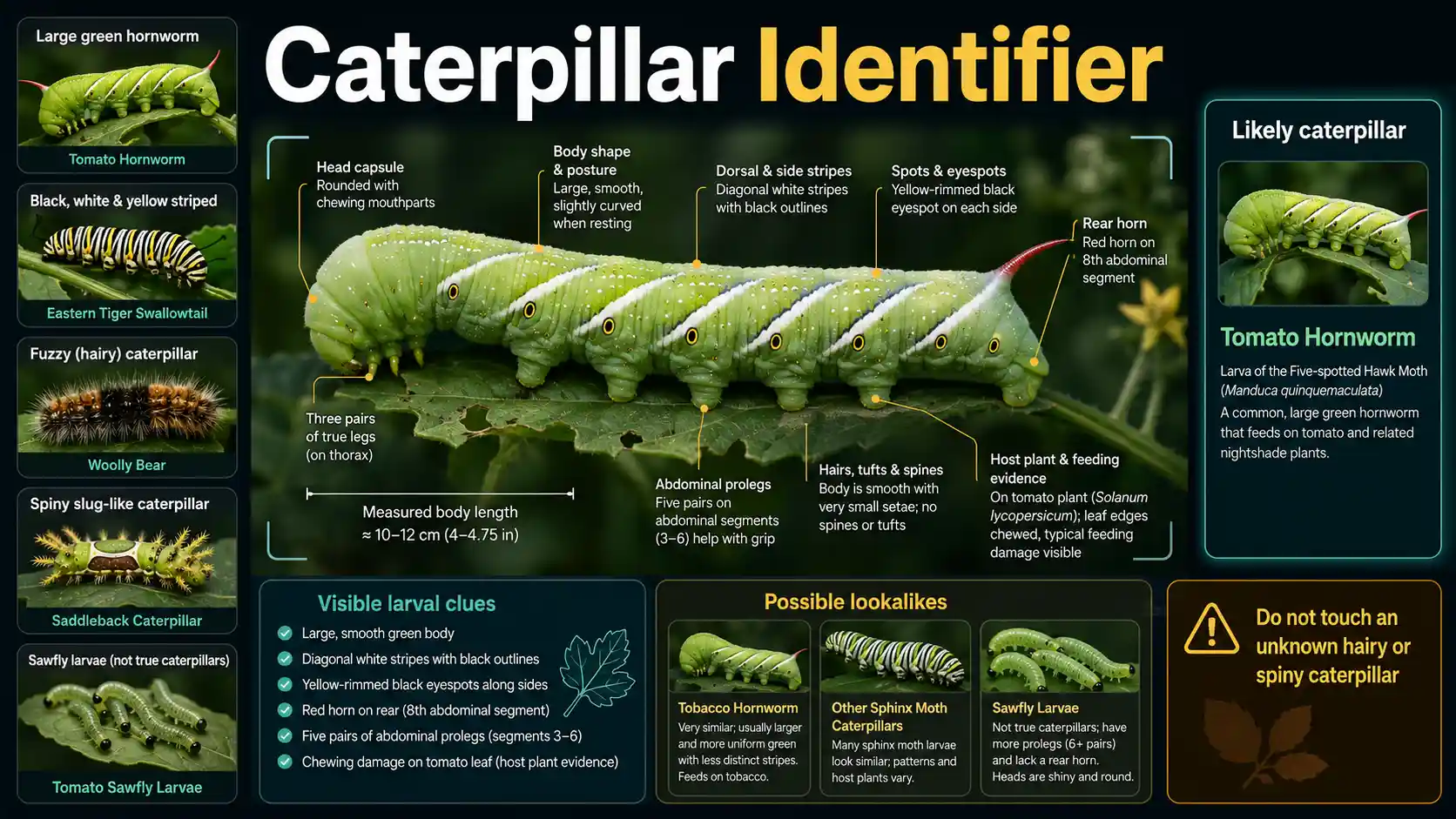
How photo-based caterpillar identification works
Larval anatomy, host evidence, date, and location build the match
A caterpillar is the larval stage of a butterfly or moth. A useful photo result begins by confirming a caterpillar-like body plan: a distinct head, three pairs of thoracic true legs, a segmented abdomen, and no more than five pairs of abdominal prolegs in typical Lepidoptera larvae.
The strongest match combines head pattern, proleg placement, body shape, stripes, spots, hairs, spines, horns, posture, measured size, the plant or surface where the larva was found, observation date, habitat, and geographic region. No single color or texture proves a species.
Caterpillars change between instars. A young larva may have a different pattern, hair covering, horn, or body proportion from its mature form, and a wandering pre-pupal caterpillar may no longer be on its normal food plant.
The result separates likely identity from sting risk, plant damage, infestation, rarity, and control. A convincing species suggestion does not establish that touching is safe or that pesticide treatment is necessary.
- 1Upload, take, or paste one image
Choose a file, use your phone camera, click the paste icon, or press Ctrl+V or Command+V.
- 2Add facts that the photo cannot show
Country, environment, approximate size, location, and observed behavior can narrow the answer.
- 3Review the match and its evidence
Check the likely name, confidence bar, visible clues, alternatives, safety note, and recommended next step.
Caterpillars, larvae, host evidence, and lookalikes
Identify butterfly and moth larvae without forcing every specimen to species
The tool can compare familiar garden caterpillars, unusual wild larvae, immature stages, feeding shelters, and caterpillar-like organisms. It returns a family or broader group when instar changes, hidden anatomy, or missing host and regional context prevent a responsible exact answer.
Moth larvae such as sphinx and hawk moths, giant silkmoths, tiger moths, tussock moths, loopers, underwings, cutworms, armyworms, and leafrollers
Smooth green, brown, striped, spotted, horned, tailed, humped, hairy, bristly, spiny, slug-like, case-bearing, and twig-mimicking caterpillar forms
Garden, crop, tree, shrub, wildflower, woodland, grassland, wetland, and household caterpillars photographed with host or habitat context
Egg clusters, shed larval skins, silk shelters, rolled leaves, tents, feeding traces, frass, pupation behavior, and naturally found cocoons when enough evidence is visible
Caterpillar lookalikes such as sawfly larvae, beetle grubs, fly maggots, lacewing larvae, caddisfly larvae, millipedes, slugs, worms, and plant structures
Photo evidence that separates caterpillar groups
Show the head, true legs, prolegs, rear end, pattern, host, and measured size
A full side view is often the most useful image because it shows the body profile and leg arrangement. Add a top view, close head and rear images, the host plant, feeding evidence, date, location, and a safe scale reference.
Photograph the caterpillar from above and from the side without touching it. Show the head, thoracic legs, abdominal prolegs, rear end, full pattern, measured length, the exact leaf or surface where it was found, and a wider image of the host plant or feeding damage.
- Keep a safe distance and photograph the caterpillar without touching, moving, squeezing, or placing it on your skin.
- Take one sharp side view that shows the head, three pairs of true legs, abdominal prolegs, body profile, and rear end.
- Add a top view for dorsal stripes, spots, humps, hairs, spines, horns, eyespots, and segment-by-segment markings.
- Measure the caterpillar beside a ruler or familiar object without forcing it into a straight position.
- Photograph the exact leaf, stem, bark, food item, wall, or ground surface where it was naturally found.
- Include the whole host plant, then add close images of leaves, flowers, fruit, bark, and feeding damage when safe.
- Record the country or region, observation date, habitat, approximate height above ground, and whether the larva was feeding, resting, wandering, or spinning silk.
- Use even daylight and avoid flash glare that can hide fine hairs, waxy coatings, translucent tissue, or subtle stripes.
- Show separate larvae individually because mixed broods, parasites, shed skins, or sawfly groups can contain different subjects.
What the caterpillar result explains
A responsible answer shows the likely larval group and the evidence behind it
The result should state whether the specimen is a caterpillar, the narrowest supported taxonomic level, visible larval traits, likely host relevance, realistic lookalikes, and the next observation needed. It should never hide uncertainty behind a precise-looking percentage.
- The most likely caterpillar common name and scientific name when the evidence supports them
- A family, genus, butterfly-versus-moth group, or broader larval classification when species-level evidence is missing
- A high, moderate, or low confidence label without a false numerical accuracy score
- Visible evidence from the head, true legs, prolegs, segment pattern, hairs, spines, horns, posture, size, host, and season
- The apparent larval stage or condition, including early instar, later instar, wandering prepupa, shed skin, cocoon, or uncertain state when visible
- Realistic lookalikes and the next feature, angle, host record, date, or location needed to separate them
- A clear distinction between likely identity, possible host association, observed feeding, and whether management is actually justified
- Safer observation guidance, uncertainty limits, and practical next steps for expert, extension, poison-control, or plant-care confirmation
Common caterpillar lookalikes
Prolegs, head shape, body structure, habitat, and feeding behavior separate similar larvae
Many soft-bodied larvae and invertebrates are casually called caterpillars. These comparisons show why color, hair, plant damage, looping movement, or group feeding cannot establish the insect order by itself.
Caterpillar or sawfly larva
Butterfly and moth caterpillars usually have five or fewer pairs of abdominal prolegs. Sawfly larvae commonly have six or more and may feed in coordinated groups. Show a clear side view because hidden legs make counts unreliable.
Looper caterpillar or other inchworm-like larva
Geometer and some owlet larvae have reduced middle prolegs and move by looping. Confirm the head, thoracic legs, rear prolegs, body markings, measured size, host plant, and region rather than relying on movement alone.
Caterpillar or beetle larva
Many beetle larvae have a harder head, three thoracic leg pairs, and no abdominal prolegs, while some grubs are C-shaped. Body texture, rear structures, habitat, wood or food association, and leg arrangement help separate them.
Caterpillar or fly maggot
Typical maggots lack the distinct caterpillar head capsule, thoracic legs, and abdominal prolegs. A tapered body, wet organic source, breathing structures, and movement may support a fly larva.
Spiny caterpillar or plant structure
Slug caterpillars, galls, seeds, scale insects, leaf lesions, buds, and debris can share a flattened colorful outline. Show movement, head position, legs, segmentation, attachment, and several angles.
Caterpillar cocoon or spider egg sac
Silk cocoons, bagworm cases, rolled-leaf shelters, spider egg sacs, plant galls, and debris bundles can look similar. Construction, attachment, opening, contents, movement, host, and habitat are more useful than color.
Why caterpillar identification can fail
Hidden legs, changing instars, weak host evidence, and safety assumptions reduce confidence
A caterpillar may look different after molting, before pupation, when wet, under artificial light, or after parasitism. Similar larvae may share the same color and plant. A responsible result stays broad when the head, side profile, prolegs, rear end, size, date, host, or location is missing.
- The caterpillar is photographed only from above, hiding its true legs, prolegs, side stripes, spiracles, and body profile.
- The image omits the head or rear end, which may contain the strongest horns, tails, false eyes, or anal-proleg clues.
- No measured size, date, country, or habitat is provided for a larva whose pattern occurs in many unrelated groups.
- A detached leaf is shown without enough detail to identify the host plant or prove the caterpillar was feeding on it.
- Several larvae are assumed to be identical even though a mixed group or parasitoid emergence may be present.
- A curled, wet, crushed, molting, parasitized, or preparing-to-pupate larva is compared directly with a normal field-guide image.
- Every fuzzy or brightly colored caterpillar is assumed to sting, while smooth or plain larvae are assumed harmless.
- A sawfly larva is called a caterpillar without checking true legs, visible prolegs, posture, and group-feeding behavior.
- Plant holes, webbing, frass, tents, or rolled leaves are photographed without a clear image of the actual larva.
- One caterpillar is treated as proof of a damaging infestation or as a reason for immediate pesticide use.
Worked caterpillar-identification examples
Anatomy, host plant, behavior, season, and geography narrow the larval match
Each case combines a complete specimen photo with the evidence that separates hornworms, milkweed-feeding larvae, fuzzy caterpillars, slug caterpillars, and sawfly lookalikes.
Large green caterpillar with a rear horn on tomato
A side view can compare the tail horn, diagonal stripes, spiracles, head, true legs, prolegs, measured length, tomato-family host, date, and region. The result may suggest a hornworm or another sphinx-moth larva, but color and one horn alone do not prove the exact species.
Black, white, and yellow striped caterpillar on milkweed
The identifier checks paired tentacles, stripe sequence, body texture, head pattern, prolegs, milkweed attachment, size, season, and geographic range. Monarch, queen, soldier, milkweed-tussock, and unrelated striped larvae require different supporting traits.
Fuzzy caterpillar crossing a walkway
A close side image should show the head, hair tufts, underlying body color, segment bands, prolegs, rear brushes, size, date, and nearby vegetation. The result avoids declaring the larva harmless or stinging from fuzziness alone and recommends no bare-skin handling.
Spiny slug-like caterpillar beneath a tree leaf
The tool compares the flattened body, reduced visible legs, dorsal saddle or patch, branching spines, color, leaf surface, tree identity, size, and region. Slug caterpillars can resemble galls, leaf debris, scale insects, or other spiny larvae.
Group of green larvae skeletonizing a shrub
A side view of one individual helps count visible prolegs and compare the head, body spots, posture, group behavior, plant identity, and feeding pattern. Six or more pairs of abdominal prolegs may support a sawfly larva rather than a butterfly or moth caterpillar.
Observe unknown larvae without touching them
Hair, bristles, or spines can cause contact reactions in some caterpillars
Do not touch an unknown hairy, bristly, or spiny caterpillar with bare skin. A photo cannot confirm that a larva is harmless or stinging, and this tool cannot diagnose a rash or exposure. Use local poison-control or medical guidance when contact causes significant pain, swelling, breathing trouble, eye exposure, or other concerning symptoms.
Photograph the caterpillar where it naturally rests and avoid bare-skin contact, especially with hairy, bristly, spiny, or unfamiliar larvae. Do not place it on a child, pet, clothing, or skin for scale. If contact causes pain, swelling, blistering, eye exposure, breathing trouble, or other concerning symptoms, seek immediate guidance from local poison-control or medical services rather than waiting for an image result.
Choose the next identification step
Use the adult, plant, or broader insect workflow when it provides stronger evidence
Questions about identifying caterpillars from pictures
Direct answers before you upload a caterpillar photo
Can a caterpillar be identified from a photo?
Often, yes. A sharp side and top view can support a family, genus, or species match when the head, legs, prolegs, markings, size, host plant, date, and location are available.
What caterpillar is this?
Upload the full larva and show the head, true legs, prolegs, rear end, body pattern, measured length, host plant, date, and region. Those clues are more reliable than color alone.
Can the tool tell whether it becomes a moth or butterfly?
Sometimes. Distinctive families and host associations may support a moth or butterfly group, but many larvae cannot be assigned confidently without stronger anatomy or rearing evidence.
Can it identify the adult species from the caterpillar?
Only when the larva has genuinely diagnostic features. Many caterpillars change between instars or resemble unrelated species, so the result may remain at family or genus level.
How do caterpillars differ from sawfly larvae?
Butterfly and moth caterpillars usually have five or fewer pairs of abdominal prolegs, while sawfly larvae commonly have six or more. A clear side view is needed because hidden or overlapping legs can mislead the count.
Are fuzzy caterpillars poisonous or venomous?
Fuzziness alone cannot answer that. Some hairy or spiny caterpillars can irritate or sting, while others do not, so avoid bare-skin contact with any unknown larva.
Can the Caterpillar Identifier confirm that a larva is harmless?
No. A photograph cannot guarantee harmlessness, and visual identification can be uncertain. Observe unknown caterpillars without touching them.
What should I do after touching a hairy or spiny caterpillar?
Avoid further contact and seek local poison-control or medical guidance when pain, swelling, eye exposure, breathing trouble, or other concerning symptoms occur. The identifier does not diagnose or treat an exposure.
Does the host plant help identify a caterpillar?
Yes. A correctly identified plant can narrow the candidates, especially when the larva is photographed feeding. A caterpillar resting on a plant does not automatically prove that plant is its host.
Can a green caterpillar be identified by color?
No. Green occurs across many moth, butterfly, and sawfly larvae. Head pattern, prolegs, stripes, horns, size, host, season, and location are needed.
Can the tool identify a hornworm?
It can compare a horned larva with sphinx-moth and other caterpillars. Show the tail horn, diagonal or longitudinal markings, spiracles, head, prolegs, size, host plant, and region.
Can it identify a caterpillar without the host plant?
Sometimes, but confidence may be lower. Add clear anatomy, measured size, date, habitat, and location when the plant is unknown.
Can a young caterpillar look different from a mature one?
Yes. Successive instars can change color, pattern, hair, horn size, and body form. Recently molted or pre-pupal larvae may also look unlike standard photographs.
Can it diagnose what is eating my plant?
It can compare a photographed larva and visible feeding evidence, but it cannot prove the cause from leaf damage alone. Photograph the actual caterpillar and identify the plant separately.
Does one caterpillar mean my plant has an infestation?
No. One larva does not establish population size, future injury, or a need for treatment. Check the whole plant, fresh damage, eggs, additional larvae, and natural enemies.
Should I spray a caterpillar immediately?
No. Confirm the identity, plant, damage level, life stage, and whether management is necessary before choosing control. Many plants tolerate limited feeding, and some caterpillars become valued pollinators.
Can I use the Caterpillar Identifier without installing an app?
Yes. Open the page in a supported browser, choose an image from your device or take a new photo, add optional context, and review the evidence-based result online.
Authoritative caterpillar anatomy and safety references
Verify difficult larvae, host associations, sawfly lookalikes, and contact risks
These museum, university-extension, and poison-control resources explain caterpillar anatomy, true legs and prolegs, instar changes, host feeding, sawfly differences, plant-damage context, and why unknown hairy or spiny larvae should not be handled.
- UMN Extension — Caterpillars on ornamental plants
Explains caterpillar appearance, true legs and prolegs, the distinction from sawfly larvae, seasonal biology, host plants, feeding injury, and why treatment is often unnecessary.
- Smithsonian Gardens — About butterflies and caterpillars
Describes caterpillar anatomy, chewing mouthparts, three pairs of thoracic legs, abdominal prolegs, instars, host-plant feeding, and transformation into the pupa and adult.
- Poison Control — Caterpillar stings
Explains why some caterpillar hairs or spines can cause pain, itching, swelling, blistering, or allergic reactions and advises avoiding bare-hand contact with unknown larvae.