Modern circulating coins through denomination, country, date, portrait, reverse design, inscriptions, mint mark, and edge
Identify circulating, foreign, commemorative, ancient-looking, and collectible coins from both sides
Coin Identifier with Dates, Mints and Design Clues
Upload clear photos of both sides of one coin. This Coin Identifier compares the date, denomination, country or issuing authority, portrait, symbols, legends, script, mint mark, edge, metal color, diameter, weight clues, and design style. It can help answer what coin is this, identify a foreign coin with unfamiliar writing, or narrow an inherited collection while keeping authenticity, grade, rarity, and value as separate questions that require stronger evidence.
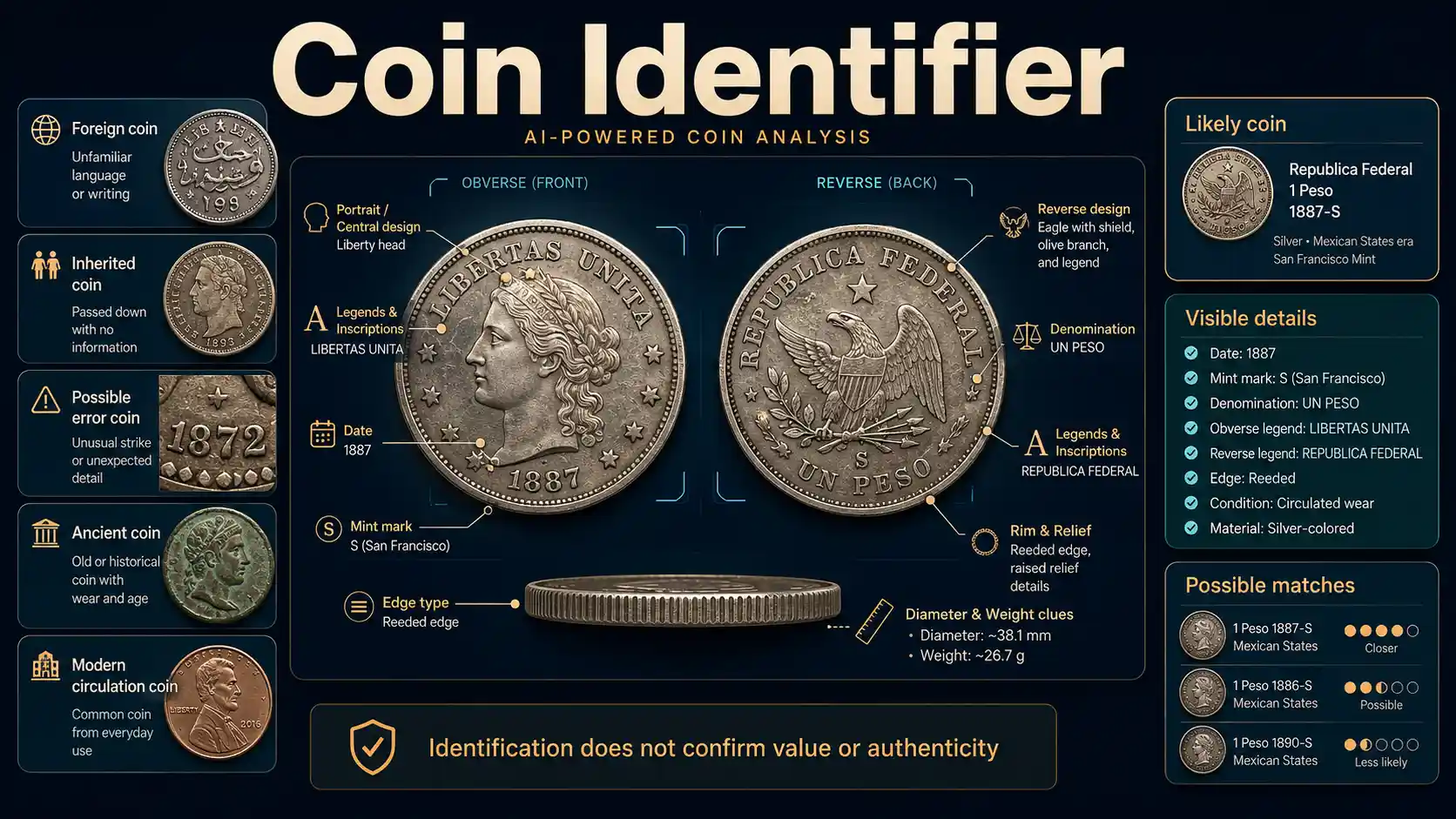
How coin identification works
Both faces, the edge, inscriptions, and measurements build the match
The tool starts with what can be read and measured. It compares the obverse and reverse subjects, denomination, date, country name, ruler, script, symbols, mint mark, edge, diameter, thickness, weight, and apparent metal color before selecting a likely type.
A coin identifier by picture works best when the full design survives. For an old coin, foreign coin, or ancient-looking piece, one missing legend or hidden edge can change the answer from an exact series to a broad regional or historical family. Identification is therefore separated from authenticity, grade, rarity, and value.
- 1Upload, take, or paste one image
Choose a file, use your phone camera, click the paste icon, or press Ctrl+V or Command+V.
- 2Add facts that the photo cannot show
Country, environment, approximate size, location, and observed behavior can narrow the answer.
- 3Review the match and its evidence
Check the likely name, confidence bar, visible clues, alternatives, safety note, and recommended next step.
Coin and numismatic coverage
Identify circulation coins, foreign issues, tokens, medals, and older types
The identifier supports modern and historic coin-like objects from many countries. It remains broad when a piece is heavily worn, corroded, altered, copied, mounted, or missing the measurements and second-side evidence needed for an exact match.
Foreign coins with unfamiliar scripts when symbols, legends, numerals, denomination, and issuing authority remain visible
Commemorative, proof-like, collector, bullion-looking, and non-circulating legal-tender types at a cautious design level
Historic and ancient-looking coins when enough portrait, legend, fabric, strike, weight, and diameter evidence survives
Tokens, medals, transit pieces, gaming counters, souvenir coins, challenge coins, and other exonumia
Possible minting anomalies at a broad level while separating likely post-mint damage from true production errors
Coin-like replicas, plated copies, cast pieces, jewelry inserts, and fantasy issues when visible evidence suggests they are not standard coins
Broader coin families when wear, corrosion, one-sided photos, holders, glare, or missing measurements prevent an exact variety match
Coin features that matter
Show both designs, the edge, date, mint mark, and physical scale
A portrait or color alone rarely proves a coin type. The strongest result combines readable design evidence with verified dimensions, weight, edge form, and context.
Photograph the obverse, reverse, and edge in even light. Keep the coin flat, fill most of the frame, preserve every inscription, and place a metric ruler nearby. Add the measured diameter and weight when available, plus the country where the coin was found or acquired. Do not clean, polish, scrape, acid-test, or alter the surface before identification.
- Photograph the complete obverse straight above the coin with the date and every inscription sharp.
- Turn the coin over and photograph the complete reverse at the same scale and lighting.
- Add a focused edge photo showing whether it is plain, reeded, lettered, segmented, decorated, or damaged.
- Use soft, even light from two sides and tilt the light rather than the coin to reveal low relief without glare.
- Place a metric ruler beside the coin and provide diameter, thickness, and weight from a reliable scale when available.
- Remove the coin from a reflective flip only when it can be done safely; never remove it from a sealed professional holder.
- Show unusual mint marks, privy marks, dates, countermarks, edge lettering, holes, clips, doubling, or off-center areas in a separate close photo.
- Keep the original orientation and include any envelope, label, holder insert, or collection note in a separate image rather than covering the coin.
- Do not clean the coin before photographing it; natural toning, patina, deposits, and wear can contain useful evidence.
What the coin result contains
A useful match identifies the type without pretending to authenticate or appraise it
The result should name the most likely coin or numismatic category, explain which visible details support it, list realistic alternatives, and state which photograph, measurement, catalog, or expert review would resolve the remaining uncertainty.
- The most likely country or issuing authority, denomination, coin type, series, and visible date
- The likely ruler, portrait, emblem, building, animal, coat of arms, or reverse subject when supported
- Visible legends, script, denomination marks, mint marks, privy marks, and edge characteristics
- A high, moderate, or low confidence label without a fabricated exact probability
- Physical attributes such as apparent metal color, diameter, thickness, measured weight, shape, alignment, and edge
- Plausible type, date, mint, token, medal, replica, or damage alternatives and the clue that separates them
- A clear distinction between identification, authenticity, grading, error attribution, rarity, and market valuation
- A practical next step such as a better edge image, verified measurement, catalog comparison, or professional numismatic examination
Common coin-identification traps
Similar designs can hide major differences in type, metal, date, and authenticity
These comparisons show why a date, portrait, color, or online price screenshot cannot stand alone. Both faces, edge, measurements, production details, and trusted references must agree.
Genuine coin or replica
Replicas may copy the design but show incorrect weight, diameter, edge, lettering, relief, surface texture, seam lines, casting bubbles, fantasy marks, or the word COPY. A photograph cannot certify authenticity.
Mint error or post-mint damage
True errors arise during planchet preparation, striking, or die use. Scratches, dents, corrosion, flattening, tool marks, heat damage, plating bubbles, and machine doubling occur later and are far more common.
Proof, proof-like, or polished coin
Proofs use special production methods and characteristic surfaces. A circulated coin polished to a mirror shine may look bright but usually shows altered texture, hairlines, rounded detail, and damaged originality.
Gold coin or gold-colored base metal
Color alone cannot establish gold content. Brass, bronze, aluminum-bronze, plating, toning, lighting, and modern coatings can create a gold appearance.
Ancient coin or modern cast copy
A convincing patina and old style do not prove age. Fabric, edge, weight, diameter, strike flow, surface crystallization, casting seams, repeated defects, provenance, and expert comparison matter.
Rare variety or normal issue
Small differences in date position, mint mark, die, lettering, doubled design, edge, and reverse type can matter, but wear, damage, photography, and wishful pattern matching often create false varieties.
Why coin identification can fail
One face, glare, cleaning, and missing measurements erase decisive clues
Coin designs repeat across denominations, countries, years, metals, replicas, and tokens. A responsible result stays broad when the reverse, edge, date, mint mark, weight, or diameter is unavailable.
- Only one side of the coin is shown, hiding the denomination, country, date, or decisive reverse design.
- Direct flash creates glare across the legends, mint mark, relief, and field.
- The coin remains tiny in the frame or is photographed through a scratched reflective holder.
- No diameter, thickness, weight, or edge photograph is supplied for a visually similar coin family.
- Automatic enhancement, sharpening, filters, or AI upscaling invents letters, dates, and surface details.
- A damaged digit, stain, plating bubble, scratch, or machine doubling is assumed to be a rare mint error.
- A gold or silver color is treated as proof of precious-metal content.
- The coin is cleaned before identification, removing patina and creating unnatural hairlines or brightness.
- An auction asking price or viral social-media post is treated as the coin's verified value.
- A replica, token, medal, jewelry piece, fantasy issue, or altered coin is assumed to be genuine legal tender.
Worked coin-identification examples
Design details and measurements narrow the likely issue
Each example combines both faces with the edge, dimensions, weight, inscriptions, and collection context so the tool can separate real coin families from tokens, replicas, damage, and unsupported value claims.
Foreign coin with unfamiliar writing
Clear photos of both sides, the edge, diameter, weight, visible numerals, symbols, portrait direction, and where it was acquired can narrow the country, denomination, date system, and coin series without guessing from one character.
Old coin from an inherited family collection
The portrait, legends, reverse device, mint mark, date, edge, metal color, holder label, and family note can identify the likely type. The result should not convert inheritance history into proof of authenticity, rarity, or value.
Coin that appears to have a minting error
Matched lighting and close views of the suspected feature can compare an off-center strike, clip, die crack, doubled die, strike-through, or broadstrike with scratches, dents, corrosion, plating problems, machine doubling, and other post-mint damage.
Ancient-looking bronze coin with heavy patina
Diameter, weight, fabric, portrait, remaining legend, reverse figure, edge, patina, find history, and collection context may support a broad culture, ruler, or type. Authenticity and legal provenance still require specialist review.
Modern coin found in circulation that looks valuable
A clear date, mint mark, denomination, reverse design, edge, and condition can identify the issue. A normal circulation coin, commemorative design, plated novelty, altered date, or genuine variety must be separated before any value discussion.
Protect the coin and preserve the evidence
Do not clean or alter a coin before it is identified
Do not clean, polish, scrape, drill, acid-test, or otherwise alter an unidentified coin. A photo can suggest a type, but it cannot certify authenticity, grade, precious-metal content, rarity, legality, or market value. Handle possible ancient, archaeological, radioactive, contaminated, or sharp-edged finds carefully and seek qualified local advice when needed.
Cleaning can permanently reduce numismatic value and remove evidence needed for authentication. Valuable, ancient, archaeological, culturally protected, contaminated, or possibly counterfeit pieces should be examined by a qualified numismatist, conservator, museum, dealer, grading service, or relevant authority.
Choose the right identification workflow
Use another tool when the coin-like object is geological, manufactured, or part of a larger scene
Questions about identifying coins by photo
Direct answers before you upload a coin
Can I identify a coin from a picture?
Yes. Clear photographs of both sides and the edge can often identify the country, denomination, type, series, date, and mint. Weight and diameter improve difficult matches.
What coin is this if I cannot read the language?
Upload both faces and include every visible symbol and numeral. Script style, portrait, emblem, denomination, date system, edge, size, and weight can identify many foreign coins without a readable English legend.
Can this identify an old coin found in a collection?
It can suggest the likely type from design and measurements. It cannot prove the family history, authenticity, rarity, grade, ownership, or market value of the coin.
Can a photo tell me how much my coin is worth?
No reliable value can come from identification alone. Value depends on exact variety, authenticity, grade, surface problems, demand, certification, and current comparable sales.
Can the tool identify a mint mark?
Yes, when the mark is sharp and its position is visible. Wear, corrosion, added marks, filled dies, tiny privy marks, and reflections can make a mint attribution uncertain.
Can it identify a rare error coin?
It can compare a visible anomaly with common error categories, but professional attribution is needed. Ordinary damage, machine doubling, plating bubbles, and cleaning often imitate mint errors.
Does a missing mint mark make a coin rare?
Not automatically. Some mints and years normally used no mark, while genuine missing-mark varieties require exact date, design, die, and production evidence.
Can it identify an ancient coin?
It may narrow the culture, ruler, city, denomination, or type when the portrait, legend, reverse, fabric, diameter, and weight survive. Ancient-coin authenticity and provenance need specialist examination.
Can one photo prove that a coin is genuine?
No. Cast copies, struck counterfeits, altered dates, added mint marks, plated pieces, replicas, and deceptive surfaces can resemble genuine coins in photographs.
Can a coin's color reveal its metal?
Color provides only a clue. Toning, plating, corrosion, lighting, alloys, cleaning, and surface treatments can make base-metal coins look gold or silver.
Should I clean a dirty or tarnished coin first?
No. Cleaning can remove original surfaces, create scratches, change color, destroy evidence, and reduce collector value. Photograph the coin as found.
What photos produce the best coin identification?
Use sharp straight-on images of both faces, a focused edge view, even angled lighting, a metric scale, and separate close-ups of the date, mint mark, and unusual features.
Why does coin weight and diameter matter?
Different denominations and types can share similar designs. Verified weight, diameter, thickness, and edge often separate lookalikes, replicas, tokens, and altered pieces.
Can it identify tokens and medals?
Yes, it may recognize transit tokens, trade tokens, medals, gaming counters, souvenir pieces, and challenge coins. These objects may resemble coins but are not always legal tender.
Can it grade my coin from a photo?
It may describe visible wear or damage, but it cannot assign a reliable professional grade. Lighting, focus, luster, cleaning, marks, strike, and hidden surfaces affect grading.
Can I identify a coin online without installing an app?
Yes. Use the browser uploader to submit a JPEG, PNG, or WebP image, then add measurements and context to improve the result.
Are uploaded coin photos permanently stored by SnapIdentify?
SnapIdentify processes the normalized image for the request and does not intentionally write it to local disk. The configured AI provider processes it under its service terms.
Authoritative numismatic references
Verify terminology, historical types, grading, and authenticity carefully
These official mint, museum, and numismatic-education resources explain coin anatomy, global monetary objects, grading terminology, and the evidence needed beyond a single image.
- U.S. Mint — Anatomy of a Coin
The U.S. Mint defines the obverse, reverse, edge, rim, inscriptions, mint marks, relief, field, and major coin finishes used in visual description.
- Smithsonian National Numismatic Collection
The Smithsonian provides a global research collection of coins, tokens, medals, currency, dies, and other transactional objects spanning thousands of years.
- American Numismatic Association — Official Grading Standards
The ANA explains standardized grading terminology and why accurate condition assessment requires careful observation and numismatic experience.