Common igneous rocks such as granite, basalt, obsidian-like volcanic glass, pumice, scoria, rhyolite, diorite, gabbro, and pegmatite textures
Compare rocks, minerals, crystals, ores, gemstones, and lookalikes from visible evidence
Rock and Mineral Identifier with Property Clues
Upload or paste a clear photo of one specimen. This Rock and Mineral Identifier compares grain size, crystal form, layering, luster, color pattern, transparency, cleavage, fracture, weathering, inclusions, and any safe test results or location details you provide. It returns the most defensible rock, mineral, or broader material match, explains the evidence, and separates natural specimens from common glass, slag, concrete, ceramic, and metal lookalikes when the photograph supports that distinction.
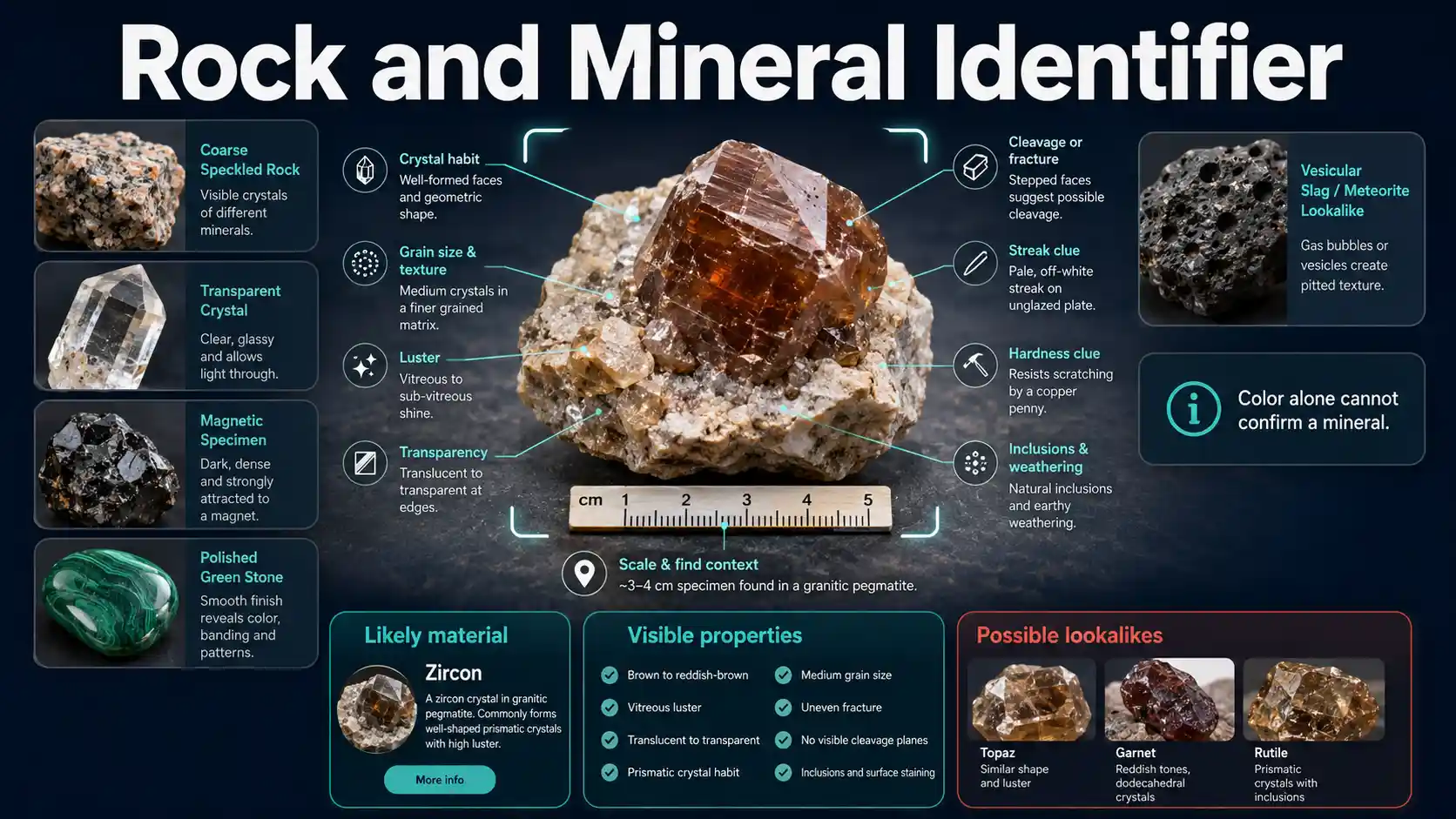
How rock and mineral identification works
Texture, structure, physical properties, and context must agree
The tool first decides whether the specimen appears to be a mixed rock, a dominant mineral, a crystal aggregate, a gemstone-like material, a meteorite candidate, or a manufactured lookalike. It compares grains, crystal habit, layering, foliation, vesicles, luster, transparency, cleavage, fracture, inclusions, and weathering before suggesting a name.
A photograph cannot perform a hardness, streak, density, magnetism, fluorescence, or chemical test. When you provide a safe observation, the tool uses it as one supporting clue rather than proof. This matters when a shiny black rock could be magnetite, hematite-rich material, slag, metal, or several other possibilities.
Rock identification and mineral identification are related but different. Granite is a rock made from visible mineral grains, while quartz is a mineral with its own physical properties. The result should stay at the rock or material level when the image shows a mixed aggregate rather than one coherent mineral.
- 1Upload, take, or paste one image
Choose a file, use your phone camera, click the paste icon, or press Ctrl+V or Command+V.
- 2Add facts that the photo cannot show
Country, environment, approximate size, location, and observed behavior can narrow the answer.
- 3Review the match and its evidence
Check the likely name, confidence bar, visible clues, alternatives, safety note, and recommended next step.
Rock, mineral, crystal, and material coverage
Compare natural specimens with common manufactured lookalikes
The identifier covers common rocks, minerals, crystals, ores, gemstone-like materials, and meteorite candidates. It also checks whether glass, slag, ceramic, concrete, brick, metal, resin, or another manufactured material fits the visible evidence better.
Sedimentary rocks such as sandstone, shale, conglomerate, breccia, limestone, chert, coal-like material, and evaporite-rich specimens
Metamorphic rocks such as slate, phyllite, schist, gneiss, marble, quartzite, serpentinite-like material, and foliated or banded textures
Common minerals and crystal groups such as quartz, calcite, feldspar, mica, gypsum, halite, fluorite, garnet, olivine, pyrite, magnetite, hematite, and malachite-like material
Gemstone-like and lapidary materials at a cautious visual group level, including natural, synthetic, treated, dyed, glass, resin, and assembled possibilities
Ore-like, metallic, magnetic, rusty, heavy, black, green, white, transparent, translucent, or sparkling specimens when multiple properties are available
Meteorite candidates and common lookalikes such as slag, basalt, magnetite, hematite, iron-rich concrete, clinker, and corroded metal without claiming confirmation
Manufactured and altered materials such as glass, ceramic, brick, concrete, asphalt, slag, smelter waste, resin, metal, and decorative aggregate
Properties that matter
Show grains, crystals, luster, breakage, scale, and context
Color can support an identification, but grain texture, crystal form, luster, cleavage, fracture, streak, hardness, density, magnetism, and geologic setting usually carry more diagnostic value.
Photograph the dry specimen in neutral daylight from several sides. Include one close view of grains or crystals, one fresh naturally broken surface when already available, and a ruler for scale. Add where it was found, whether it attracts a magnet, and any safe hardness or streak observations you already know. Do not taste, lick, burn, powder, acid-test, or deliberately break an unknown specimen for this tool.
- Photograph the specimen dry because water can deepen color and create a misleading shine.
- Use neutral daylight or a daylight-balanced lamp and include a plain white or gray background.
- Show the complete specimen, then add close views of grains, crystal faces, layers, vesicles, inclusions, and broken surfaces already present.
- Place a ruler or coin beside the specimen for scale without covering any diagnostic surface.
- Photograph several sides because cleavage, fracture, layering, and crystal habit may appear only from one direction.
- Include the surrounding outcrop, gravel, soil, beach, mine dump, construction fill, or stream context in a separate image when collecting was lawful.
- Report only safe observations you already know, such as magnet attraction, relative heft, streak on an appropriate tile, or whether a fingernail can scratch it.
- Do not create a fresh break, powder, acid reaction, flame test, taste test, or scratch on a valuable or unknown specimen for the photograph.
- Remove loose surface dirt gently without sanding, polishing, chemicals, or aggressive cleaning that could erase coatings or create hazardous dust.
What the geology result contains
A useful match explains both the specimen and its alternatives
The result should identify the specimen only as precisely as the evidence allows, state whether it is more likely a rock, mineral, or manufactured material, and name the safe observation or qualified test that would best separate remaining lookalikes.
- The most likely rock, mineral, crystal group, material class, or cautious broader identification
- A clear distinction between a mixed rock texture and a possible dominant mineral when the evidence supports it
- A high, moderate, or low confidence label without false numerical precision
- Visible evidence such as grain size, crystal habit, luster, layering, cleavage, fracture, vesicles, inclusions, and weathering
- User-supplied test evidence such as streak, safe hardness, magnetism, fluorescence, or relative density without inventing missing results
- Realistic natural and manufactured lookalikes and the property that would best separate them
- Geologic or material context, including outcrop, stream, beach, mine, construction fill, jewelry setting, or collection history when supplied
- A safe next step, better-photo guidance, and a recommendation for laboratory or expert testing when visual evidence cannot establish the answer
Common rock and mineral lookalikes
One dramatic feature rarely proves the identity
These comparisons show why several independent properties must point in the same direction before an exact mineral, gemstone, or meteorite claim becomes credible.
Quartz or calcite
Quartz commonly shows glassy luster and conchoidal fracture with hardness near 7; calcite has prominent cleavage and much lower hardness. Color alone does not separate them.
Pyrite or native gold
Pyrite often forms brittle cubes or striated crystals and has a darker streak; gold is malleable, much denser, and deforms rather than shattering. A valuable-metal conclusion needs professional confirmation.
Obsidian or manufactured glass
Both may be glassy with conchoidal fracture. Bubbles, mold marks, uniform composition, context, weathering, flow banding, and trace inclusions may help, but some pieces remain visually inseparable.
Meteorite or industrial slag
Slag often contains vesicles, glassy flow texture, irregular metal droplets, and industrial context. Meteorite confirmation cannot rely on magnetism, rust, dark color, or heaviness alone.
Jade-like stone or serpentine and glass
Green color is not diagnostic. Texture, translucency, luster, toughness, internal structure, inclusions, density, refractive properties, and laboratory tests are needed for a strong gem identification.
Granite or gneiss
Both can contain quartz, feldspar, and dark minerals. Granite usually has a more massive interlocking texture, while gneiss commonly shows compositional banding or foliation.
Why photo identification can fail
Wet color, polish, and one test can hide the decisive evidence
A wet specimen may appear darker and shinier, a polished face may hide the natural texture, and one glass-scratch or magnet test can fit many materials. Several views and independent properties produce a safer result.
- The specimen is photographed wet, making color darker and luster stronger than it appears when dry.
- Color is treated as the only identification clue even though many minerals share colors or vary widely.
- A polished face hides grain boundaries, cleavage, fracture, weathering, and the natural surface.
- The photo shows only a tiny sparkling area and not the whole rock or its surrounding matrix.
- Artificial colored light, flash glare, filters, or strong shadows alter the specimen's real appearance.
- A magnet test, glass-scratch claim, or heaviness impression is treated as proof of one exact mineral or meteorite.
- Industrial slag, glass, concrete, brick, ceramic, clinker, or corroded metal is assumed to be a natural rock.
- A gemstone-like object is assumed to be natural, untreated, valuable, or authentic from appearance alone.
- A dusty, fibrous, powdery, radioactive-looking, or mine-waste specimen is handled or cleaned before its hazards are known.
- The locality, host rock, outcrop, mine, beach, stream, or construction context is omitted even though it could remove many lookalikes.
Worked rock and mineral examples
Field context and safe observations narrow the possibilities
Each scenario combines visible structure with scale, location, existing surfaces, and non-destructive observations rather than relying on one color or internet comparison image.
Coarse speckled rock from a garden bed
A dry whole-rock photo plus grain size, light and dark mineral proportions, crystal boundaries, landscaping context, and a close view can separate granite-like, diorite-like, gneissic, concrete, and decorative aggregate possibilities.
Clear crystal that scratches glass
Scratching glass does not prove diamond or quartz. Crystal habit, cleavage, luster, inclusions, hardness against several known references, and professional gemological testing may separate quartz, topaz, corundum, glass, and other transparent materials.
Heavy black magnetic specimen
A magnet response, streak, luster, density, crystal form, rust, host rock, and fresh existing surface can help compare magnetite, hematite-rich rock, ilmenite, slag, iron metal, and meteorite-like alternatives.
Green polished stone in jewelry
Color and polish alone cannot separate jade, serpentine, aventurine quartz, dyed material, glass, resin, or another gem. Translucency, texture, inclusions, luster, setting, and laboratory tests matter more than the green color.
Vesicular dark object found near old industry
Bubbles, glassy surfaces, flow texture, metal droplets, rust, unusual shapes, industrial-site context, and an interior view can support slag or clinker over basalt, scoria, pumice, or a meteorite candidate.
Handle unknown specimens responsibly
Do not create dust, fumes, sharp fragments, or chemical reactions
Do not taste, lick, burn, crush, sand, drill, or acid-test an unknown rock or mineral. Avoid creating dust and leave fibrous, powdery, unusually heavy, radioactive-looking, or mine-waste specimens undisturbed until a qualified local professional evaluates them.
Some specimens can contain asbestos-form fibers, silica dust, lead, arsenic, mercury, uranium, or contaminated mine waste. Leave suspicious material undisturbed, wash hands after incidental contact, keep it away from children and pets, and use qualified laboratory or environmental advice when safety matters.
Choose the right identification workflow
Use another tool when the specimen is manufactured or biological
Questions about identifying rocks and minerals
Direct answers before you upload a specimen
Can a rock be identified from a picture?
A clear photo can often narrow the rock family or likely material, especially when grain size, texture, layering, crystals, scale, and locality are visible. Exact identification may still require physical tests or microscopy.
Can the tool identify a mineral from a photo?
It can suggest a likely mineral or group, but a reliable match usually combines several properties such as luster, streak, hardness, cleavage, fracture, density, crystal form, and context.
Why is color not enough to identify a mineral?
Many minerals occur in several colors, and unrelated minerals can look the same color. Color is useful only when it agrees with stronger physical and structural clues.
Does scratching glass prove that a stone is diamond?
No. Many minerals and manufactured materials can scratch ordinary glass. Diamond confirmation requires additional gemological testing and cannot be established from that observation alone.
Can it tell quartz from calcite?
Often it can suggest the better match when crystal shape, cleavage, fracture, hardness, luster, and safe existing observations are available. A photo of color alone is not enough.
Can it distinguish pyrite from gold?
It may compare crystal form, luster, color consistency, malleability clues, streak, density, and host rock, but valuable-metal decisions should be confirmed by a qualified assay or mineral professional.
Can a photo confirm a meteorite?
No. Dark color, heaviness, rust, or magnet attraction does not prove a meteorite. Slag, magnetite, hematite, basalt, concrete, and corroded metal are common lookalikes, and confirmation normally needs expert or laboratory examination.
Can it identify a gemstone in jewelry?
It may suggest a gem or simulant group, but a mounted photograph cannot reliably establish natural versus synthetic origin, treatments, exact identity, geographic origin, quality, or value.
Can it identify a polished crystal or tumbled stone?
Sometimes, but polishing removes natural crystal faces, cleavage, fracture, weathering, and matrix. Multiple views, translucency, inclusions, heft, and known test results become more important.
What is the best photo for rock identification?
Use dry neutral-light images of the whole specimen and several sides, plus close views of grains, crystals, layers, holes, inclusions, and an existing broken surface. Include a ruler and find context.
Should I perform a streak or hardness test?
Only use a suitable specimen and proper tools when you know the test is safe and will not damage something valuable. Do not scratch jewelry, finished surfaces, unknown hazardous material, or protected specimens.
Should I use acid to test a rock?
No acid test is required for this online tool. Acids can injure users, damage specimens, release fumes, and react unpredictably with unknown materials, so leave chemical testing to trained people using proper controls.
Can I lick or taste a mineral to identify it?
No. Unknown minerals can contain harmful substances or contamination. Never lick, taste, closely smell, burn, powder, or ingest a specimen for identification.
Can the tool detect asbestos or radioactive minerals?
No photo can safely confirm or exclude asbestos, radioactivity, or toxic composition. Leave fibrous, dusty, mine-waste, or suspicious specimens undisturbed and contact a qualified local professional.
Can it estimate the value of a rock, mineral, or gemstone?
No. Value depends on confirmed identity, size, condition, rarity, provenance, treatment, legality, demand, and expert grading. A visual suggestion is not an appraisal.
Can it identify where a mineral came from?
Usually not from appearance alone. Similar minerals occur in many localities, and geographic origin may require documented provenance, chemical analysis, inclusions, or comparison with verified reference material.
Are uploaded rock and mineral photos permanently stored?
SnapIdentify processes the normalized image for the request and does not intentionally write it to local disk. The configured AI provider processes the image under its service terms.
Authoritative geology and gemology references
Verify physical properties and valuable materials carefully
These public geology and gemology resources explain the physical properties used to identify minerals and why one scratch, color, or photograph cannot certify a gemstone or valuable specimen.
- National Park Service — Minerals and Physical Properties
The NPS explains mineral properties including cleavage, color, hardness, luster, streak, specific gravity, and the Mohs hardness scale.
- U.S. Geological Survey — Mineral Identification Properties
USGS educational guidance emphasizes that color is often unreliable and that luster, streak, hardness, magnetism, cleavage, and other properties work together.
- GIA — Why Scratching Glass Does Not Prove Diamond
GIA explains that many materials can scratch glass and that additional gemological tests are needed to confirm a transparent stone's identity.