Freshwater fish from rivers, lakes, ponds, reservoirs, canals, wetlands, and streams when body form, fins, markings, size, and location are visible
Identify freshwater, saltwater, aquarium, reef, and caught fish from visible field marks
Fish Identifier for Freshwater and Marine Species
Use the Fish Identifier when a clear side-view photo shows one fish and the details that separate it from similar species. The analysis compares body shape, head profile, mouth position, dorsal and anal fins, tail shape, scales, lateral-line features, barbels, markings, apparent size, habitat, and geographic location. It can help answer what fish is this from a fishing catch, aquarium, reef photograph, pond, river, lake, market display, or underwater image while keeping uncertainty, handling safety, and local regulations clear.
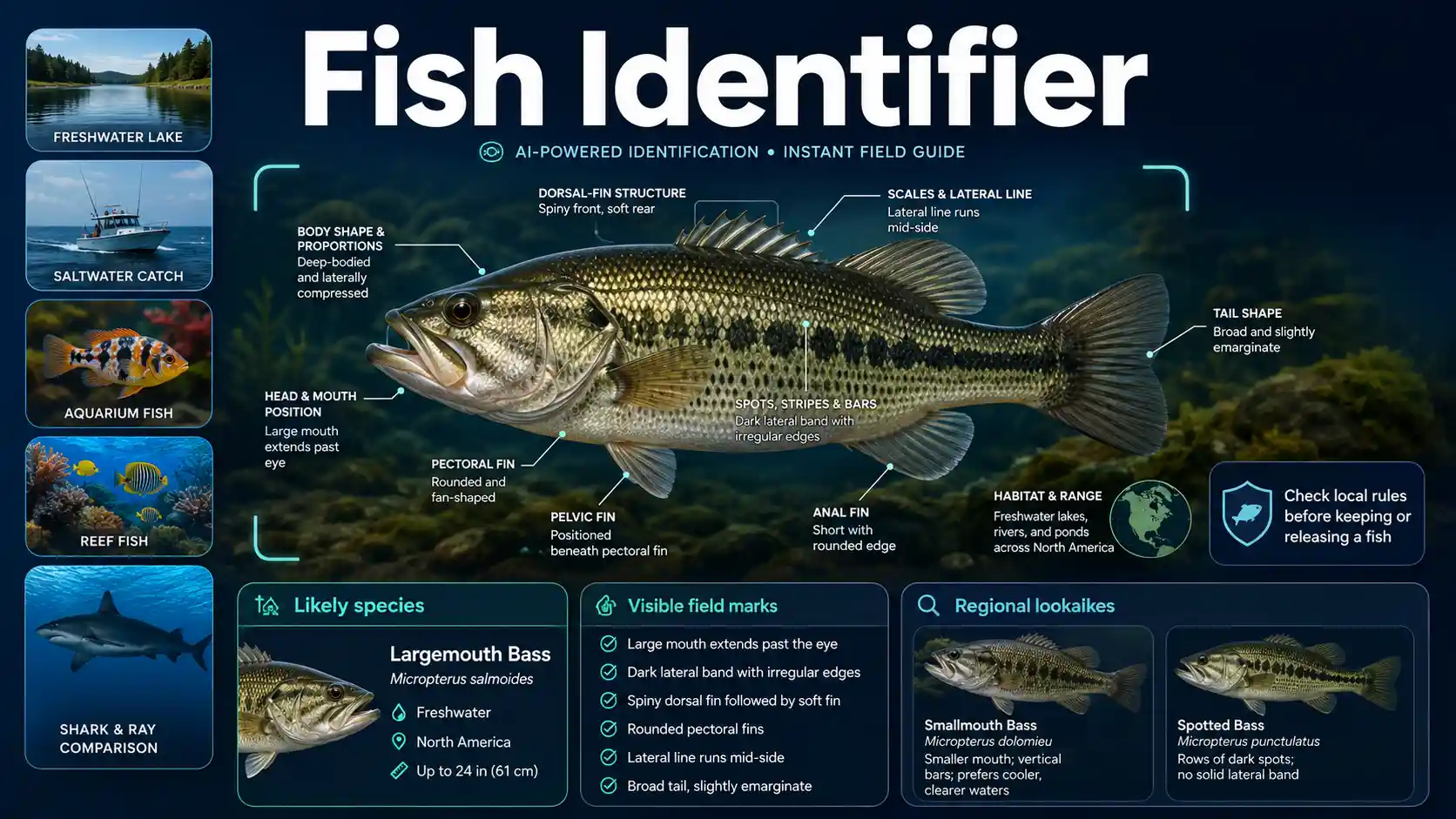
How fish identification works
Body form, fin arrangement, habitat, and range narrow the species
The analysis begins with the fish's silhouette and proportions. It compares whether the body is streamlined, deep, flattened, elongated, eel-like, armored, shark-like, or ray-like before examining the head, snout, mouth, gill-cover area, and tail.
Fin structure often separates similar groups. The Fish Identifier checks dorsal-fin number and position, visible spines or rays, pectoral and pelvic-fin placement, anal-fin shape, adipose fins, finlets, and the form of the caudal peduncle and tail without inventing counts that the photograph cannot show.
Habitat and geography refine the answer. A small striped fish from a tropical reef, a cool freshwater stream, a brackish estuary, and a home aquarium can belong to very different families even when the body pattern looks similar. Approximate length, depth, season, and behavior can be decisive.
- 1Upload, take, or paste one image
Choose a file, use your phone camera, click the paste icon, or press Ctrl+V or Command+V.
- 2Add facts that the photo cannot show
Country, environment, approximate size, location, and observed behavior can narrow the answer.
- 3Review the match and its evidence
Check the likely name, confidence bar, visible clues, alternatives, safety note, and recommended next step.
Freshwater and marine coverage
Identify caught fish, aquarium fish, reef fish, and regional species
The Fish Identifier supports whole-fish photographs from freshwater, brackish, marine, reef, aquarium, market, and underwater settings. It stays at family or group level when juvenile appearance, hidden fins, altered color, or missing location prevents a responsible species match.
Marine and brackish fish from shore, estuary, reef, open-water, pier, boat, tidepool, and underwater photographs
Common angling catches such as bass, trout, salmon, catfish, carp, pike, perch, sunfish, snapper, grouper, mackerel, jacks, flatfish, and similar regional species
Aquarium and tropical fish when body shape, fins, pattern, mature size, tank context, and cultivar-related variation provide enough evidence
Sharks, rays, skates, eels, lampreys, and other distinctive fish groups at the safest defensible taxonomic level
Juvenile, breeding, color-changing, stressed, or damaged fish when the result remains broad enough to reflect altered appearance
Fish-like subjects such as dolphins, aquatic reptiles, amphibians, crustaceans, lures, toys, and partial seafood products when the upload is not a whole fish
Fish features that matter
Show the whole profile, fins, mouth, tail, markings, and water context
A fish's color can change with depth, stress, age, breeding condition, death, lighting, or selective breeding. Structural features and geographic context usually provide stronger evidence than color alone.
Photograph the complete fish in a natural side profile whenever possible. Keep the head, mouth, dorsal fin, anal fin, tail, and body markings visible; add close views of barbels, finlets, an adipose fin, spines, spots, bands, or unusual scales. State whether the fish came from freshwater, brackish water, saltwater, an aquarium, a market, or a photograph taken underwater, and include the country, waterbody, depth, approximate length, date, and behavior when known.
- Show one complete fish in a level side profile with the head, back, belly, and tail inside the frame.
- Keep dorsal, pectoral, pelvic, anal, and tail fins visible without forcing or damaging them.
- Add a close photograph of the mouth, barbels, gill-cover area, unusual spines, finlets, adipose fin, scutes, or distinctive markings.
- Include a ruler, measuring board, or reliable length estimate without delaying release or compromising animal welfare.
- State whether the water is freshwater, brackish, or marine and name the country, coast, lake, river, reef, or aquarium setting.
- Record depth, water temperature, season, bait, schooling behavior, bottom type, and whether the fish was near vegetation, structure, reef, or open water when known.
- Use neutral daylight when possible because underwater color, flash, ice, and market lighting can alter the apparent pattern.
- For an aquarium fish, show the full side profile plus the tank context, but avoid chasing, netting, or stressing the fish for a photograph.
- For a market specimen, photograph the whole fish and label separately; a fillet or cooked portion rarely supports reliable species identification.
What the fish result contains
A responsible match explains anatomy, habitat, alternatives, and uncertainty
The result should identify the fish only as precisely as the photograph allows, explain the visible field marks, distinguish realistic regional lookalikes, and separate biological identification from current regulations, seafood safety, disease diagnosis, and invasive-species decisions.
- The most defensible common name and scientific name when the visible evidence supports them
- A broader family, order, or fish group when a species-level answer would be unreliable
- A high, moderate, or low confidence label without an uncalibrated percentage
- Visible field marks including body form, head, mouth, fins, tail, scales, lateral-line features, and color pattern
- Freshwater, brackish, marine, reef, pelagic, benthic, aquarium, or market context when supported
- Likely juvenile, adult, breeding, aquarium-variety, or altered-color context when those differences matter
- Plausible lookalikes and the exact fin, marking, measurement, habitat, or geographic clue that may separate them
- A practical next step for confirmation, safer handling, current regulations, invasive-species reporting, aquarium care, or a better photograph
Fish groups that are easy to confuse
Similar color and body shape can hide important fin and mouth differences
These comparisons show why side profile, fin arrangement, mouth position, tail, scale features, exact location, size, and life stage must be evaluated together.
Largemouth bass or smallmouth bass
Jaw reach, body bars or blotches, cheek scales, dorsal-fin connection, overall color, habitat, and regional range matter. A dark lateral band alone does not establish the species.
Trout or young salmon
Adipose fin, spots above and below the lateral line, tail spotting, mouth reach, parr marks, fin edges, life stage, and whether the fish came from freshwater or the sea help separate them.
Common carp or buffalo and sucker
Barbels, mouth orientation, lip form, dorsal-fin length, body depth, scale size, head proportions, and local range are stronger clues than a bronze body color.
Snapper or grouper
Body depth, mouth size, canine teeth already visible, dorsal profile, tail shape, fin pattern, behavior, reef depth, and region can distinguish these broad marine groups and their many lookalikes.
Shark or shark-like bony fish
Gill slits versus a gill cover, fin support, tail structure, body covering, mouth position, and head shape separate sharks from remoras, cobia, sturgeons, and other superficially similar fishes.
Sole, flounder, or halibut-like flatfish
Eye side, body outline, lateral line, mouth size, tail shape, scale texture, fin rays, size, depth, and geographic range are needed because many flatfish share the same flattened body plan.
Why fish identification can fail
Hidden fins and missing water context can erase the decisive evidence
Many species share a silvery body, dark back, stripes, spots, or a forked tail. A cropped frame, folded fins, altered color, absent scale, and missing waterbody can turn a possible species answer into only a family-level suggestion.
- Only the head, tail, underside, fillet, or a small cropped section is visible.
- The fins are folded, hidden by a hand, cut off by the frame, or damaged after capture.
- Strong underwater color casts, flash glare, ice, blood, stress, or postmortem fading change the natural pattern.
- The photograph lacks the water type, exact location, depth, approximate length, or date needed to narrow regional species.
- A juvenile is compared only with adult field-guide images even though its pattern and proportions differ.
- A common market name is treated as proof of one biological species.
- One stripe, spot, tail color, or body color is used without checking fin arrangement, mouth, body form, and range.
- Several fish overlap in a school, tank, cooler, or market tray and the intended subject is unclear.
- The fish is handled longer or more aggressively merely to expose a feature for identification.
- The result is used as a substitute for current fishing regulations, seafood safety testing, disease diagnosis, or invasive-species instructions.
Worked fish-identification scenarios
Anatomy and water context turn a broad fish photo into a useful match
Each scenario combines a complete side profile with the field marks and location details that matter for freshwater catches, marine fish, aquarium species, reef photographs, and whole market specimens.
Unknown freshwater catch with a deep body
A fish identifier by picture works best when the side profile shows body depth, mouth size, dorsal-fin shape, pectoral-fin length, tail, operculum, spots, and an accurate lake or river location. Those clues can separate sunfish, crappie, perch, cichlids, and juvenile bass-like fish.
Silvery saltwater fish caught from a pier
A clear side view of the mouth, lateral line, finlets, scutes, dorsal fins, tail fork, eye size, and body markings, combined with coast and season, can narrow jacks, mackerels, herrings, mullets, and similar schooling fish.
Colorful tropical fish in a home aquarium
An aquarium fish identifier should compare body form, mouth, dorsal and anal fins, tail, eye stripe, bars, spots, and mature size while allowing for captive color varieties, hybrids, juveniles, stress coloration, and inaccurate shop labels.
Small striped reef fish in blue underwater light
The original frame, corrected color, depth, reef habitat, schooling behavior, body profile, fin placement, and tail shape can help distinguish damselfish, butterflyfish, wrasses, grunts, snappers, and juvenile lookalikes without treating color alone as proof.
Whole fish beside a seafood counter label
A market fish identifier can compare the complete fish, head, mouth, fins, tail, scales, and printed name. The result may flag inconsistencies, but species authenticity, freshness, origin, toxins, and safe consumption require records or testing beyond a photograph.
Use the result responsibly
A fish name does not establish safe handling, legal possession, or safe consumption
Avoid handling an unknown fish more than necessary. Teeth, gill plates, fin spines, venomous spines, toxic tissues, protected status, and local possession rules may not be obvious from one photograph. Never release aquarium fish, bait, or an unknown non-native fish into natural water, and check the current local fisheries authority before keeping, moving, or consuming a catch.
Check current local regulations before keeping, transporting, selling, or releasing a fish. Do not release aquarium fish, bait, or tank contents into natural water. Avoid teeth, gill plates, and fin spines; some fishes have venomous spines or toxic tissues. Use fisheries authorities, aquatic veterinarians, seafood-safety professionals, or invasive-species programs when the decision carries legal, ecological, food-safety, or animal-welfare consequences.
Choose the correct specialist
Aquatic mammals, mixed underwater scenes, and packaged products need a different analysis
Questions about identifying fish by photo
Direct answers before you upload a fish picture
Can I identify a fish from a picture online?
Yes. Upload one clear whole-fish photo and add the water type, location, approximate length, and date. The tool returns the narrowest match supported by body form, fins, mouth, tail, markings, and range.
What fish is this from my fishing catch?
Show a level side profile, dorsal and anal fins, mouth, tail, scales, markings, and a size reference. State the exact waterbody or coast before comparing regional catches.
Can the Fish Identifier recognize freshwater species?
It can compare many lake, river, pond, stream, and reservoir fish. Waterbody, drainage, habitat, body depth, fin arrangement, mouth position, barbels, and markings improve the result.
Can it identify saltwater or reef fish?
Yes, when the complete profile, fins, tail, mouth, pattern, depth, habitat, and geographic region are visible. Blue underwater light and age-related color changes can lower confidence.
Can I use it as an aquarium fish identifier?
Yes. Show the fish at rest from the side and include its approximate size and tank context. Captive varieties, hybrids, juveniles, and stress colors may support only a species group.
Can one photograph identify a juvenile fish?
Sometimes. Juveniles may have different bars, spots, fin proportions, body depth, and habitat from adults, so exact location, length, and several views are especially important.
Which fish features matter most?
Start with body shape, mouth position, number and placement of major fins, tail shape, barbels, adipose fin or finlets, scale texture, lateral line, markings, size, and habitat.
Does the exact location improve fish identification?
Yes. Continent, ocean, coast, drainage, lake, river, reef, depth, salinity, and season can remove species that do not occur in the photographed environment.
Can the tool count fin rays or spines from a photo?
Only when they are sharp, separated, and fully visible. Folded fins, overlapping rays, damage, and perspective can make counts unreliable, so the result should not invent them.
Can it identify a fish from a fillet or cooked dish?
Usually not reliably. Removing the head, fins, tail, scales, and body shape eliminates many diagnostic features. A fillet should receive a broad or uncertain answer rather than a confident species claim.
Can a photo confirm that a fish is safe to eat?
No. A photograph cannot establish freshness, temperature control, toxins, contamination, allergens, parasites, species substitution, legal harvest, or suitability for raw consumption.
Can the result tell me whether I may keep the fish?
No. Size limits, seasons, protected species, bag limits, gear rules, and invasive-species instructions change by jurisdiction. Check the current local fisheries authority before keeping or releasing it.
Should I release an unknown aquarium fish into a pond or river?
No. Never release aquarium fish, bait, plants, or tank water into natural waterways. Contact a retailer, aquarium group, shelter, veterinarian, or local wildlife authority for lawful alternatives.
Can the Fish Identifier diagnose aquarium fish disease?
No. Spots, color loss, swelling, damaged fins, abnormal posture, and breathing changes can have several causes. Use an aquatic veterinarian or qualified fish-health professional.
Why did the fish result return low confidence?
The fish may be distant, partly hidden, juvenile, damaged, color-shifted, photographed without fins visible, or missing the location, habitat, depth, and size needed to separate lookalikes.
Can I identify a fish online without installing an app?
Yes. SnapIdentify runs in a modern browser, so you can upload, drag, photograph, or paste a fish image without installing a dedicated fish-identification app.
Are uploaded fish photos permanently stored by SnapIdentify?
SnapIdentify processes the normalized image for the request and does not intentionally write it to local disk. The configured AI provider processes the image under its service terms.
Authoritative fish morphology, range, and aquatic-stewardship references
Verify species, local occurrence, regulations, and invasive status independently
These scientific and government resources explain the morphology used in fish identification, provide regional species information, and emphasize preventing the release or movement of aquatic organisms between waters.
- FishBase — Morphology and Quick Identification
FishBase explains how descriptive characters, body measurements, and countable features such as fin rays and spines support standardized fish descriptions and identification.
- NOAA Fisheries Species Directory
NOAA Fisheries provides regional species profiles with appearance, range, biology, protected status, and fishery information for many marine and migratory fishes.
- U.S. Fish and Wildlife Service — Aquatic Invasive Species
The Service explains why aquatic organisms should not be released or moved between waters and emphasizes preventing the spread of invasive species.