Common yard, garden, woodland, grassland, desert, wetland, and waterside snakes when body pattern, scale texture, proportions, habitat, and location are visible
Compare snake patterns, scales, proportions, habitat, and regional range from a safe-distance photo
Snake Identifier with Safer Visual Species Clues
Use this Snake Identifier when you need to identify a snake from a photo without approaching or handling it. The tool compares body build, scale texture, stripes, bands, blotches, head and neck proportions, tail features, apparent size, habitat, behavior, season, and geographic range. It returns the narrowest responsible match, explains which clues support it, and keeps potentially venomous or uncertain snakes under a strict safety warning.
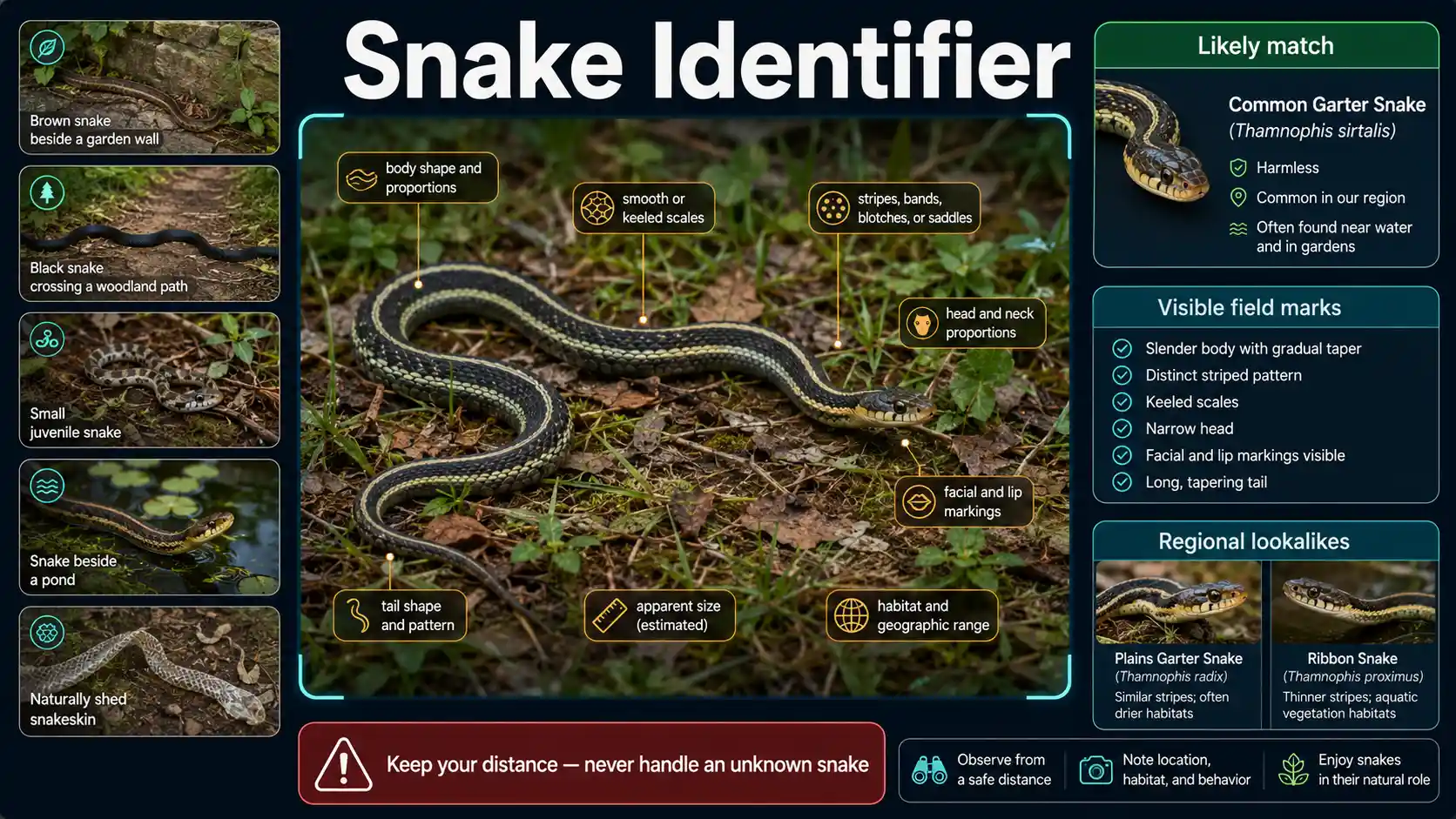
How snake identification works
Pattern, scale texture, body form, habitat, and range must agree
When someone asks, “what kind of snake is this?”, color is only the starting point. The analysis compares stripes, bands, blotches, saddles, rings, scale texture, body build, head and neck proportions, tail features, apparent size, behavior, habitat, and geographic range.
An AI snake identifier is most useful when it explains both the leading match and the missing evidence. A broad regional group is more responsible than a precise species when the image is distant, the snake is juvenile, the pattern is obscured, or the location is unknown.
Harmless versus venomous snake identification cannot rest on one shortcut. Head shape, pupils, body thickness, swimming posture, and color rhymes all have exceptions, and no user should move closer to inspect them.
- 1Upload, take, or paste one image
Choose a file, use your phone camera, click the paste icon, or press Ctrl+V or Command+V.
- 2Add facts that the photo cannot show
Country, environment, approximate size, location, and observed behavior can narrow the answer.
- 3Review the match and its evidence
Check the likely name, confidence bar, visible clues, alternatives, safety note, and recommended next step.
Snake identification coverage
Compare common snakes, juveniles, waterside species, and shed skins
The identifier can evaluate safely photographed snakes across many habitats and regions. It returns a broader match when geographic range, head detail, scale texture, tail, or pattern evidence does not support a defensible species name.
Striped, banded, ringed, blotched, saddled, speckled, checkered, and mostly solid-colored snakes without assuming that color alone proves a species
Small and juvenile snakes at a cautious family, genus, or species level when their age-related pattern and regional range provide enough evidence
Black, brown, gray, green, red, yellow, and multicolored snakes by combining markings with scale texture, body build, head pattern, tail, habitat, and geography
Aquatic and semiaquatic snakes through visible anatomy, waterside habitat, regional range, and multiple field marks rather than swimming posture alone
Shed snakeskins at a broader level when head scales, dorsal scales, belly scales, tail, length, and find location remain intact and clearly photographed
Snake-like animals and objects such as legless lizards, worms, eels, cables, hoses, and toys when the visible structure shows that the subject is not a snake
Snake features that matter
Show the full pattern and habitat without moving closer
A safely taken full-body photograph is more useful than a dangerous close-up. Geography and natural context often separate similar snakes better than an enlarged but blurry view of the head.
Stay well beyond striking distance and use optical zoom or a safely taken existing photograph. Show the complete snake from above or the side, preserve the natural colors, include surrounding habitat for scale, and state the country plus state, province, or region. Never move, pin, capture, kill, turn over, or reposition a snake to reveal its pupils, belly, tail scales, facial pits, or other features.
- Photograph from a safe distance with optical zoom; never step closer simply to improve the identification.
- Keep the full body, head, and tail in one frame when they are naturally visible.
- Take a second safe-distance angle only when you can do so without blocking the snake's escape route.
- Preserve natural color by avoiding filters, flash glare, extreme shadows, and heavy digital sharpening.
- Include a wide habitat view showing water, rocks, leaf litter, grass, trees, buildings, or other environmental context.
- Estimate length only from a distant reference already in the scene; do not place an object beside the snake.
- State the country and the most specific safe location, such as state, province, region, or nearby park.
- Note whether the snake was climbing, swimming, basking, crossing a path, hiding in debris, or resting near a building.
- For a shed skin, photograph the entire skin flat without stretching it, then add close views of the head end, dorsal scales, belly, and tail if intact.
What the snake result contains
A responsible match explains uncertainty before risk
The result should identify the narrowest supported group, explain the visible features, compare plausible regional lookalikes, and state clearly when venom status or species cannot be confirmed from the photograph.
- The most likely common name, scientific name, family, genus, or regional snake group supported by the photograph
- A high, moderate, or low confidence label without an uncalibrated percentage
- Visible evidence from body build, scales, pattern, head and neck proportions, tail, habitat, apparent size, and geography
- Realistic lookalikes and the safely observable feature or regional fact that would help separate them
- A note when age, molt, lighting, injury, or regional variation may change the snake's appearance
- A cautious venom-risk statement that never labels an uncertain snake harmless
- Geographic relevance showing whether the leading match fits the stated country and region
- The safest next step, including distance, pet and child precautions, local expert verification, or emergency escalation
Snake lookalikes that need regional context
One color, head shape, or defensive pose can mislead
These comparisons illustrate why several independent features and geographic range must agree. None should be used as permission to approach or handle the snake.
Watersnake or cottonmouth
Body thickness and swimming posture are not enough. Regional range, facial pattern, eye stripe, lip markings, body bands or blotches, scale texture, tail features, and multiple safe-distance views matter.
Black racer or rat snake
Both can appear solid black as adults. Smooth versus weakly keeled scales, sheen, chin and belly pattern, eye size from the existing image, head proportions, body length, climbing behavior, and region help separate them.
Juvenile rat snake or copperhead
Juveniles may share gray or brown blotches. Blotch shape, head markings, tail-tip color, scale texture, body proportions, geographic range, and a qualified local review are safer than guessing from one pattern fragment.
Garter snake or ribbon snake
Both often show lengthwise stripes. Body slenderness, tail proportion, head pattern, side-stripe position, lip markings, habitat, and region provide better evidence than stripe color alone.
Coral snake or banded mimic
Color rhymes are not globally reliable. Ring order, ring completeness, head pattern, body proportions, geographic range, and regional expert knowledge must be considered together.
Hognose snake or viper-like defensive display
A harmless hognose may flatten its neck, hiss, and strike defensively. Upturned snout, body pattern, scale texture, range, and the entire safely photographed animal matter more than the temporary head shape.
Why snake identification can fail
Safety shortcuts create both wrong answers and unnecessary risk
Juvenile pattern changes, local color variation, molt, shadows, partial views, absent location, and defensive head flattening can all mislead an image model. A low-confidence answer is safer than a false harmless label.
- The photo is taken from too far away to show pattern edges, scale texture, head markings, or tail shape.
- The user walks closer, corners the snake, or blocks its retreat to obtain a sharper image.
- A triangular-looking head is treated as proof that the snake is venomous.
- A round or vertical pupil is inferred from a blurry image or used as a universal safety test.
- One color rhyme is used to classify a banded snake outside the region where that rhyme was developed.
- A black, brown, or green body color is used without considering juveniles, regional variation, lighting, and molt stage.
- The location is omitted even though snake ranges differ sharply between countries and regions.
- A swimming posture, flattened head, tail vibration, or defensive display is treated as a species-level feature by itself.
- A damaged or stretched shed skin is measured as though it represents the snake's exact living length.
- The user waits for an online result after a bite instead of seeking emergency medical help immediately.
Worked snake-identification scenarios
The right regional and visual clues narrow each sighting
These examples show how a free snake identifier by picture can use context naturally while avoiding close contact, folk tests, and unsupported venom claims.
Brown snake beside a garden wall
A brown snake identifier by picture works best when the photograph shows the complete pattern, head markings, neck width, scale texture, tail, nearby ground cover, approximate length, and exact region. Brown color alone cannot separate small earth snakes, juvenile rat snakes, watersnakes, vipers, and many local species.
Black snake crossing a woodland path
A black snake identifier by picture should compare body length, smooth or keeled sheen, chin color, belly pattern when naturally visible, eye size from the existing image, head proportions, climbing or ground behavior, and regional range. These clues can help distinguish racers, rat snakes, kingsnakes, indigo snakes, and other dark species.
Small juvenile snake in a garage
A baby snake identifier by photo must account for juvenile blotches, bright tail tips, incomplete adult coloration, and small scale. Keep people and pets away, leave an exit route, and use a local wildlife professional when the snake must be removed.
Heavy-bodied snake beside a pond
A waterside photograph can compare bands or blotches, facial markings, scale texture, body build, visible tail pattern, habitat, and geographic range. It should not decide between a watersnake and a cottonmouth from swimming position, head shape, or body thickness alone.
Shed snakeskin found in an attic
A snake skin identifier by photo may examine the head-scale arrangement, smooth or keeled dorsal scales, width, belly scales, paired or unpaired tail scales, and intact tail. A damaged shed often supports only a broad group, and its presence does not prove that a snake is still inside.
Snake safety comes before species certainty
Never approach a snake to improve an online result
Do not approach, touch, trap, kill, or try to move an unknown snake. Keep children and pets away. If anyone is bitten, move away from the snake and contact local emergency medical services or a poison center immediately; do not wait for an online identification.
Most identification questions can wait; a bite cannot. Keep people and pets away, allow the snake to retreat, and use animal control or a qualified wildlife professional when removal is necessary. After any bite, contact local emergency medical services or a poison center immediately and do not delay care for a species name.
Choose the right visual workflow
Not every long, legless, or snake-like subject is a snake
Questions about identifying snakes by photo
Clear answers before you upload a snake picture
Is this a free snake identifier by picture?
Yes. You can upload a safely taken JPEG, PNG, or WebP image and receive a likely match, visible clues, lookalikes, uncertainty, and a safety-focused next step.
Can I identify a snake from a photo online?
Often, yes. A full-body photo, exact region, habitat, apparent size, scale texture, pattern, and tail provide the strongest evidence. A distant or partial image may support only a family or species group.
What kind of snake is this?
The tool compares body build, scales, markings, head and neck proportions, tail, habitat, behavior, season, and geographic range. It will not force a species when the decisive evidence is missing.
Can an AI snake identifier confirm that a snake is harmless?
No. An uncertain photograph must never be treated as proof that a snake is harmless or safe to handle. Keep your distance and use a qualified local expert for important safety decisions.
Can a picture identify a venomous snake?
A clear regional photograph may support a cautious likely match, but it cannot guarantee venom status. Head shape, pupil shape, body thickness, and color alone are not universal tests.
Can the tool identify a baby snake from a photo?
It may narrow the possibilities, but juvenile patterns often differ from adults. Small size does not mean low risk, so never approach or handle a young snake for identification.
Why are brown snakes difficult to identify?
Many unrelated snakes are brown. Pattern shape, scale texture, head markings, age, belly markings when already visible, habitat, and regional range matter more than the base color.
Why are black snakes difficult to identify?
Several species become mostly black as adults. Smooth or keeled scales, sheen, chin and belly markings, head proportions, body length, behavior, and geography help separate them.
Can SnapIdentify identify a shed snakeskin?
Sometimes at a broad level. The head end, scale texture, belly scales, tail scales, total condition, and find location are useful, but stretched or damaged sheds rarely prove an exact species.
Does a triangular head mean a snake is venomous?
No. Some nonvenomous snakes flatten their heads when threatened, and simplified head-shape rules do not work for every venomous group. Use multiple features and regional knowledge.
Can I use a red, yellow, and black color rhyme?
Do not rely on a rhyme as a universal safety rule. Banded patterns, color order, and mimics vary across regions, and photographs can distort color. Keep your distance and seek local verification.
Does location improve snake identification?
Yes. Country, state or province, habitat, elevation, season, and proximity to water can eliminate species that do not occur in that region.
What should I do if a snake is inside my home?
Keep people and pets away, close interior doors when it can be done safely, give the snake space, and contact local animal control or a qualified wildlife professional. Do not try to catch it yourself.
What should I do after a snakebite?
Move away from the snake and contact local emergency medical services or a poison center immediately. Do not wait for this tool, try to capture the snake, cut the wound, apply suction, or use a tourniquet.
Should I kill or capture a snake for identification?
No. Handling, trapping, or killing increases bite risk and may violate wildlife laws. A safely taken photograph and location are more appropriate for identification.
Are uploaded snake photos permanently stored by SnapIdentify?
SnapIdentify processes the normalized image for the request and does not intentionally write it to local disk. The configured AI provider processes it under its service terms.
Authoritative snake identification and safety guidance
Use regional experts and emergency services for high-risk decisions
These public-health, extension, and wildlife sources explain safe distance, snake morphology, the limits of simplified venom rules, and the need for immediate medical care after a bite.
- CDC/NIOSH — Venomous Snakes at Work
CDC advises people not to touch or handle snakes, recommends photographing only from a safe distance, and treats a possible venomous bite as an immediate medical emergency.
- NC State Extension — Snakes
NC State explains snake morphology, scale texture, regional species differences, and why triangular head shape can be misleading when nonvenomous snakes flatten their heads.
- National Park Service — Snake and Wildlife Safety
The National Park Service recommends leaving snakes alone, giving them space, avoiding handling, and not approaching closely enough merely to decide whether a snake is venomous.