Common deciduous broadleaf trees using leaves, twigs, buds, bark, fruit, flowers, branching, and crown form
Identify broadleaf trees, conifers, palms, and tree-like plants from multiple visible clues
Tree Identifier with Leaf, Bark and Bud Clues
Upload or paste a clear tree picture to compare the whole-tree shape, branching, leaves or needles, bark, buds, twigs, flowers, fruit, cones, thorns, sap clues, season, habitat, and location. This Tree Identifier can suggest a likely species, genus, or family from a photo, but it stays broader when the image shows only one leaf, distant bark, a young sapling, or an ornamental cultivar with incomplete evidence.
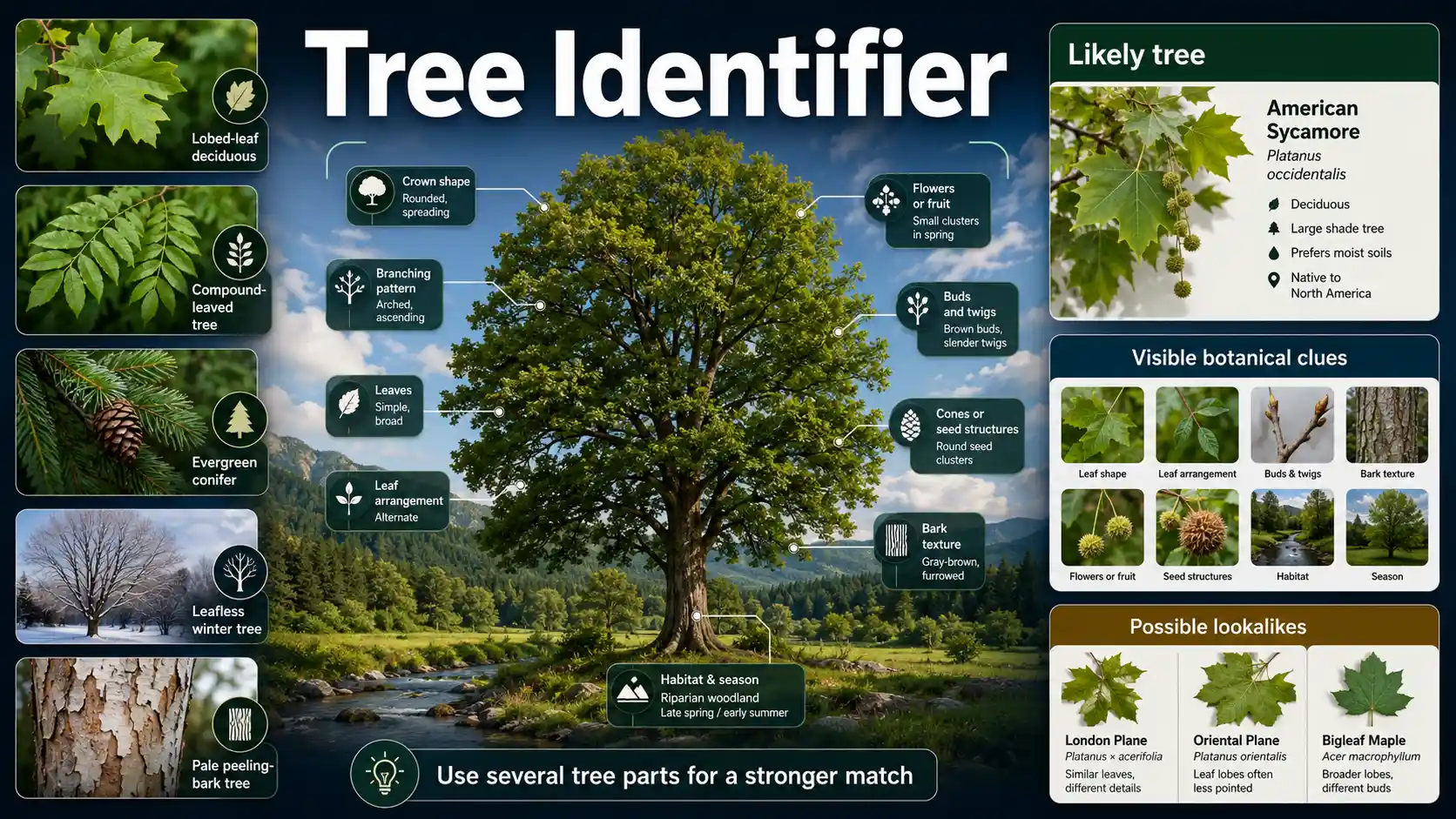
How tree identification works
A reliable tree match combines the whole form with close botanical details
The analysis begins with growth form, crown architecture, branching, trunk, and whether the plant is a broadleaf tree, conifer, palm, cycad, tree fern, bamboo, shrub, or vine. It then compares attached leaves or needles, twigs, buds, bark, flowers, fruit, cones, thorns, and seasonal structures.
A tree identifier by leaf works best when the leaf remains attached and its arrangement on the twig is visible. Bark, buds, fruit, and geographic range provide independent checks. In winter, buds, leaf scars, twigs, persistent fruit, bark, branching, and silhouette replace many missing summer clues.
- 1Upload, take, or paste one image
Choose a file, use your phone camera, click the paste icon, or press Ctrl+V or Command+V.
- 2Add facts that the photo cannot show
Country, environment, approximate size, location, and observed behavior can narrow the answer.
- 3Review the match and its evidence
Check the likely name, confidence bar, visible clues, alternatives, safety note, and recommended next step.
Tree and woody-plant coverage
Identify deciduous trees, conifers, palms, saplings, and tree-like plants
The tool covers common wild and cultivated trees worldwide. It returns a family, genus, species group, or tree type when a hybrid, cultivar, juvenile specimen, distant crown, or incomplete seasonal photo lacks decisive characters.
Conifers and evergreens using needles or scales, bundle arrangement, cones, twigs, bark, and overall habit
Street, park, garden, orchard, woodland, riparian, mountain, and coastal trees when geographic context is supplied
Saplings and juvenile trees at a broader level when adult bark, fruit, flowers, or mature foliage are not yet present
Palms, cycads, tree ferns, bamboo, and other tree-like plants when their distinctive growth architecture is visible
Trees photographed in winter through buds, twigs, leaf scars, bark, branching, persistent fruit, and silhouette
Ornamental hybrids and cultivars at species or cultivar-group level when an exact named selection cannot be supported
Tree-like shrubs, vines, artificial trees, poles, and other lookalikes when the uploaded subject is not a true tree
Tree features that matter
Show leaves, twigs, buds, bark, fruit, and the complete growth form
A tree's color or one leaf outline is rarely enough. Independent clues from the whole tree and several attached structures make the suggested identification more defensible.
Start with one full-tree photo, then add a close view of an attached mature leaf or needle cluster, the twig and buds, bark, and any flower, fruit, nut, seed pod, cone, thorn, or persistent structure. Include the country or region, season, habitat, approximate height, and whether the tree is wild, planted, street-side, orchard-grown, or indoors.
- Photograph the whole tree from far enough away to show crown shape, branching, trunk form, and surrounding habitat.
- Take a sharp close view of one attached mature leaf and show how leaves or needles join the twig.
- Include the leaf underside, petiole, margin, veins, lobes, leaflets, or needle bundles when safely reachable from the ground.
- Photograph a young twig with several buds and leaf scars; do not break a branch to obtain it.
- Show bark on the lower trunk and, when visible from the ground, bark on younger branches because texture changes with age.
- Add flowers, fruit, nuts, pods, cones, seed heads, thorns, or persistent structures without tasting or handling unknown material.
- Place a ruler or familiar object beside a fallen leaf, fruit, cone, or twig for scale, but keep it associated with the source tree.
- State the country or region, habitat, season, elevation, and whether the tree is planted, wild, orchard-grown, or street-side.
- Use daylight and avoid digital filters, portrait blur, heavy zoom, and backlighting that hide leaf, bud, bark, or crown details.
What the tree result contains
A useful tree identification explains morphology, season, and uncertainty
The result should name the tree only as precisely as the evidence allows, connect the suggestion to visible structures, compare realistic regional alternatives, and state which next photograph would improve confidence.
- The most likely common and scientific name when the evidence supports them
- A broader family, genus, species group, hybrid group, or tree type when exact identification is not defensible
- A high, moderate, or low confidence label without an uncalibrated percentage
- Visible evidence from leaves, needles, bark, buds, twigs, branching, flowers, fruit, cones, and overall habit
- Seasonal and geographic relevance, including whether the candidate fits the supplied region and habitat
- Plausible lookalikes and the leaf, bud, bark, fruit, cone, or branching feature that would separate them
- An explanation of whether the upload appears to be a tree, shrub, vine, palm, conifer, or manufactured lookalike
- A practical next photo or observation plus safety, arborist, plant-health, toxicity, or legal verification limits
Common tree lookalikes
Leaves can converge while twigs, buds, fruit, and branching reveal the difference
These comparisons show why a leaf-only tree identifier can be misleading and why the source twig, whole tree, seasonal structures, and geography matter.
Maple or plane tree
Both can have broad lobed leaves. Maples usually show opposite leaves and branching with paired buds and samaras; plane trees have alternate leaves, distinctive bark, and spherical fruit clusters.
Ash, hickory, walnut, or locust
All may have compound leaves. Opposite versus alternate branching, bud form, leaflet count, leaf scars, fruit, thorns, pith, bark, and odor already present in damaged tissue help separate them.
Pine, spruce, fir, hemlock, or larch
Needles in bundles, individual needle attachment, twig pegs, flattened needles, cone orientation, deciduous needles, bark, and crown form distinguish these conifers.
Birch or aspen and poplar
Pale bark alone is not proof. Leaf shape and teeth, petiole form, catkins, buds, lenticels, peeling pattern, trunk form, and regional range provide stronger separation.
Oak species with similar lobed leaves
Lobe tips, sinuses, leaf base, underside hairs, bud clusters, acorn cup, bark, twig thickness, and geography often matter more than overall leaf outline.
Cedar, juniper, arborvitae, or cypress
Scale sprays, juvenile needles, cone or berry-like structures, leaf arrangement, twig form, scent already released naturally, bark, and regional cultivation help separate these evergreen groups.
Why tree identification can fail
A detached leaf cannot carry the whole identity of a tree
Seasonal variation, juvenile shoots, pruning, hybrids, cultivars, damaged foliage, overlapping crowns, and missing twig or fruit context can make a confident species name irresponsible.
- Only one detached leaf is photographed with no twig, source tree, location, or scale.
- The whole tree is a distant silhouette and the leaves, bark, buds, fruit, or cones are not visible.
- Several trees overlap in one image, so the close-up cannot be connected confidently to the correct trunk or crown.
- A fallen leaf or fruit is assumed to belong to the nearest tree without showing that it was attached.
- Leaf color is treated as decisive even though season, stress, lighting, cultivar, and decay can change it.
- Young shoots, root suckers, water sprouts, or shade leaves are treated as typical mature foliage.
- Bark is photographed too closely without a trunk-wide view, age context, or additional twig and leaf evidence.
- Winter identification is attempted without buds, twig arrangement, leaf scars, persistent fruit, or branching details.
- A pruned ornamental, grafted tree, hybrid, or cultivar is forced into a wild species based on one decorative trait.
- The request asks the photo to prove edibility, toxicity, structural danger, disease, invasiveness, or legal removal status.
Worked tree-identification examples
Whole-tree form and close structures narrow the likely species
Each example combines the broad habit with attached leaves or needles, buds, bark, fruit, cones, season, habitat, and geographic range so the tool can compare realistic alternatives.
Lobed roadside tree with opposite leaves
A whole crown, an attached leaf pair, petioles, buds, winged fruit, bark, and regional location can separate maples from plane trees, sweetgums, sycamores, and other lobed-leaved trees.
Tall tree with compound leaves and diamond-pattern bark
Opposite or alternate twig arrangement, leaflet number, bud placement, seed clusters, leaf scars, bark, and location help compare ash, hickory, walnut, locust, and similar compound-leaved trees.
Evergreen with needles and hanging cones
Needle attachment, bundle count, needle cross-section, cone orientation, twig texture, bark, crown form, elevation, and region can distinguish pine, spruce, fir, larch, hemlock, and related conifers.
Leafless winter tree beside a house
Terminal and lateral buds, opposite or alternate branching, leaf scars, lenticels, persistent fruit, bark, twig color, and silhouette can narrow the tree without relying on missing leaves.
Tree with peeling pale bark and small toothed leaves
Bark color and peeling pattern should be combined with leaf shape, double or single serration, catkins, buds, twig texture, trunk form, and regional range to compare birches and similar trees.
Use the result responsibly
Identification does not establish edibility, structural safety, or removal rights
Do not climb, cut, peel bark, break branches, taste plant parts, or approach a damaged tree or one near power lines to improve a photo. A visual match cannot certify edibility, toxicity, structural safety, legal removal, or disease status. Use a qualified arborist, botanist, extension service, poison service, or local authority when the decision carries risk.
Do not taste tree parts, climb for samples, peel bark, break branches, enter traffic, approach storm-damaged limbs, or work near power lines. Use a qualified arborist for structural risk, a plant pathologist for disease, a poison service after exposure, and current local authorities for protected, invasive, heritage, or removal status.
Choose the evidence-specific tool
Use the plant, flower, or plant-health workflow when that is the real question
Questions about identifying trees by photo
Direct answers before you upload a tree
Can I identify a tree from a picture?
Yes. A clear whole-tree image plus attached leaves, twigs, buds, bark, fruit, flowers, or cones can support a likely match. One distant photo may only support a broad group.
Can one leaf identify a tree?
Sometimes, but one leaf is often insufficient. Leaf attachment, arrangement, buds, twigs, bark, fruit, crown form, season, and location frequently separate similar trees.
How do I identify a tree by its leaves?
Show whether the leaf is simple or compound, opposite or alternate, lobed or unlobed, toothed or smooth, and include veins, petiole, underside, twig, and whole-tree context.
Can bark alone identify a tree?
Bark can narrow the possibilities, especially in winter, but age, weather, disease, and trunk position change its appearance. Add buds, twigs, fruit, leaves, and crown form.
Can I identify a tree without leaves?
Yes. Winter identification can use bud arrangement, bud shape, twig color, leaf scars, lenticels, bark, branching, persistent fruit, cones, thorns, and silhouette.
How do I identify an evergreen tree?
Photograph needles or scales, how they attach to the twig, any visible bundles, cones, bark, crown shape, and the whole branch. Location and elevation also help.
Can the tool identify a tree from fruit or nuts?
Fruit, nuts, pods, cones, and seed heads can be strong clues when shown attached to the tree with leaves, twigs, bark, scale, season, and location.
Can it identify a young sapling?
It may identify the family, genus, or species group, but juvenile leaves, smooth young bark, suckers, and missing fruit can make an exact species uncertain.
Can it identify an ornamental tree cultivar?
It may suggest the species or cultivar group. Exact named cultivars often require provenance, nursery records, mature flowers or fruit, and specialist comparison.
Does location improve tree identification?
Yes. Country, region, elevation, habitat, climate, planting context, and season can remove species that do not naturally or commonly occur there.
Can the result tell whether a tree is native or invasive?
Not reliably from a photo alone. Native, introduced, invasive, regulated, and protected status depend on a confirmed identity and current local jurisdiction.
Can the tool tell whether tree fruit or nuts are edible?
No. Do not eat, taste, brew, or use an unknown tree part based on an AI result. Similar-looking species and plant parts can carry different risks.
Can it tell whether a tree is poisonous to pets?
No. A likely identity is not enough to assess exposure risk. Contact a veterinarian or poison service with the specimen, amount, time, and symptoms after a possible exposure.
Can a photo show whether a tree is dangerous or likely to fall?
No. Structural risk depends on roots, internal decay, defects, loading, soil, weather, and site conditions that require an on-site qualified arborist assessment.
Can Tree Identifier diagnose a tree disease?
No. It may identify the host tree, but disease, insects, drought, nutrient stress, root damage, herbicide injury, and decay require a separate plant-health diagnosis.
Why did the tree result return low confidence?
Low confidence usually means the photo lacks attached foliage, buds, twigs, fruit, bark context, whole-tree form, location, or seasonal features needed to separate lookalikes.
Are uploaded tree photos permanently stored?
SnapIdentify processes the normalized image for the identification request and does not intentionally write it to local disk. The configured AI provider processes it under its service terms.
Authoritative tree and botanical references
Verify morphology, accepted names, range, and risk separately
These extension, forestry, and botanical resources explain seasonal tree-identification characters and provide expert-reviewed names and distributions that a single AI photograph cannot establish by itself.
- University of Minnesota Extension - Beginner Tree Identification
UMN Extension explains how leaf form and arrangement, bark, buds, fruit, and overall tree shape support neighborhood tree identification across seasons.
- USDA Forest Service - Identifying Hardwoods Growing on Pine Sites
This Forest Service guide illustrates hardwood identification using leaves, bark, buds, flowers, fruit, winter silhouettes, and a diagnostic key.
- Plants of the World Online - Royal Botanic Gardens, Kew
Kew provides expert-reviewed accepted plant names, synonyms, classification, life forms, and geographic distributions for vascular plants worldwide.